

The UK government has announced it will cease funding the Jodrell Bank Observatory, prompting the University of Manchester to pursue alternative sources of financial support to keep the facility operational through 2028. The decision prioritizes government investment in projects expected to generate long-term returns, according to officials.
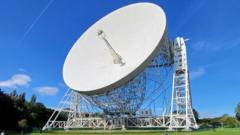
Jodrell Bank operates the Lovell Telescope, a 250-foot dish antenna that dominates the observatory’s campus in rural Cheshire. The facility also includes the Mark II Radio Telescope and visitor amenities across a site spanning less than one square mile. The observatory achieved UNESCO World Heritage Site status and was established on relatively interference-free land selected by astronomer Sir Bernard Lovell, who moved initial equipment to the location in 1945 to study radio signals from space.
The Lovell Telescope, completed in 1957, was engineered as the world’s largest steerable radio telescope of its era. The massive 3,200-tonne structure incorporated materials repurposed from decommissioned Royal Navy vessels and required a year of calculations before construction began. Though subsequently surpassed in size by other radio telescopes globally, the Lovell Telescope has undergone continuous modernization and remains integral to UK radio astronomy capabilities.
The observatory connects with the e-Merlin network, which comprises five additional telescopes distributed across the Midlands and East Anglia, amplifying its scientific capabilities. Research conducted at the facility has contributed to identifying supermassive black holes, discovering galaxies, tracking spacecraft, and advancing understanding of planetary and stellar formation processes. Approximately 28 jobs depend on sustained facility operations, and the funding withdrawal threatens to impact thousands of scientists who rely on the observatory’s research infrastructure.
Astronomers have criticized the funding decision as strategically counterproductive, particularly given ongoing construction of the Square Kilometre Array in South Africa and Australia, expected to begin data collection within five years. Supporters argue that reduced UK investment in radio astronomy infrastructure may compromise the nation’s ability to participate meaningfully in forthcoming international scientific endeavors. The Science and Technology Facilities Council continues providing limited funding for certain observatory activities related to SKA development, with the array’s global headquarters operating from the Jodrell Bank site.
Article Attribution | Read More at Article Source
Article summary produced by Claude AI