

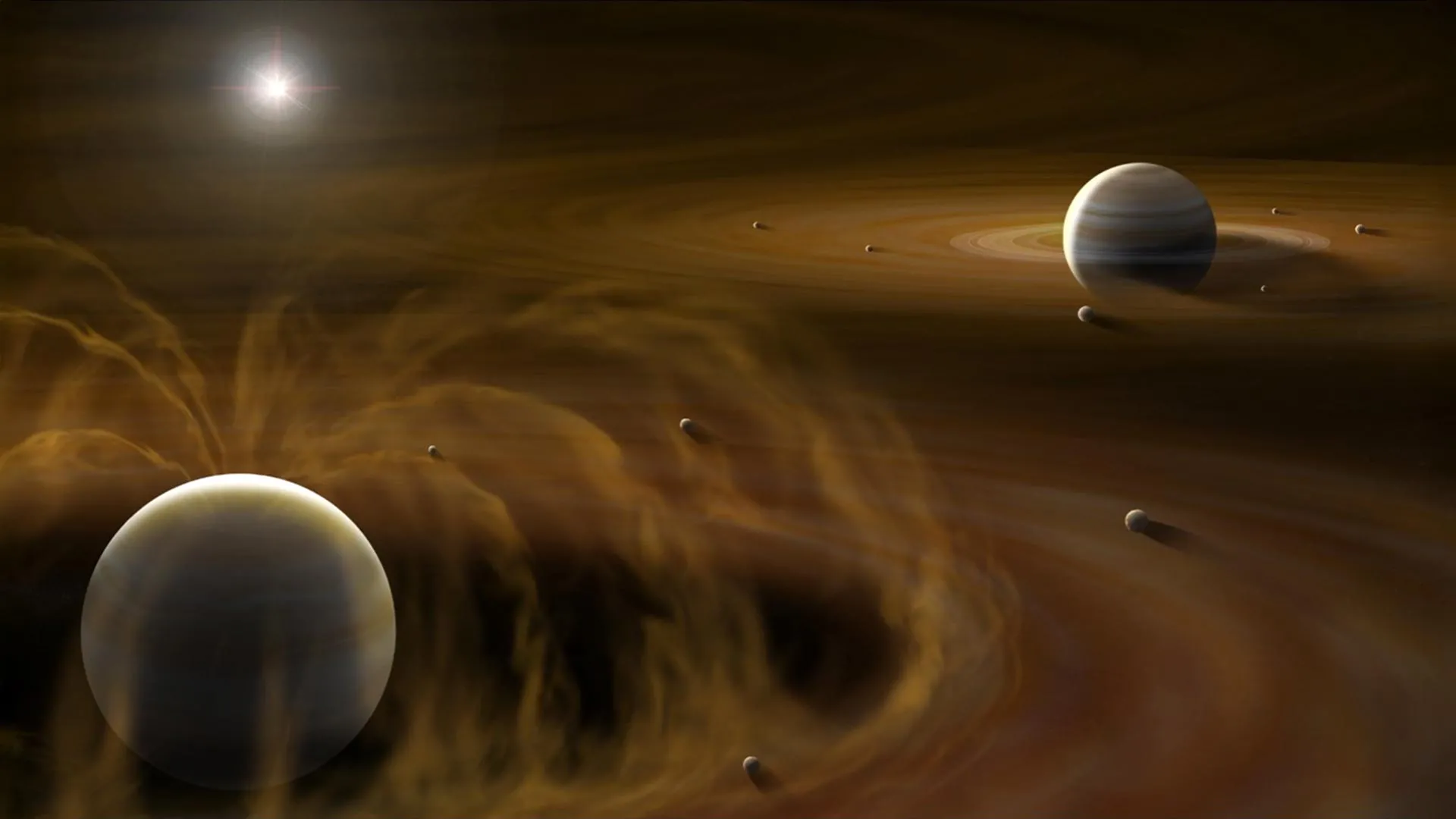
Jupiter and Saturn, the Solar System’s two largest planets, maintain dramatically different moon systems despite their similar classification as gas giants. Jupiter hosts over 100 reported moons including four exceptionally large ones, with Ganymede being the biggest moon in the Solar System. Saturn, conversely, possesses more than 280 moons but is dominated by the single massive moon Titan, the Solar System’s second largest.
The stark contrast between these two planetary satellite systems has long puzzled astronomers. Existing theories of satellite formation have proposed various mechanisms, though none fully accounted for both systems’ characteristics. A collaborative research team from institutions in Japan and China, led by scientists at Kyoto University, developed a new computational model to investigate how these divergent moon families could have originated from similar planetary environments.
Using advanced numerical simulations, the researchers examined the internal structures and thermal characteristics of both planets during their early formation stages. This approach enabled them to estimate how the magnetic fields of young Jupiter and Saturn may have evolved. The team also modeled the circumplanetary disks—rotating collections of material surrounding each planet from which moons form—and conducted N-body simulations tracking moon formation and orbital migration patterns.
The simulations revealed that differences in planetary magnetic field strength likely controlled the structure of each planet’s circumplanetary disk, ultimately determining which moons could survive. Young Jupiter’s robust magnetic field generated a magnetospheric cavity within its disk, effectively creating a protected region that allowed Io, Europa, and Ganymede to migrate and remain stable. Saturn’s comparatively weaker magnetic field generated no such protective zone, meaning migrating moons could not persist within its disk, resulting in the survival of primarily Titan.
These findings suggest predictive applications for exoplanet systems. According to the model, planets matching or exceeding Jupiter’s size should typically develop compact multi-moon systems, while smaller gas giants similar to Saturn may generally form systems dominated by one or two large moons. The research team plans to extend their theoretical framework to additional moons and potential exomoon systems around distant planets.
Article Attribution | Read More at Article Source
Article summary produced by Claude AI