

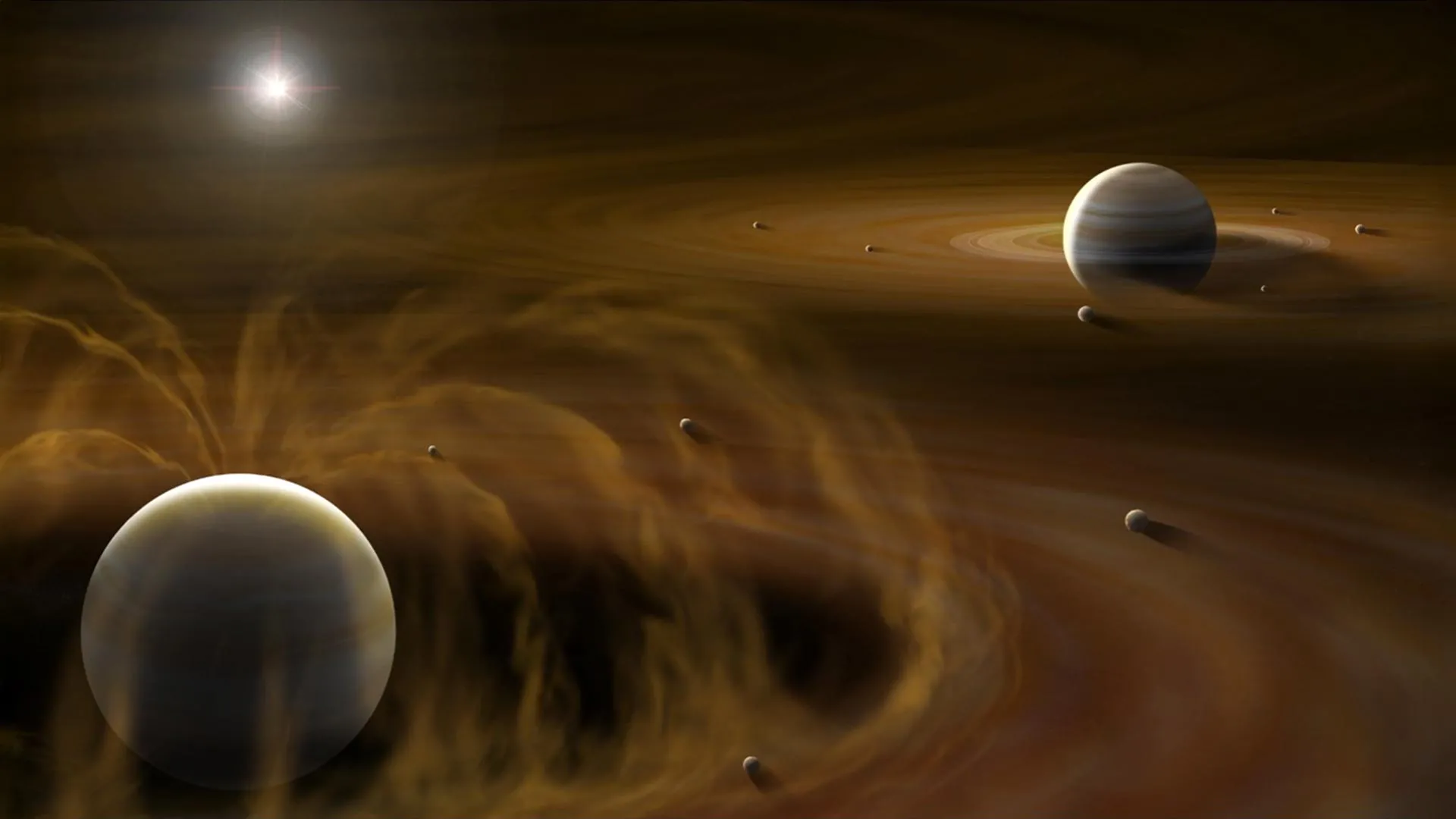
Jupiter and Saturn, the two largest planets in the Solar System, possess dramatically different moon systems despite their comparable sizes and composition as gas giants. While Jupiter currently has more than 100 reported moons including four exceptionally large ones, Saturn has more than 280 moons but is dominated by the single massive moon Titan. The fundamental difference in these satellite systems has long puzzled astronomers seeking to understand planetary moon formation.
Researchers from institutions in Japan and China, including Kyoto University, developed a new theoretical model to explain these disparities by examining the role of planetary magnetic fields during the early formation of these gas giants. Using numerical simulations, the team investigated the internal structures and thermal evolution of young Jupiter and Saturn, allowing them to estimate how each planet’s magnetic field evolved over time. The researchers also modeled the circumplanetary disks surrounding both planets—the rotating collections of material from which moons form—and conducted orbital simulations to track moon formation and migration.
The simulations revealed that Jupiter’s more powerful magnetic field in its youth created a magnetospheric cavity within its circumplanetary disk. This protected inner region likely allowed moons such as Io, Europa, and Ganymede to be captured and preserved as they migrated through the disk. Saturn’s weaker magnetic field, by contrast, could not generate a comparable cavity, leaving migrating moons vulnerable to disruption or ejection from the system.
The research carries implications for understanding planetary systems beyond our own. According to the model, gas giants comparable to Jupiter or larger should typically develop compact systems containing multiple large moons. Smaller gas planets similar in size to Saturn may generally end up with only one or two substantial moons. The team plans to extend their theoretical framework to additional moons and to explore potential exomoon systems orbiting distant gas giants.
Article Attribution | Read More at Article Source
Article summary produced by Claude AI