

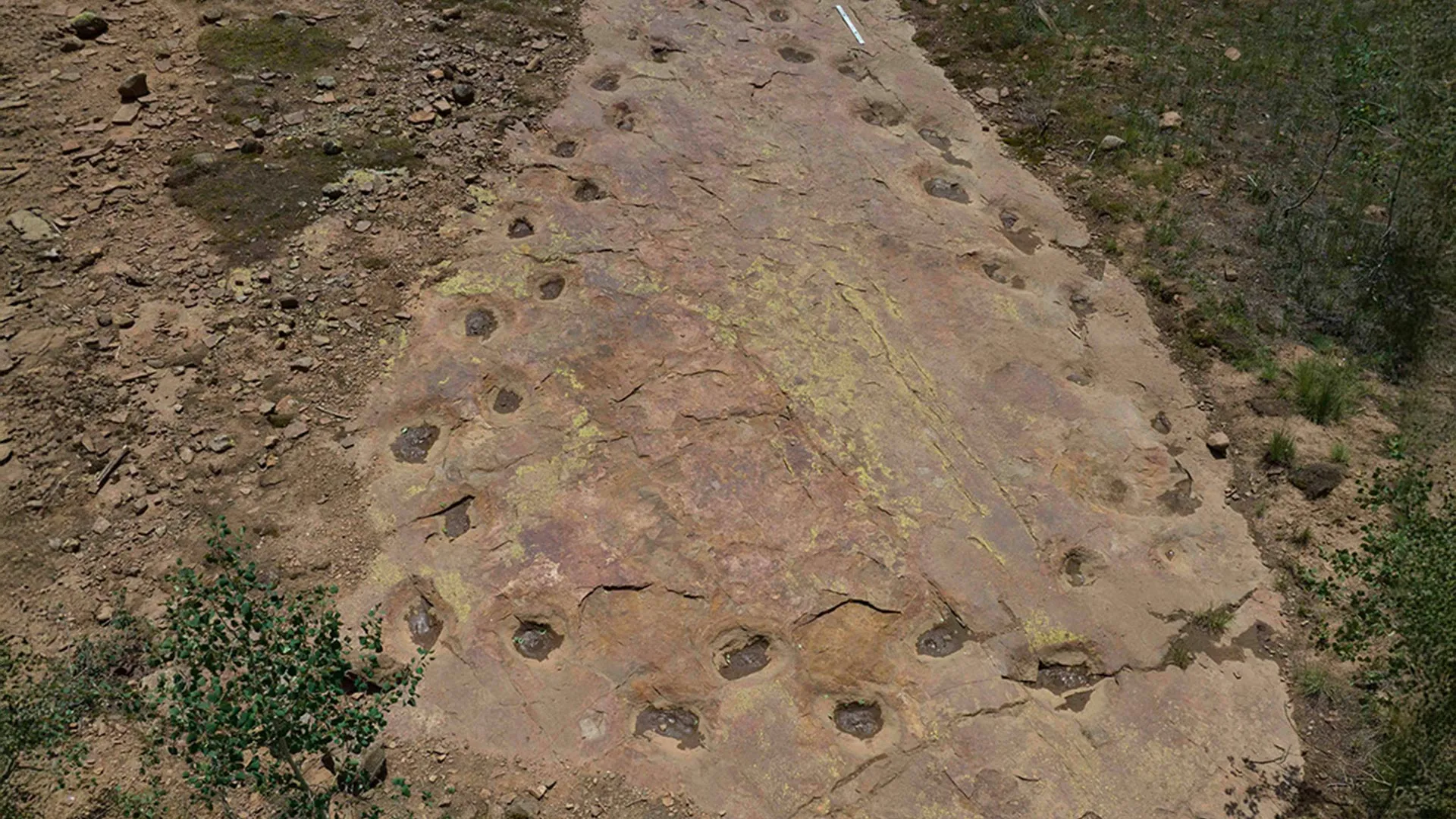
Researchers have documented a rare continuous trail of fossilized footprints near Ouray, Colorado that provides unprecedented insight into how a giant sauropod moved during the Late Jurassic period. The trackway, located at the West Gold Hill Dinosaur Tracksite, spans 95.5 meters and contains more than 130 individual footprints from a long-necked dinosaur such as Diplodocus or Camarasaurus.
Dr. Anthony Romilio of The University of Queensland’s Dinosaur Lab led the study of this distinctive looping trail, which is among the most continuous and tightly curved sauropod footprint sequences ever documented. The trackway is notable because it forms a complete loop, with the animal initially heading northeast before curving back and resuming its original direction of travel. Scientists have speculated about the reasons behind this unusual turning behavior, but the preserved record offers a rare opportunity to study how a massive sauropod navigated tight turns.
Due to the enormous scale of the tracksite, conventional ground-level documentation proved impractical. Researchers employed drone technology to capture high-resolution imagery of the entire area, which was then processed into a detailed three-dimensional model. This virtual reconstruction allowed scientists to analyze the footprints with millimeter-scale precision in laboratory settings, revealing subtle patterns invisible to observers examining the site on foot.
Analysis of the footprint data uncovered significant variations in the dinosaur’s walking pattern. Notably, the spacing between left and right footprints shifted from narrow to wide throughout the sequence, demonstrating that stride width naturally changes as dinosaurs move. Additionally, researchers identified a persistent difference of approximately 10 centimeters between the lengths of left and right steps, raising the possibility that the animal may have been walking with a limp, though alternative explanations such as directional preference remain possible.
The findings demonstrate that extended dinosaur trackways can preserve behavioral information that shorter footprint sequences typically cannot reveal. Scientists suggest that comparable analysis methods could be applied to other long trackways worldwide to extract previously inaccessible behavioral data. The U.S. Forest Service provided support for the investigation.
Article Attribution | Read More at Article Source
Article summary produced by Claude AI