

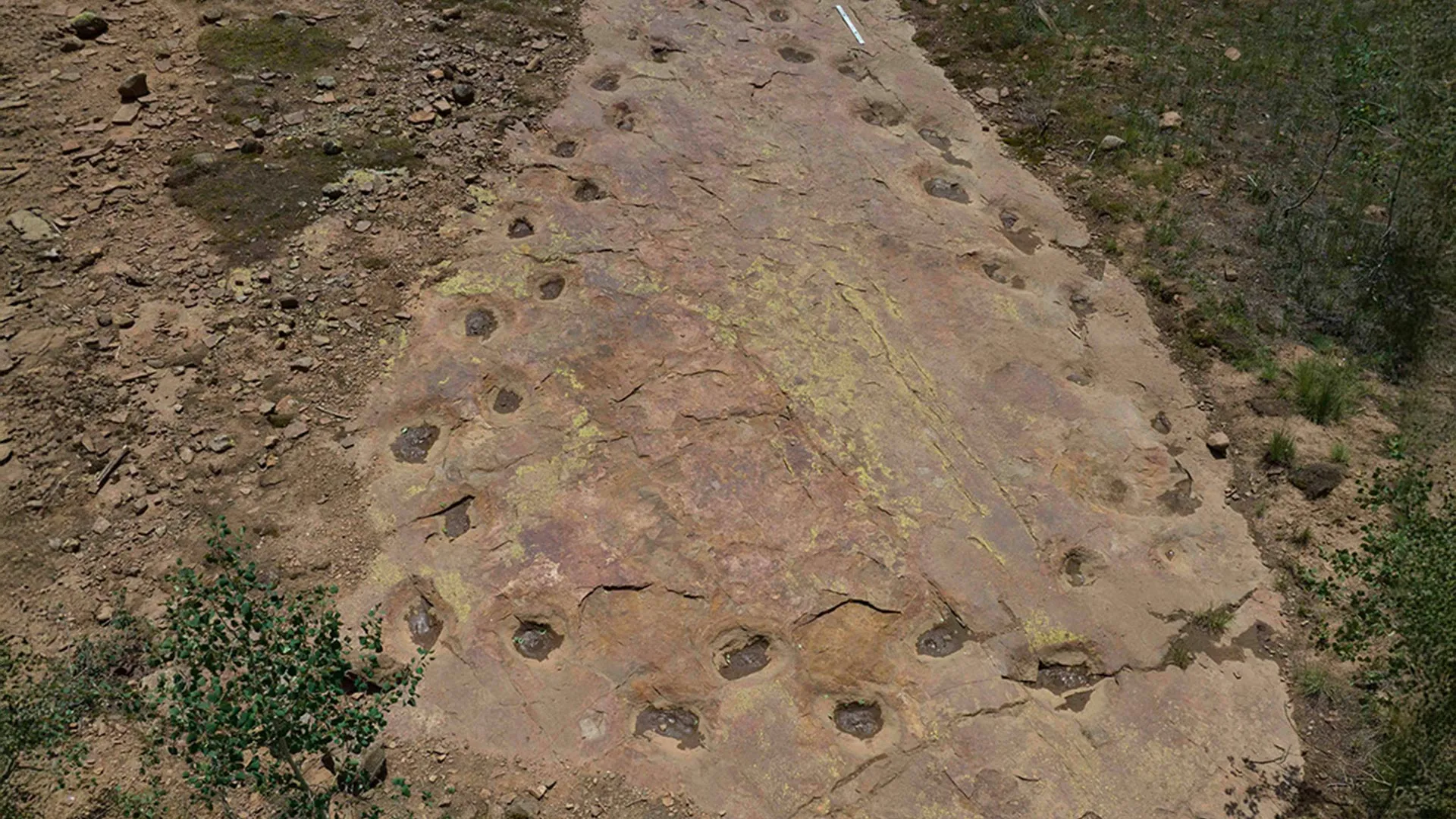
Researchers have conducted a detailed analysis of a rare fossilized footprint trackway near Ouray, Colorado, that dates to 150 million years ago during the Late Jurassic period. The trail, discovered at the West Gold Hill Dinosaur Tracksite, consists of more than 130 individual footprints spread across a distance of 95.5 meters and represents one of the most continuous and tightly curved sauropod trackways ever documented.
Dr. Anthony Romilio from The University of Queensland’s Dinosaur Lab led the study of the trackway, which was left by a long-necked sauropod such as Diplodocus or Camarasaurus. The trackway is distinctive because it forms a complete loop, with the animal beginning its path toward the northeast, executing a full circular turn, and then resuming the same direction of travel. While the reason for this looping behavior remains unknown, the continuous nature of the trail provides an exceptional opportunity to study how a massive sauropod navigated a tight turning radius.
Documenting the entire site presented logistical challenges due to its enormous scale. Researchers addressed this issue by employing drone technology to capture high-resolution imagery of the complete trackway. Using these aerial images, the team generated a detailed three-dimensional digital model that could be analyzed with millimeter-scale precision in the laboratory, revealing patterns that would have been difficult to discern from ground-level examination alone.
Analysis of the footprint patterns revealed subtle but consistent behavioral indicators. The spacing between the dinosaur’s left and right footprints varied throughout the journey, shifting from relatively narrow to distinctly wide, suggesting that step width naturally changes as a sauropod moves. Additionally, researchers detected a persistent difference of approximately 10 centimeters between the lengths of the dinosaur’s left and right steps, which could potentially indicate a limp or simply a natural preference for one side of the body.
The findings indicate that extended dinosaur trackways can preserve behavioral details that shorter track segments might obscure, suggesting similar analytical methods could be applied to other long trackways around the world. The research has received support from the U.S. Forest Service.
Article Attribution | Read More at Article Source
Article summary produced by Claude AI