

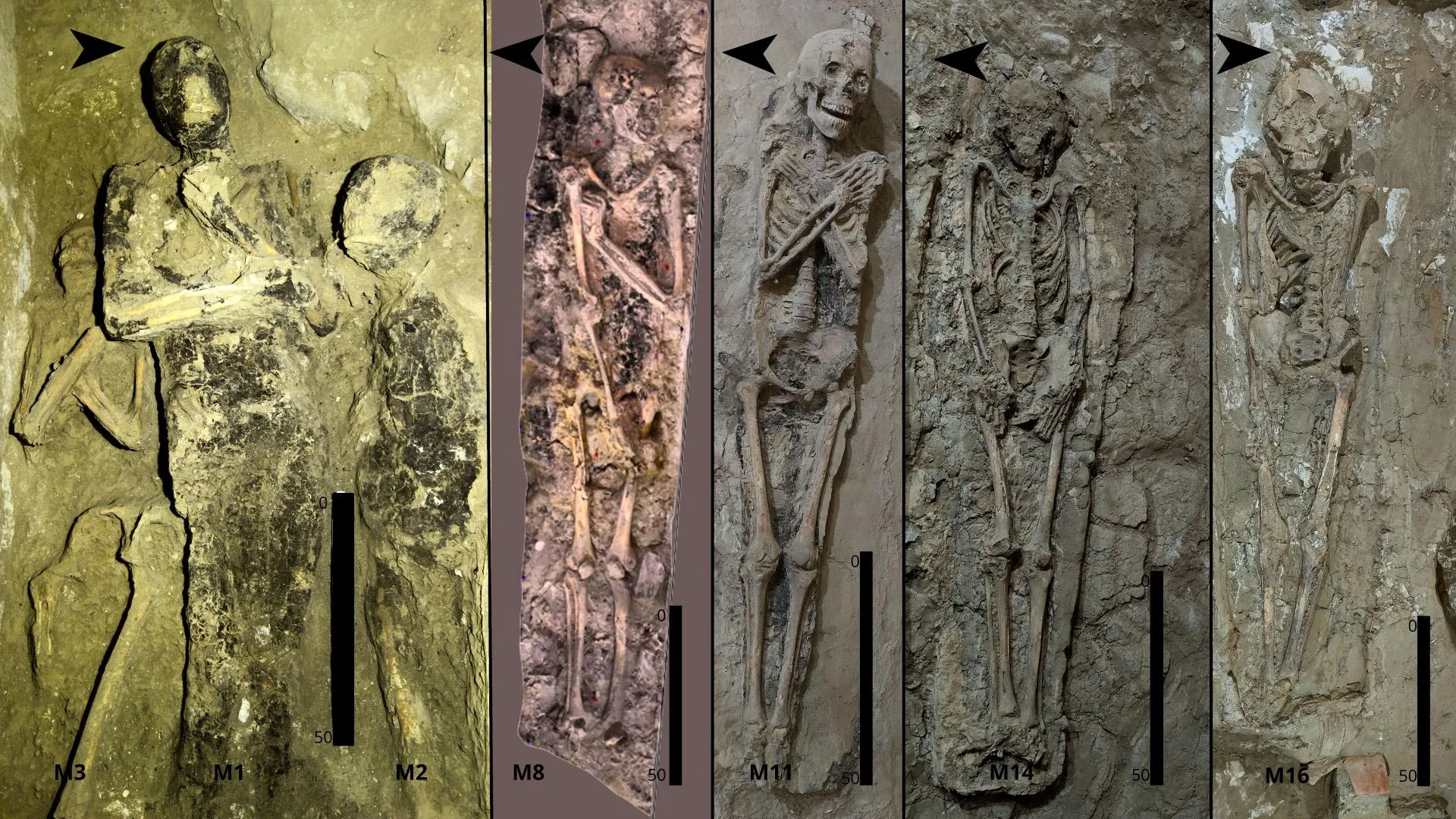
A research team from the University of La Laguna in Spain conducted a detailed examination of chamber three in tomb TT 209, located within the Theban Necropolis near Luxor. The study, published in Frontiers in Environmental Archaeology, documents how this burial space was adapted and reused across multiple historical periods, from its construction during the Twenty-fifth Dynasty through the Ptolemaic period.
The chamber contained 16 mummified individuals, one mummified dog, and additional fragmentary human remains distributed across nine distinct funerary deposits. Rather than representing a chaotic accumulation of bodies over time, the arrangement demonstrated intentional spatial organization. Early burials, dating to the Twenty-fifth Dynasty, featured individuals of apparent high social standing placed in coffins with valuable grave goods, including contents from Phoenician amphorae. These early burials were spaced distinctly apart from one another, with bodies typically positioned with extended arms.
As centuries passed, burial practices underwent significant transformation. During the Persian period, the chamber became progressively more densely occupied, with new bodies placed in whatever available space remained. A notable shift involved the increasing use of vertical stacking, where multiple bodies were arranged on top of one another. By the Ptolemaic Period, this practice had become dominant, with approximately two-thirds of burials employing this arrangement. Bodies in these later deposits lacked coffins but were carefully mummified and often accompanied by upright jars associated with specific rituals absent from earlier phases.
One particularly striking feature was a stack of four human mummies topped with a mummified dog, discovered in the chamber’s southeastern section. Researchers suggest this arrangement may indicate a close relationship between the humans and the animal, or possibly reflect evolving spiritual beliefs in which animals served as symbolic guides to the afterlife. Later burials also showed changes in arm positioning, with some individuals buried in the Osirian position, characterized by arms crossed over the chest.
The researchers concluded that the tomb’s evolution reflected not cultural decline but rather an ongoing adaptive process where each new burial was integrated with consideration for previous occupants. While flooding, fires, and repeated human entry complicated the archaeological record, the findings suggest that deposits previously interpreted as disordered may warrant reinterpretation as evidence of deliberate funerary practices evolving across generations.
Article Attribution | Read More at Article Source
Article summary produced by Claude AI