

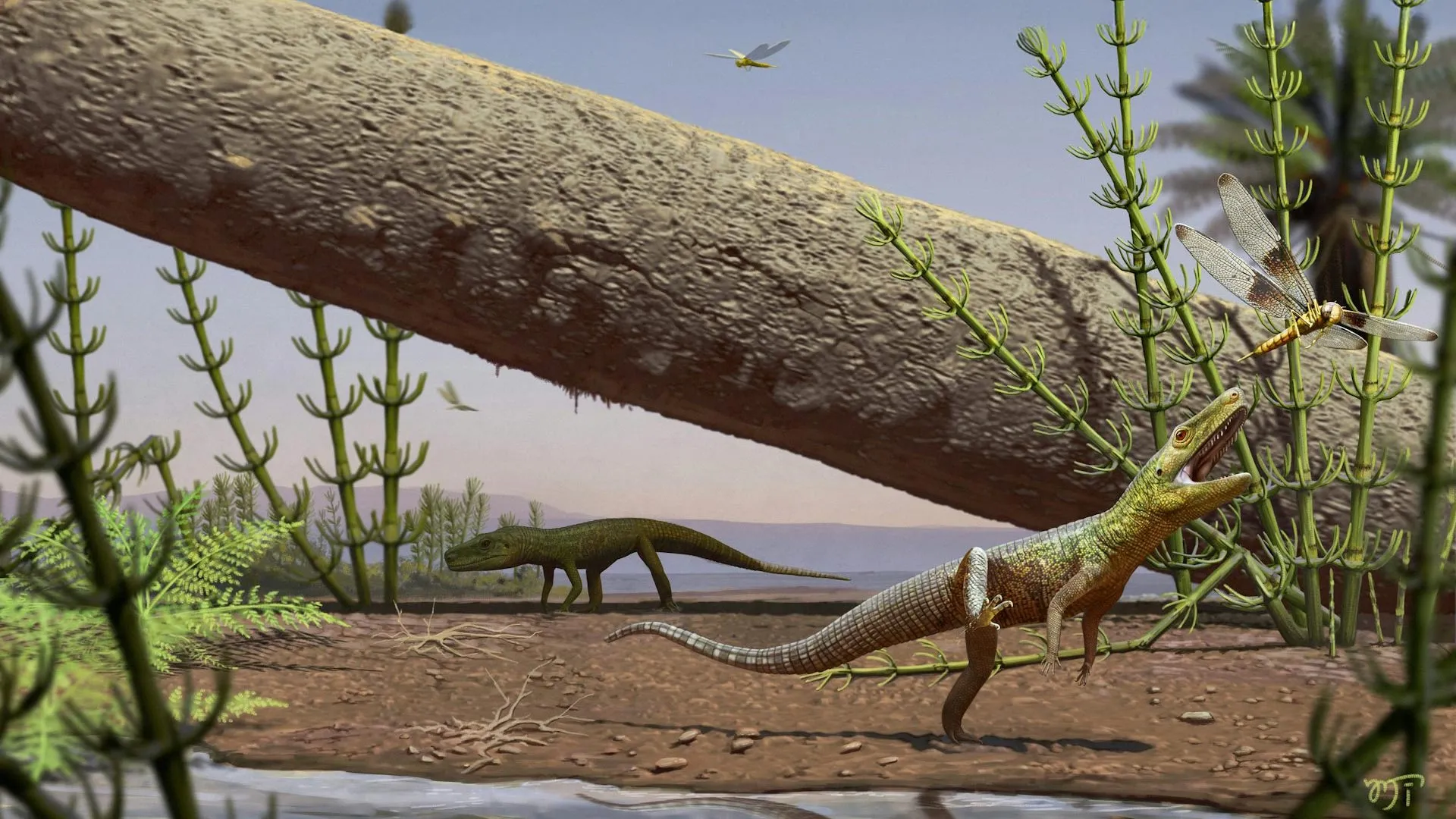
Scientists have identified a previously unknown reptile species in Rio Grande do Sul, Brazil, that lived approximately 240 million years ago during the Middle Triassic Period. Named Silescelida acristata, this fossil was discovered in the Dona Francisca region within the UNESCO Quarta Colônia Geopark and was formally described following the rediscovery of a missing fragment in 2022. The specimen represents an important contribution to understanding the evolutionary history of archosauriforms, the ancient reptile group that eventually gave rise to both crocodiles and dinosaurs.
The fossil record indicates that Silescelida acristata lived during a critical period in Earth’s history, approximately 252 million years after the Permian–Triassic extinction event that devastated most life on the planet. During this time of ecological recovery, various reptile lineages diversified and adapted to new roles in terrestrial ecosystems. The newly identified species was a small, quadrupedal predator comparable in size to a modern alligator, with a diet likely consisting of smaller animals.
Although fragmentary, consisting primarily of preserved limb bones, the fossil provides significant insights into the animal’s biology and relationships. The femur exhibits a semi-erect leg position lower on the body rather than positioned to the side, representing a locomotor adaptation that enhanced movement efficiency. Phylogenetic analyses suggest connections to the Euparkeriidae, a poorly understood group of archosauriforms previously known only from Africa, Asia, and Europe.
The discovery substantially expands the known geographic range of these reptiles and indicates they were more widely distributed during the Triassic than fossil evidence had previously suggested. The finding underscores South America’s importance in studying the origin and diversification of major terrestrial vertebrate groups. Rio Grande do Sul continues to establish itself as a critical region for understanding Triassic fauna and the evolutionary transitions that ultimately transformed life on Earth’s continents.
The research was conducted collaboratively by institutions including the Federal University of Santa Maria, the Federal University of Rio Grande do Sul, and the Pontifical Catholic University of Rio Grande do Sul, with findings published in Scientific Reports.
Article Attribution | Read More at Article Source
Article summary produced by Claude AI