

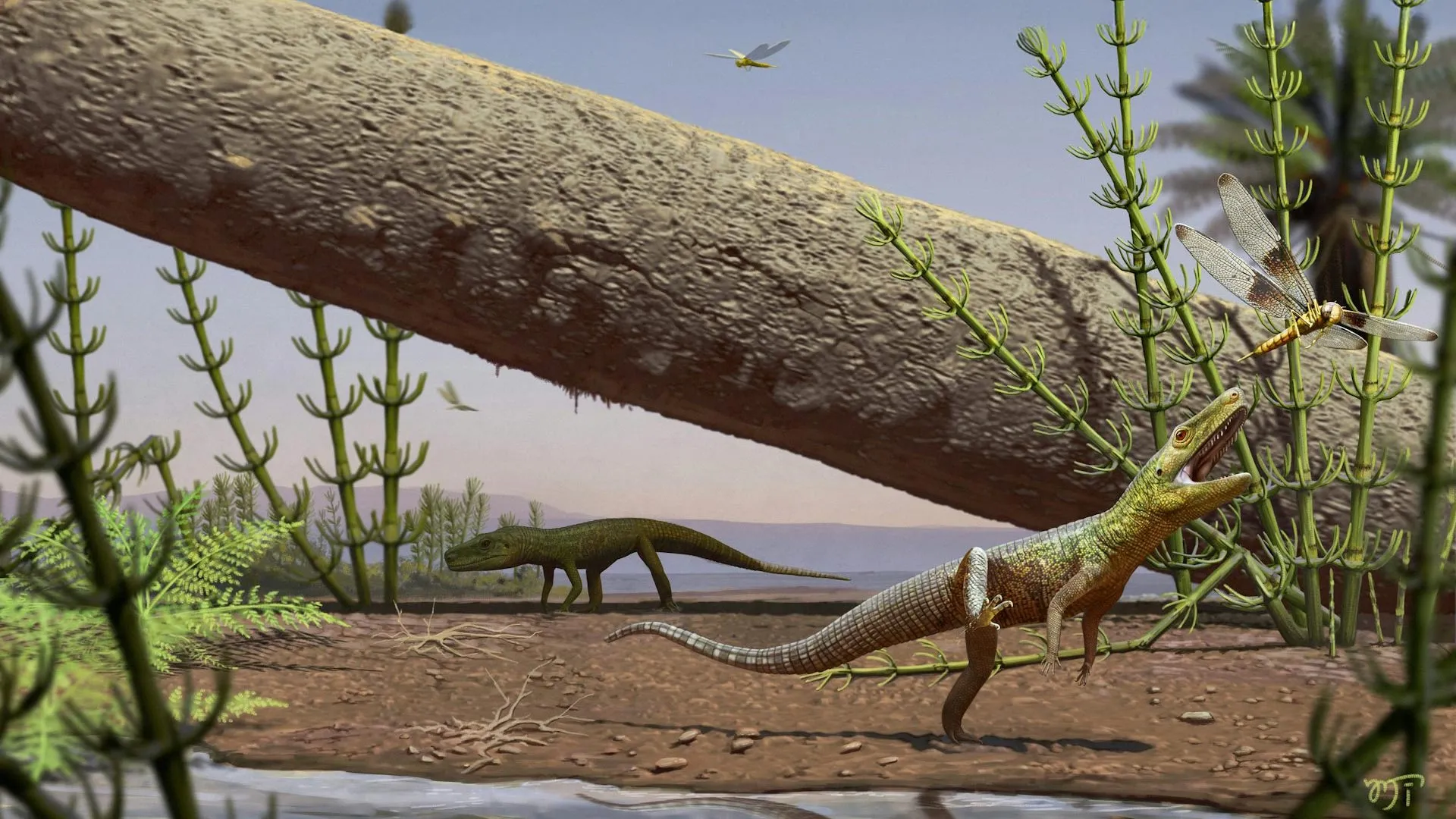
Scientists have identified a previously unknown species of ancient reptile in Brazil’s Rio Grande do Sul state, named Silescelida acristata, which lived approximately 240 million years ago during the Middle Triassic Period. The fossil was discovered in the Dona Francisca area within rocks belonging to the UNESCO Quarta Colônia Geopark. The research team included paleontologists from the Quarta Colônia Center for Paleontological Research at the Federal University of Santa Maria, along with collaborators from the Federal University of Rio Grande do Sul and the Pontifical Catholic University of Rio Grande do Sul. Their findings were published in Scientific Reports.
Silescelida acristata represents an important archosauriform, a reptile group that gave rise to archosaurs—the lineage encompassing crocodiles and dinosaurs, including birds. The creature lived during a period when terrestrial ecosystems were recovering from the Permian-Triassic extinction event, which occurred approximately 252 million years ago. At this time, different reptile lineages were adapting to new ecological roles, with archosauriforms undergoing significant diversification. The fossil specimen was a small, four-limbed animal comparable in size to a modern alligator, likely functioning as a predator in Middle Triassic ecosystems.
The preserved fossil material consists primarily of limb bones, which despite their fragmentary nature contain significant evolutionary information. One notable feature is the femur, or thigh bone, which exhibits a semi-erect leg position—lower on the body rather than extending to the side. This anatomical arrangement enabled more efficient locomotion by reducing drag during movement and represents a key characteristic related to the anatomical transformations that would later contribute to archosaur success. Phylogenetic analysis suggests Silescelida acristata may be related to the Euparkeriidae, a poorly understood group of archosauriforms previously known only from Africa, Asia, and Europe.
The discovery has an unusual history. Part of the fossil was accidentally lost for more than two decades before researchers located the missing fragment in 2022 during a technical visit to the PUCRS scientific collection. This rediscovery enabled confirmation of the specimen’s origin and formal description as a new species. The animal’s name reflects this narrative: Silescelida combines references to “silence” and “leg,” while acristata means “without a crest,” referring to the absence of a bony protrusion on the femur found in related species.
The findings demonstrate that archosauriform evolutionary history was more complex and geographically widespread than previously understood. Rio Grande do Sul continues to establish itself as a crucial region for studying Triassic fauna and vertebrate evolution, with its rock formations preserving fossils from multiple stages of terrestrial vertebrate development. The study underscores how even fragmentary fossil material can reveal fundamental information about species identification, locomotion, evolutionary relationships, and geographic distribution patterns.
Article Attribution | Read More at Article Source
Article summary produced by Claude AI