

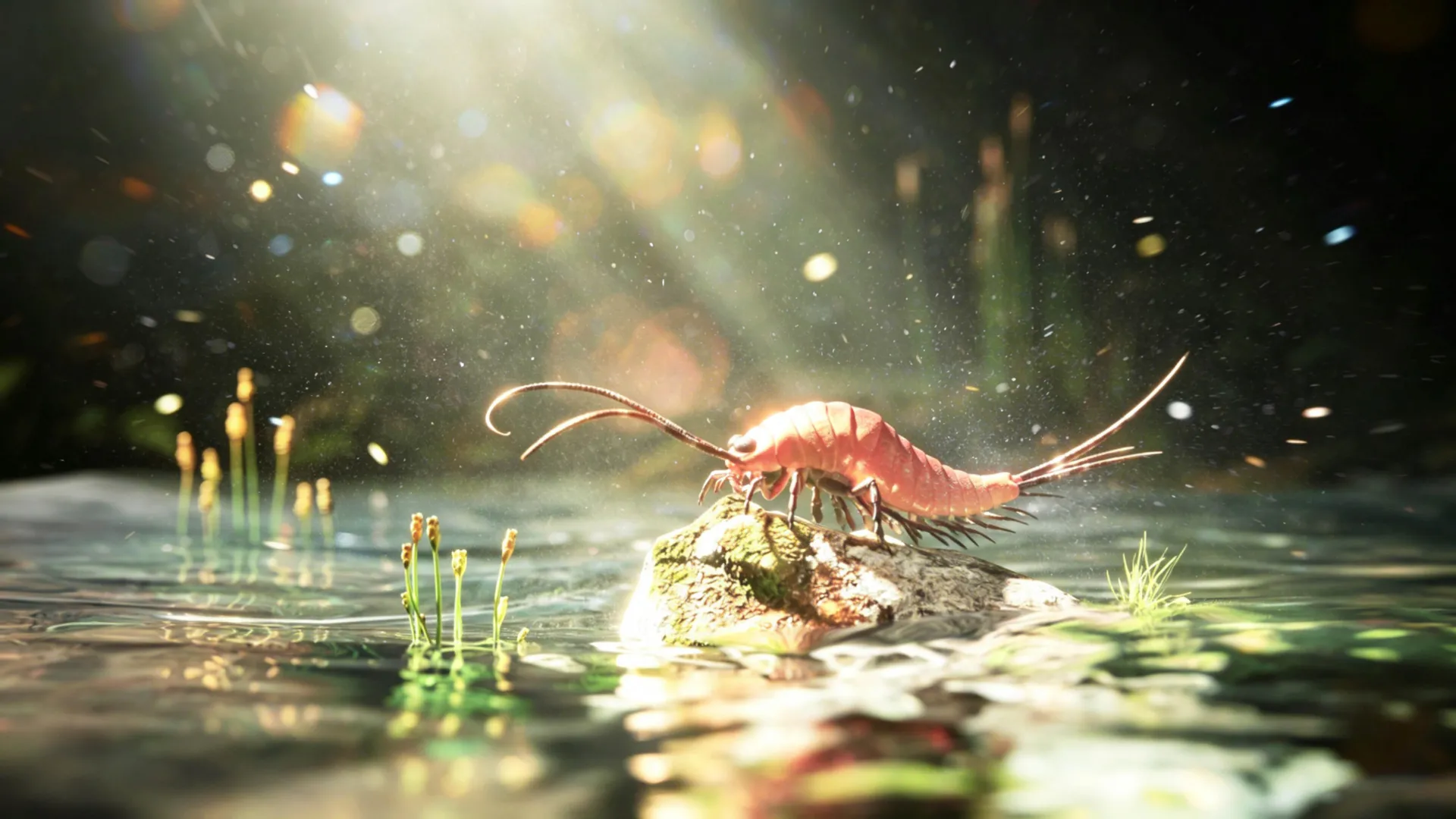
An international research team has identified a newly described insect species from approximately 324 million years ago that provides critical insights into how insects transitioned from aquatic to terrestrial environments. The fossil, named Chosha praecursor, was discovered in calcareous claystone concretions in western Texas and preserves remarkably detailed anatomical structures. Using advanced imaging techniques, researchers determined that specimens previously misclassified as crustacean larvae were actually adult female insects measuring between 32 and 49 millimeters in length.
The discovery helps address a significant gap in the fossil record spanning roughly 80 million years between the earliest known hexapods from the Early Devonian period and abundant insect fossils from the Late Carboniferous. The research team, led by Prof. Chenyang Cai of the Nanjing Institute of Geology and Paleontology and Erik Tihelka of the University of Cambridge, analyzed C. praecursor alongside other primitive stem insect fossils from earlier and later periods to reconstruct evolutionary stages. Their findings were published in Nature on August 26.
C. praecursor displayed a combination of features linking it to both ancient aquatic ancestors and modern insects. The specimen possessed characteristics typical of hexapods, including six walking legs and an ovipositor, but also retained paddle-like abdominal appendages not found in living insects. Geological evidence indicates the fossils originated in near-shore, shallow-water delta environments, suggesting the animals inhabited amphibious, semi-aquatic zones along the boundary between water and land.
The research demonstrates that early insects did not immediately become fully terrestrial upon beginning to colonize land. Rather, they underwent a gradual transition, maintaining and modifying features inherited from their crustacean relatives over an extended period. The study reveals important evolutionary changes, including the progressive reduction and loss of abdominal appendages as insects adapted to terrestrial life, ultimately leading to the body plan characteristic of modern insects. The ovipositor preserved in the fossil suggests early insects had already developed specialized reproductive adaptations that may have facilitated their eventual diversification across varied terrestrial habitats.
Article Attribution | Read More at Article Source
Article summary produced by Claude AI