

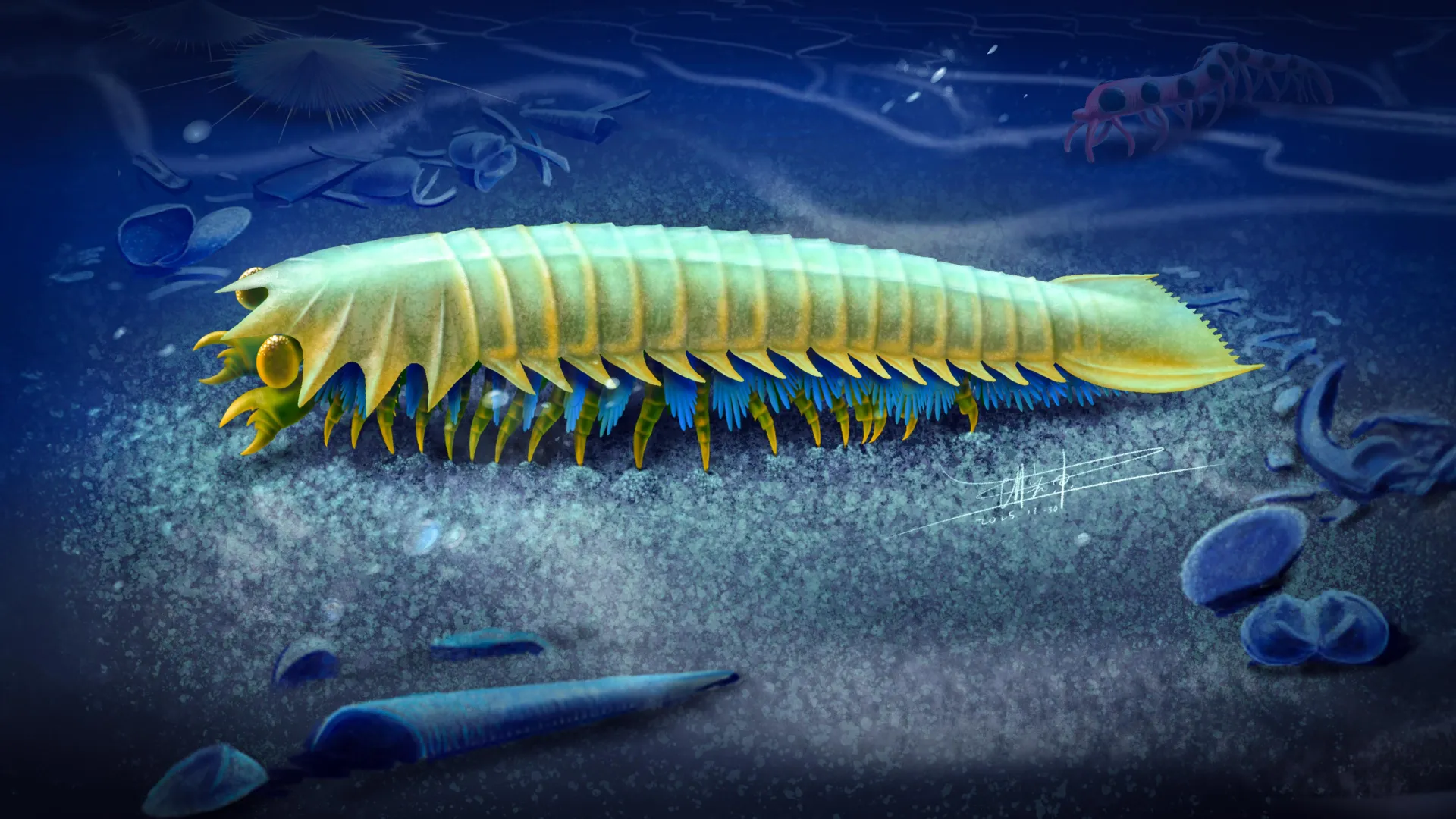
Researchers from Yunnan University and the University of Leicester have discovered fossil evidence of the evolutionary origins of spider fangs, tracing them back to a small marine creature called Urokodia that lived during the early Cambrian Period. The finding, published in Nature, identifies pincer-like appendages in the ancient organism as an early form of chelicerae, the specialized structures that eventually developed into the fangs and pincers found in modern spiders, scorpions, ticks, and related creatures.
Urokodia measured only 2-3 centimeters in length and bore little obvious resemblance to its modern descendants. The fossil was discovered at the Chengjiang site in Yunnan Province in southern China, a renowned location known for exceptionally well-preserved specimens. Using X-ray tomography, researchers examined the rock surrounding the fossil and found that much of the creature’s soft anatomy had been preserved in a mummified state for hundreds of millions of years. The scans revealed two pincer-like appendages positioned just behind the animal’s eyes, representing an early iteration of chelicerae. The fossil also contained features on Urokodia’s legs that may have functioned as book gills for underwater respiration, similar to structures still present in modern aquatic chelicerates such as horseshoe crabs.
Chelicerates represent one of the most successful animal lineages, having adapted to both marine and terrestrial environments and becoming effective predators. The Chengjiang fossil site preserves evidence of more than 200 animal species that inhabited ancient oceans over 500 million years ago, providing insights into the early evolution of complex animal life on Earth. Researchers emphasized that despite the fearsome reputation spiders have acquired in popular culture, most modern species pose no threat to humans, as their venom and fangs evolved to subdue prey far smaller than people.
Article Attribution | Read More at Article Source
Article summary produced by Claude AI