

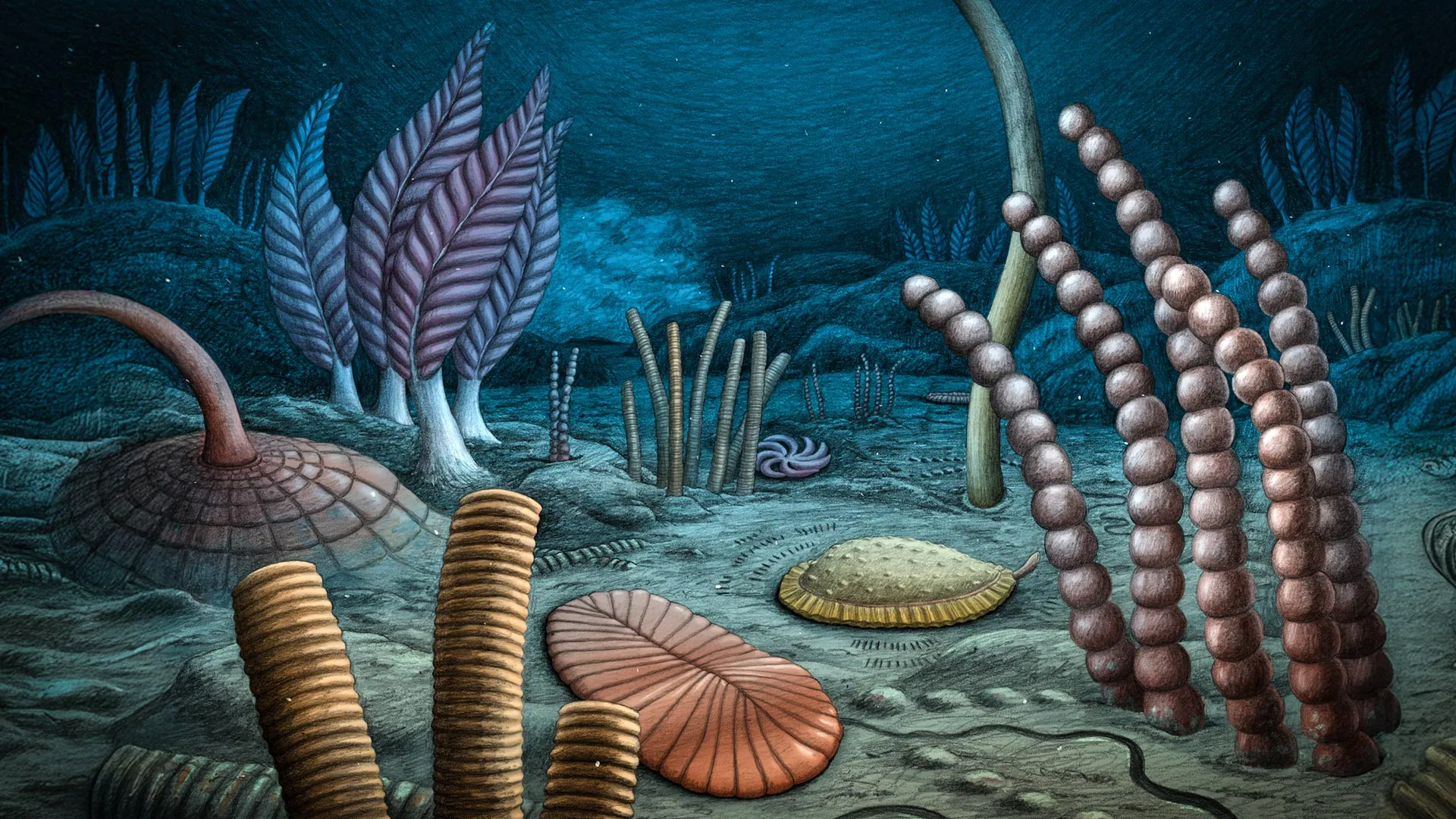
Researchers working in Canada’s Northwest Territories have uncovered a major fossil deposit containing some of the oldest known complex animal life on Earth. The specimens, belonging to the Ediacaran biota, are estimated to be approximately 567 million years old. This discovery, led by scientists from the American Museum of Natural History and Dartmouth College, was published in Science Advances and reveals that animal movement and sexual reproduction emerged 5-10 million years earlier than previously documented evidence suggested.
The Ediacaran biota consisted primarily of soft-bodied organisms that inhabited ancient seafloors. These creatures exhibited diverse and unfamiliar body plans, including flat discs, leafy structures, and ribbed ovals. While some species can be linked to modern animal groups such as mollusks, nematodes, comb jellies, and cnidarians, others have no clear living relatives. The rarity of well-preserved Ediacaran fossils stems from the fact that soft-bodied organisms rarely fossilize without exceptional environmental conditions. Prior to this discovery, documented sites with more than 10 species were extremely rare, limiting scientific understanding of this crucial period in animal evolution.
The newly discovered site is particularly significant because it represents the first documented White Sea assemblage fossils found in North America. Previously, White Sea fossils had only been identified in Europe, Asia, and Australia. The researchers identified more than 100 specimens at the location, including six groups previously unrecorded in North America. Notably, some specimens were found to be older than other known White Sea fossils, placing them within the timeframe of the earlier Avalon assemblage. The fossil-bearing rock layers extend hundreds of feet underground, suggesting substantial additional discoveries may be possible.
Several organisms preserved at the site had never before been documented in North America. Dickinsonia was a flat organism that moved across the seafloor and absorbed nutrients through its lower surface. Funisia, a tube-shaped creature that lived in clusters, provides the oldest known fossil evidence of sexual reproduction. Kimberella, which possessed a muscular foot and fed on seafloor material, may represent the oldest known fossil bilaterian, the animal group characterized by distinct front and back ends and bilateral symmetry that comprises over 99 percent of all known animal species.
The fossils indicate that these organisms inhabited deeper marine environments than scientists had previously associated with the White Sea assemblage. This finding supports an emerging hypothesis that early animal life may have first appeared in offshore, deep ocean settings before gradually expanding into shallower coastal waters. The deep ocean’s relative environmental stability, including consistent temperature and oxygen levels, may have provided favorable conditions for early animal diversification. The collected specimens will eventually join the permanent collection at the Prince of Wales Northern Heritage Centre in Yellowknife, Northwest Territories.
Article Attribution | Read More at Article Source
Article summary produced by Claude AI