

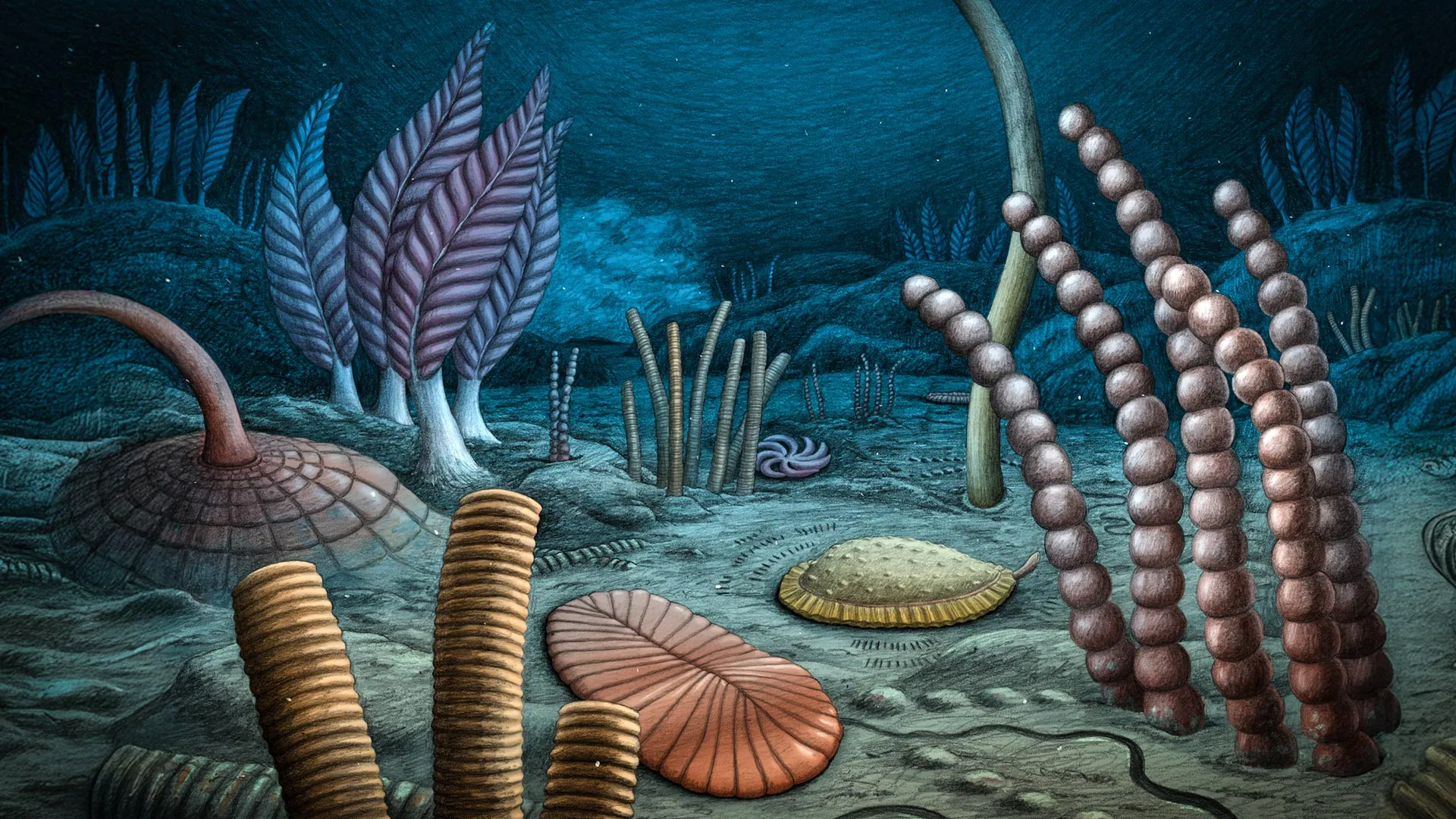
Scientists from the American Museum of Natural History and Dartmouth University have documented a significant fossil discovery in Canada’s Mackenzie Mountains in the Northwest Territories. The site, located on the traditional lands of the Sahtú Dene and Métis communities, contains more than 100 fossils from the Ediacaran biota, a collection of soft-bodied organisms that inhabited ancient seafloors. Some specimens have been dated to approximately 567 million years ago, positioning them among the earliest complex animals on Earth.
The Ediacaran period represents a crucial transition in life’s history, occurring after roughly 3 billion years dominated by microbes. The organisms at this site displayed diverse morphologies, including flat discs, leafy forms, and ribbed ovals. Prior to this discovery, White Sea assemblage fossils—a major grouping of Ediacaran organisms dated to 559-550 million years ago—had been documented in Europe, Asia, and Australia, but not previously in North America. The new site includes six groups never before recorded on the North American continent.
The specimens reveal organisms capable of behaviors indicating animal movement and sexual reproduction. Dickinsonia was a flat organism that moved across the seafloor while absorbing nutrients through its lower surface. Funisia, a tube-shaped organism found in clusters, provides the oldest known fossil evidence of sexual reproduction. Kimberella, which moved using a muscular foot, may represent an early mollusk relative and potentially the oldest known fossil bilaterian—animals with distinct front-to-back and top-to-bottom organization.
The discoveries suggest that animal evolutionary innovation may have initially occurred in deeper marine environments before spreading into shallower coastal waters—a pattern opposite to later animal evolution trends. The stability of deep ocean conditions, with minimal temperature and oxygen fluctuations, may have provided favorable circumstances for early animal diversification. Additional fossil-bearing rock layers at the site may contain more specimens, offering future research opportunities to further refine understanding of Ediacaran Earth history.
Article Attribution | Read More at Article Source
Article summary produced by Claude AI