

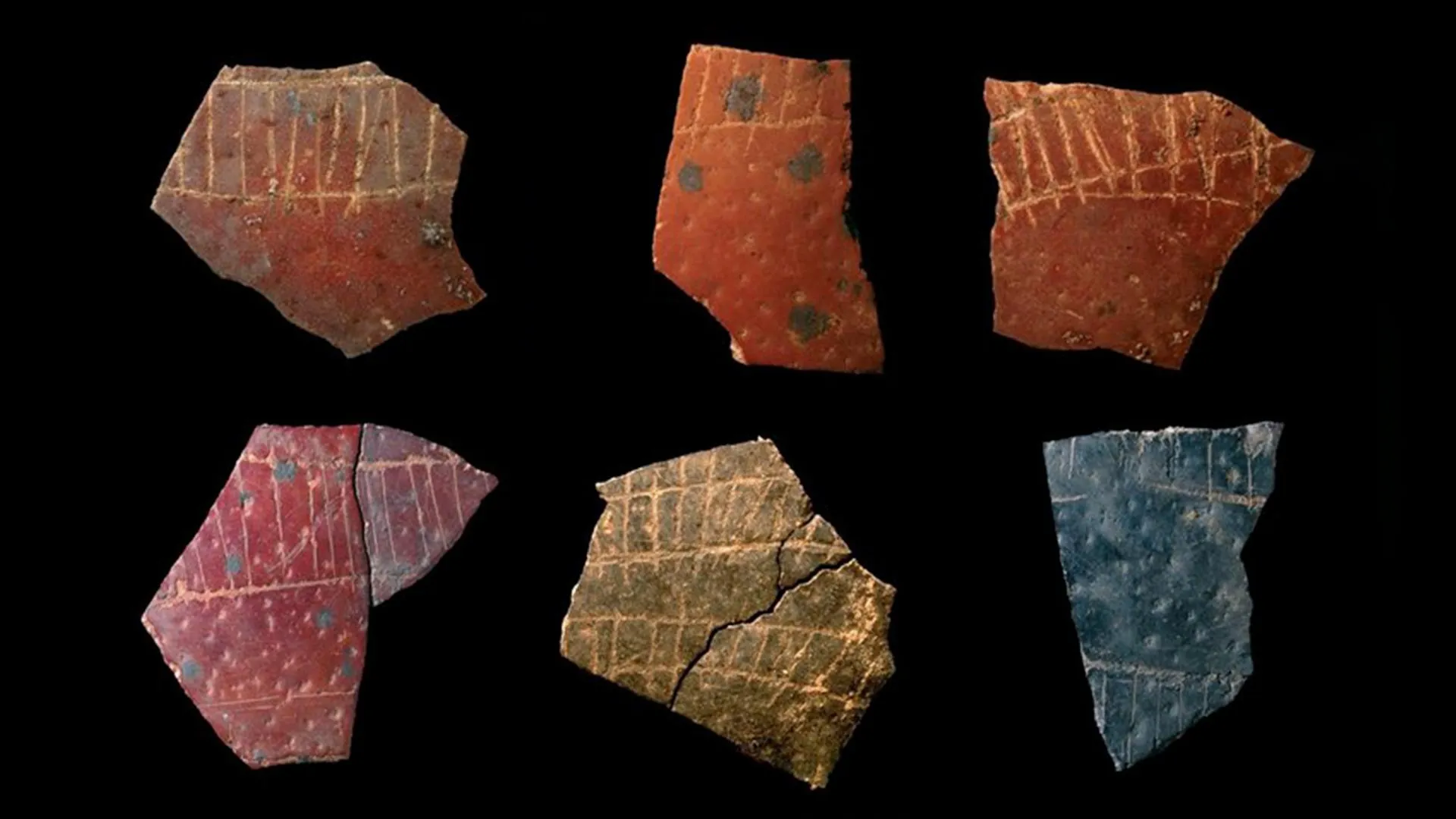
Researchers from the University of Bologna have published findings on hundreds of engraved ostrich eggshell fragments recovered from archaeological sites in South Africa and Namibia, all exceeding 60,000 years in age. The fragments were created by Homo sapiens populations inhabiting the region during this period and appear to have served practical purposes as water containers.
A systematic quantitative analysis of 112 fragments from Diepkloof, Klipdrift, and Apollo 11 sites examined the engraved markings using geometric and statistical techniques not previously applied to such artifacts. The research, led by Professor Silvia Ferrara and first-authored by Valentina Decembrini, applied methods to reconstruct the directions, angles, and paths of the engraved lines across the eggshell surfaces.
The analysis revealed that over 80 percent of the configurations displayed consistent spatial patterns. Recurring design elements included angles approximating 90 degrees and parallel line arrangements. More intricate designs featured hatched bands, grids, and diamond-shaped motifs that demonstrated evidence of rotation, translation, repetition, and hierarchical embedding of signs within the same surface. Rather than random scratches or improvised decoration, the markings reflected organized, geometric principles applied with apparent mastery.
The research suggests these engravings represent more than decorative or utilitarian markings, but rather evidence of emerging abstract thought in early human cognition. The ability to systematically arrange visual elements according to defined rules demonstrates sophisticated mental planning, with creators apparently visualizing complete designs before execution. The researchers note this capacity for organizing visual space according to abstract principles represents a fundamental human trait that would eventually develop into symbolic systems and writing.
The study was published in PLOS One under the title “Earliest Geometries. A Cognitive Investigation of Howiesons Poort Engraved Ostrich Eggshells” and represents work conducted through the FIS Advanced project SAPIENCE, directed by Ferrara in collaboration with Professor Enza Spinapolice of Sapienza University of Rome.
Article Attribution | Read More at Article Source
Article summary produced by Claude AI