

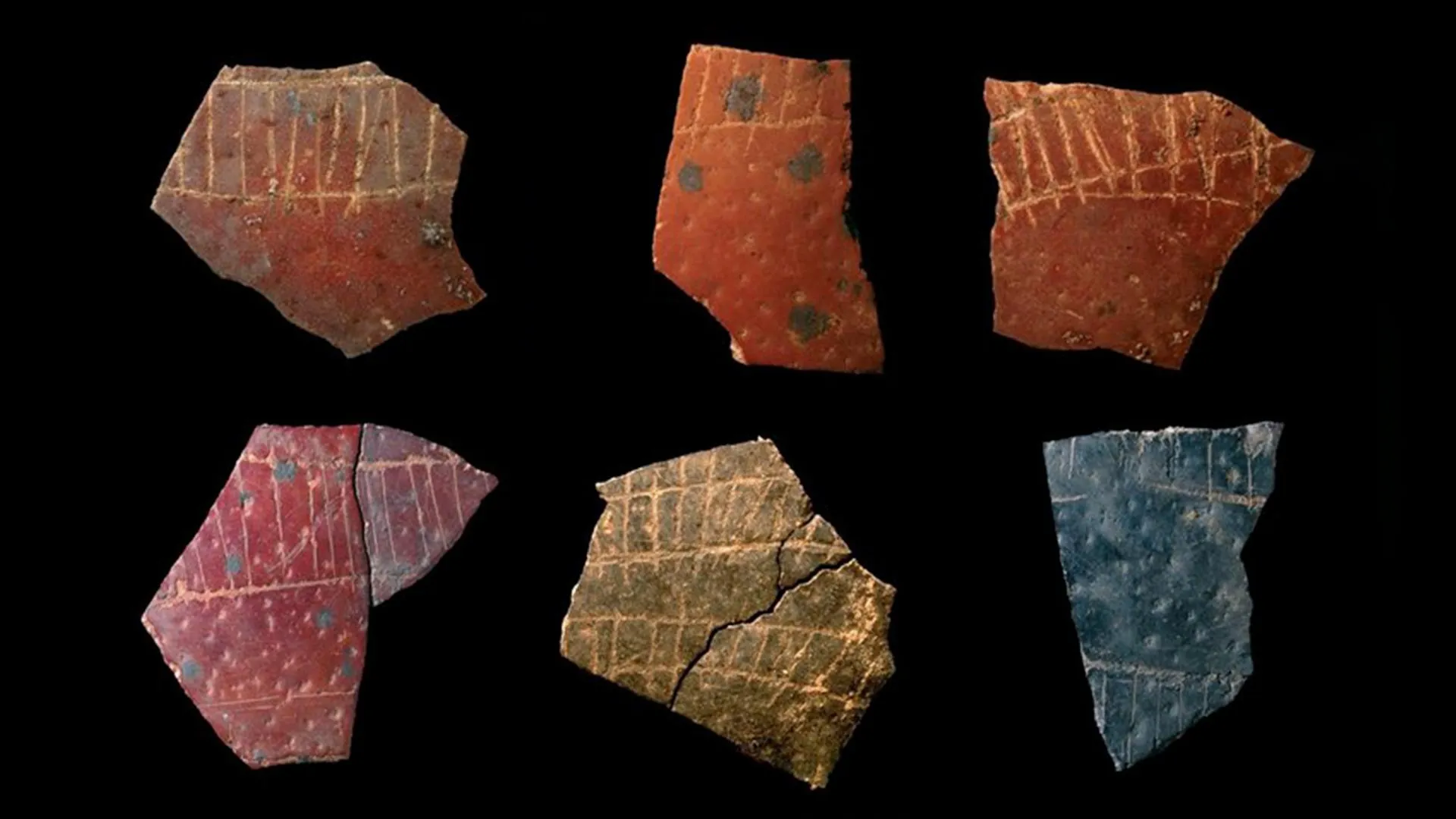
Researchers at the University of Bologna have completed a detailed analysis of hundreds of engraved ostrich eggshell fragments discovered at archaeological sites in southern Africa. The artifacts, which exceed 60,000 years in age, were created by early Homo sapiens groups and likely served as water containers. The study, published in PLOS One, applied geometric and statistical techniques to examine 112 fragments recovered from excavations in South Africa and Namibia.
The investigation revealed that the engravings followed consistent organizational principles rather than representing random markings. Geometric analysis showed that more than 80 percent of the recovered fragments displayed recurring spatial patterns, including angles approximating 90 degrees and sets of parallel lines. The designs also incorporated more complex elements such as hatched bands, grids, and diamond-shaped forms that demonstrated evidence of rotation, translation, repetition, and hierarchical embedding of symbols.
The research indicates that the creators of these engravings possessed considerable capacity for visual-spatial planning and demonstrated mastery of geometric relationships. According to the study coordinators, the markings suggest the artisans envisioned complete designs before executing them, implying deliberate planning rather than improvisation. The patterns demonstrate a systematic approach to arranging shapes and lines according to defined rules and principles.
The significance of the findings extends beyond the aesthetic or utilitarian purposes the engravings may have originally served. The research team emphasizes that the capacity to organize visual elements according to abstract principles represents an important indicator of emerging abstract thought in human cognitive development. The ability to transform simple forms into complex systems through rule-based processes represents a characteristic trait that has shaped human cultural and technological advancement, eventually contributing to the development of symbolic systems and written language.
Article Attribution | Read More at Article Source
Article summary produced by Claude AI