

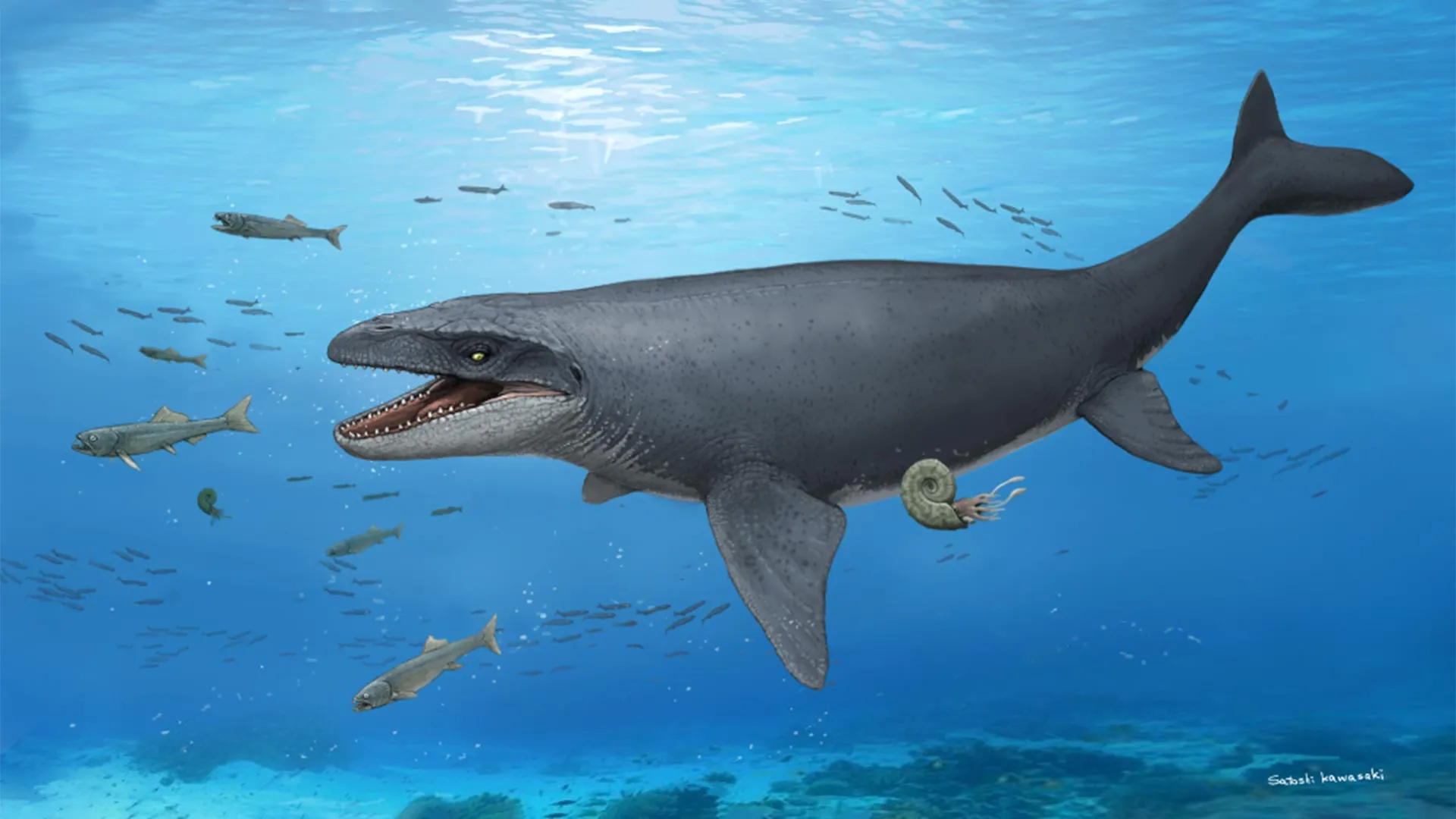
A collaborative team of scientists from multiple Japanese institutions has identified four fossil bones that had remained unrecognized within rock samples containing mosasaur remains. The specimens were originally collected from Sobura in Kaizuka City, Osaka Prefecture between 1990 and 1992 and subsequently stored at the Natural History Museum in Kishiwada City. The recent discovery occurred when researchers examined unprepared rock fragments that had been in storage, revealing bones that had not been previously extracted or studied.
The most significant finding is the identification of a premaxilla, the bone forming the front portion of the upper jaw. This marks the first confirmed instance of a premaxilla recovered from a mosasaur fossil discovered in Japan. The bone’s presence in the specimen provides researchers with important anatomical data that was previously unavailable for Japanese mosasaur studies. When the fossils were originally discovered, scientists had limited comparative material available, making comprehensive species identification challenging at that time.
Additional notable features include distinctive characteristics on the basisphenoid, a bone located near the braincase. This bone exhibits short horn-like projections and lacks a ventral median groove, features that differ from those documented in previously described mosasaur species. The combination of these unusual anatomical traits suggests the specimen may represent a previously undescribed mosasaur species, though further research is required to confirm this possibility.
Mosasaurs were large marine reptiles that inhabited oceans globally during the Late Cretaceous period, approximately 98 to 66 million years ago. The discoveries underscore the scientific value of reexamining museum collections and unprepared specimens, as decades of accumulated comparative fossil data and advanced research methods can reveal previously overlooked or misidentified remains. The findings may contribute to a more comprehensive understanding of northwestern Pacific marine ecosystems during the Cretaceous Period. Research results were presented at the 177th Annual Meeting of the Palaeontological Society of Japan on June 27, 2026.
Article Attribution | Read More at Article Source
Article summary produced by Claude AI