

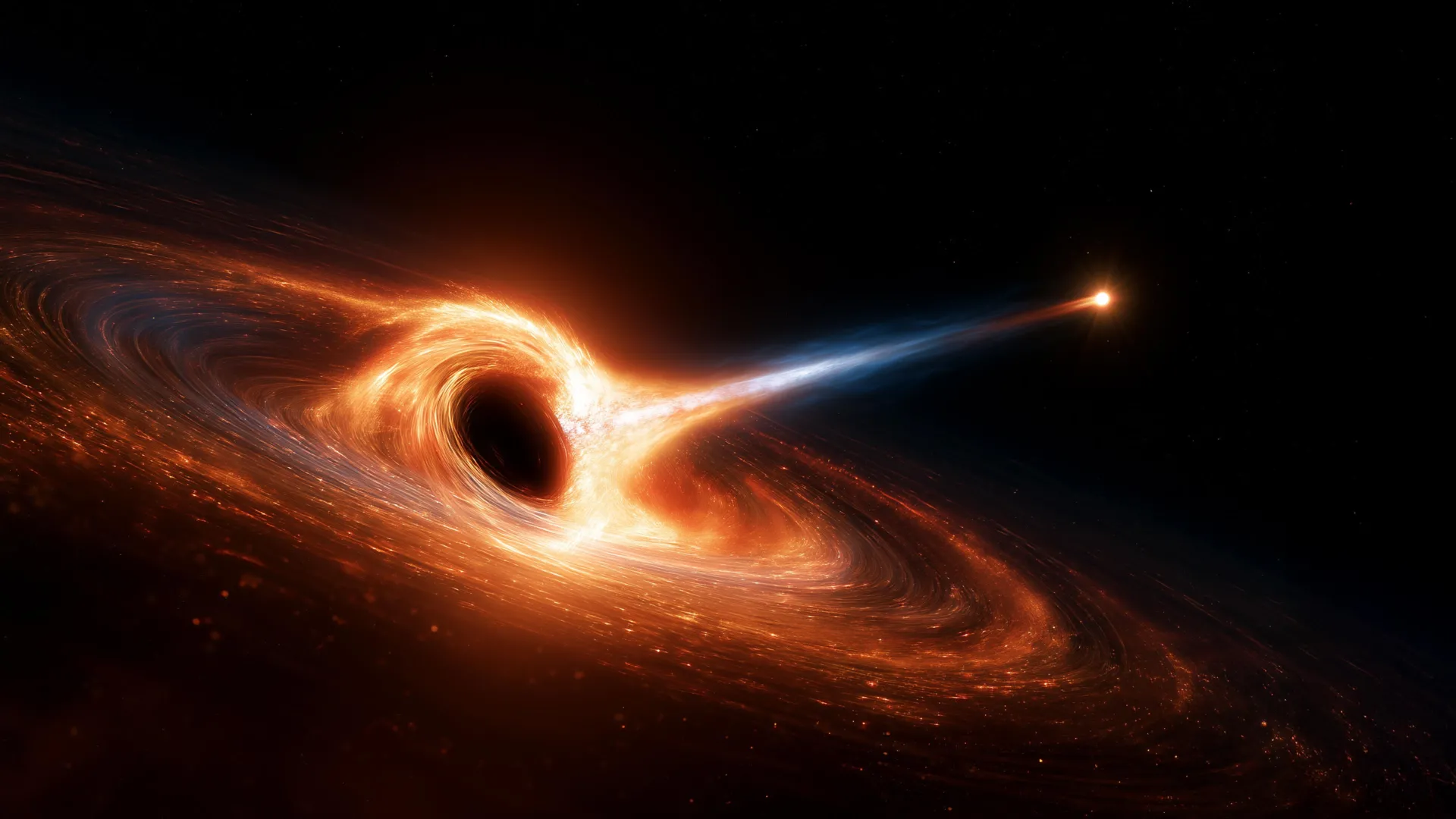
A black hole has destroyed a massive star through a gravitational encounter that generated some of the most energetic radiation ever observed by astronomers. The event, formally designated AT2024wpp and nicknamed the Whippet, was detected using the Zwicky Transient Facility at Palomar Observatory in California and quickly confirmed through observations from multiple ground and space-based instruments. The discovery was presented at the AAS conference in Phoenix, Arizona, with research led by Associate Professor Daniel Perley of Liverpool John Moores University.
The destruction of the star, known as a Tidal Disruption Event, produced extraordinary power—roughly 400 billion times the output of Earth’s Sun during its peak, surpassing the most powerful supernovae known to science. The star was progressively torn apart by the black hole’s immense gravity, with material forming a disk around the black hole that became intensely heated as it spiraled inward. This process generated X-ray radiation along with a powerful outflow of gas that interacted with material the star had previously expelled, creating the bright blue optical and ultraviolet emissions observed in the initial phase of the event.
Researchers detected a powerful shock wave that traveled outward through surrounding gas at one-fifth the speed of light, though this wave appeared to dissipate after approximately six months. Observations indicated the shock likely fizzled upon reaching the outer boundary of a gas bubble that had been created by the doomed star’s earlier stellar winds.
An unusual discovery emerged from follow-up spectroscopic observations made with multiple observatories. While the initial month revealed no recognizable chemical signatures, weak signatures of hydrogen and helium subsequently appeared as the event faded. Notably, the helium was traveling at extremely high velocity, exceeding 6,000 kilometers per second along the line of sight, suggesting either a dense core fragment survived the initial destruction or a third object in the system was being bombarded by radiation and particle winds from the feeding black hole.
Article Attribution | Read More at Article Source
Article summary produced by Claude AI