

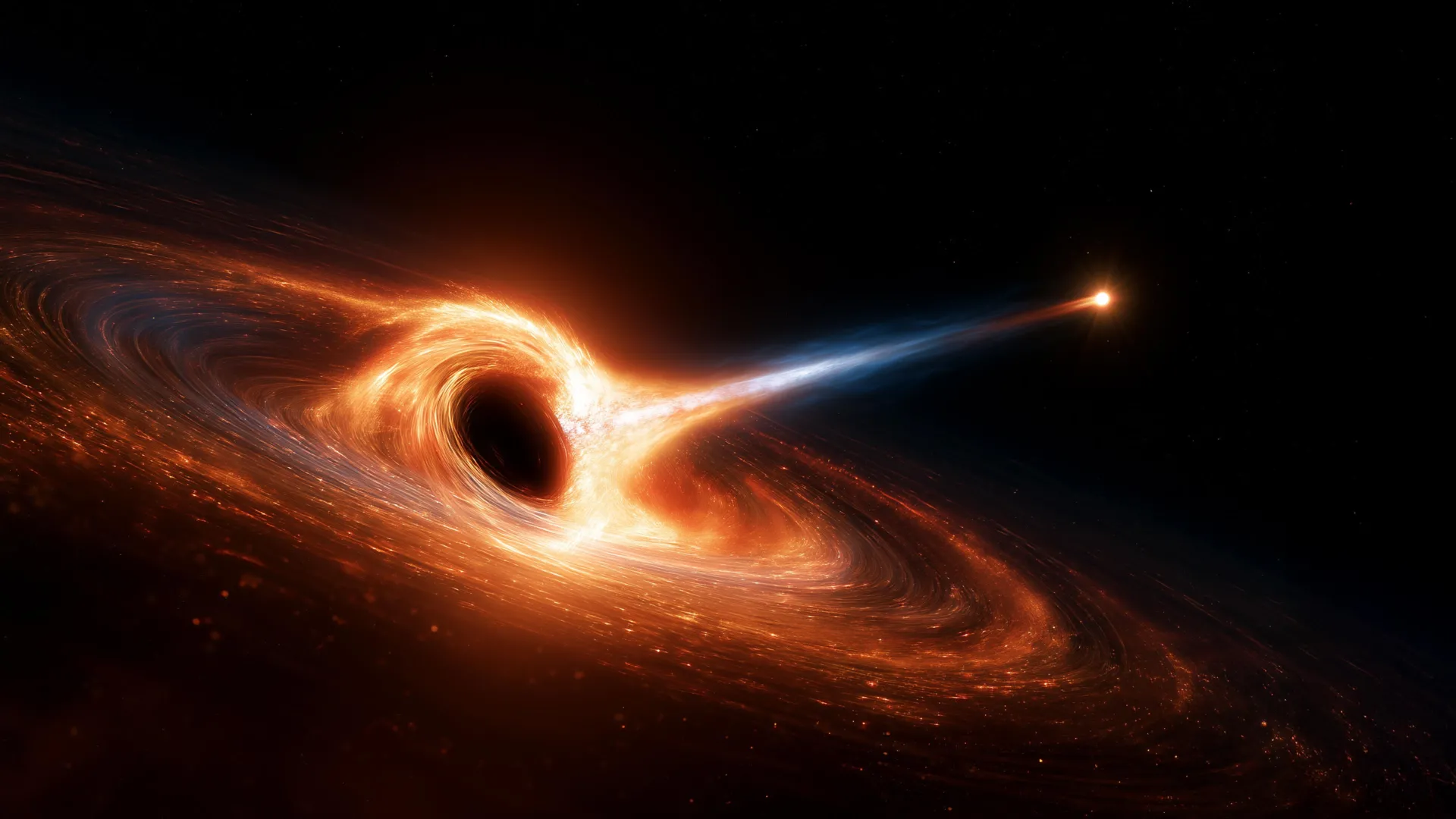
A rare cosmic event involving a black hole tearing apart a massive star has been observed and documented by astronomers worldwide. The phenomenon, formally designated AT2024wpp and nicknamed the Whippet, was detected using the Zwicky Transient Facility at Palomar Observatory in California by assistant professor Anna Ho of Cornell University. The event was presented at a conference in Phoenix, Arizona, and research findings have been submitted to the Monthly Notices of the Royal Astronomical Society, with associate professor Daniel Perley of Liverpool John Moores University as lead author.
The destruction of the star generated one of the most powerful cosmic events ever recorded. During the initial phase, the energy being released reached approximately 400 billion times the output of Earth’s Sun, far exceeding even the most powerful supernovae known to science. While astronomers have previously observed similar phenomena known as Tidal Disruption Events, this occurrence took place on an unprecedented scale. The event created a powerful shock wave that traveled through surrounding gas at one-fifth the speed of light before apparently dissipating after roughly six months.
The star’s material formed an intensely hot disk around the black hole, producing X-ray radiation and powerful outflows of gas that generated the bright blue optical and ultraviolet emissions observed during the initial days following the event. The system also produced radio and millimeter signals detected by researchers. The event provides valuable opportunities for studying black holes, their formation, and their growth mechanisms through the physics of such stellar destruction.
One puzzling aspect has emerged from continued observations using multiple observatories including Keck, Magellan, and the Very Large Telescope. While chemical signatures were absent during the first month following the explosion, weak signatures of hydrogen and helium gas subsequently appeared. The helium signal was particularly surprising, traveling at extremely high velocity and suggesting that a densely bound structure may have survived the initial destruction. Researchers have proposed this material could originate from a stream released by the star’s core or potentially from a third object in the system being bombarded by radiation from the active black hole.
Article Attribution | Read More at Article Source
Article summary produced by Claude AI