

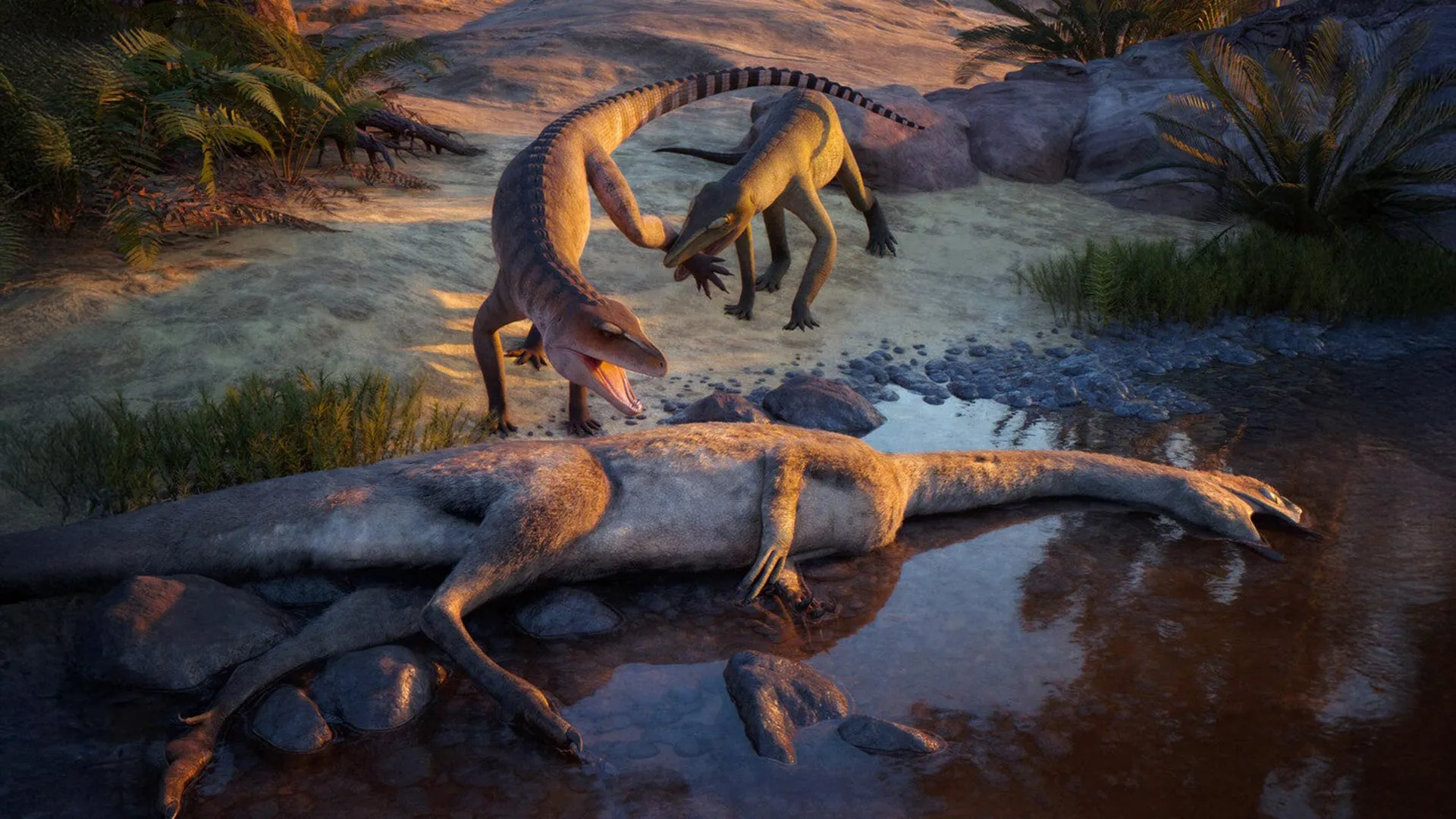
Researchers at Yale University have formally described a newly identified species of early crocodile relative from the late Triassic Period, which has been housed in museum collections for approximately 75 years without formal analysis. The fossil was discovered in 1948 at Ghost Ranch in northern New Mexico and represents one of only a handful of well-preserved specimens from this evolutionary lineage.
The species, named Eosphorosuchus lacrimosa, shared its final moments with another early crocodile relative, Hesperosuchus agilis, approximately 210 million years ago. Both animals, each roughly the size of a jackal, died and were buried together, likely during a sudden geological event such as a flash flood or mudslide. The exceptional preservation conditions at Ghost Ranch allowed the specimens to remain intact through subsequent geological time until their excavation.
Despite their close relationship, the two species displayed markedly different anatomical features. Hesperosuchus possessed a longer, narrower snout and was built for swift land-based hunting, while Eosphorosuchus exhibited a shorter, more heavily reinforced skull with enlarged jaw muscles adapted for capturing larger prey. These structural differences suggest the animals pursued distinct hunting strategies, potentially reducing direct competition for food resources within the same ecosystem.
The identification was confirmed through computed tomography scanning conducted at Yale, which revealed anatomical features distinguishing Eosphorosuchus from previously known Hesperosuchus specimens. The research demonstrates how existing museum collections continue to yield important paleontological insights. This discovery contributes to understanding the diversification of early crocodile lineages during the late Triassic, a period when multiple reptilian lineages were expanding into diverse ecological roles before the eventual dominance of dinosaurs.
Article Attribution | Read More at Article Source
Article summary produced by Claude AI