

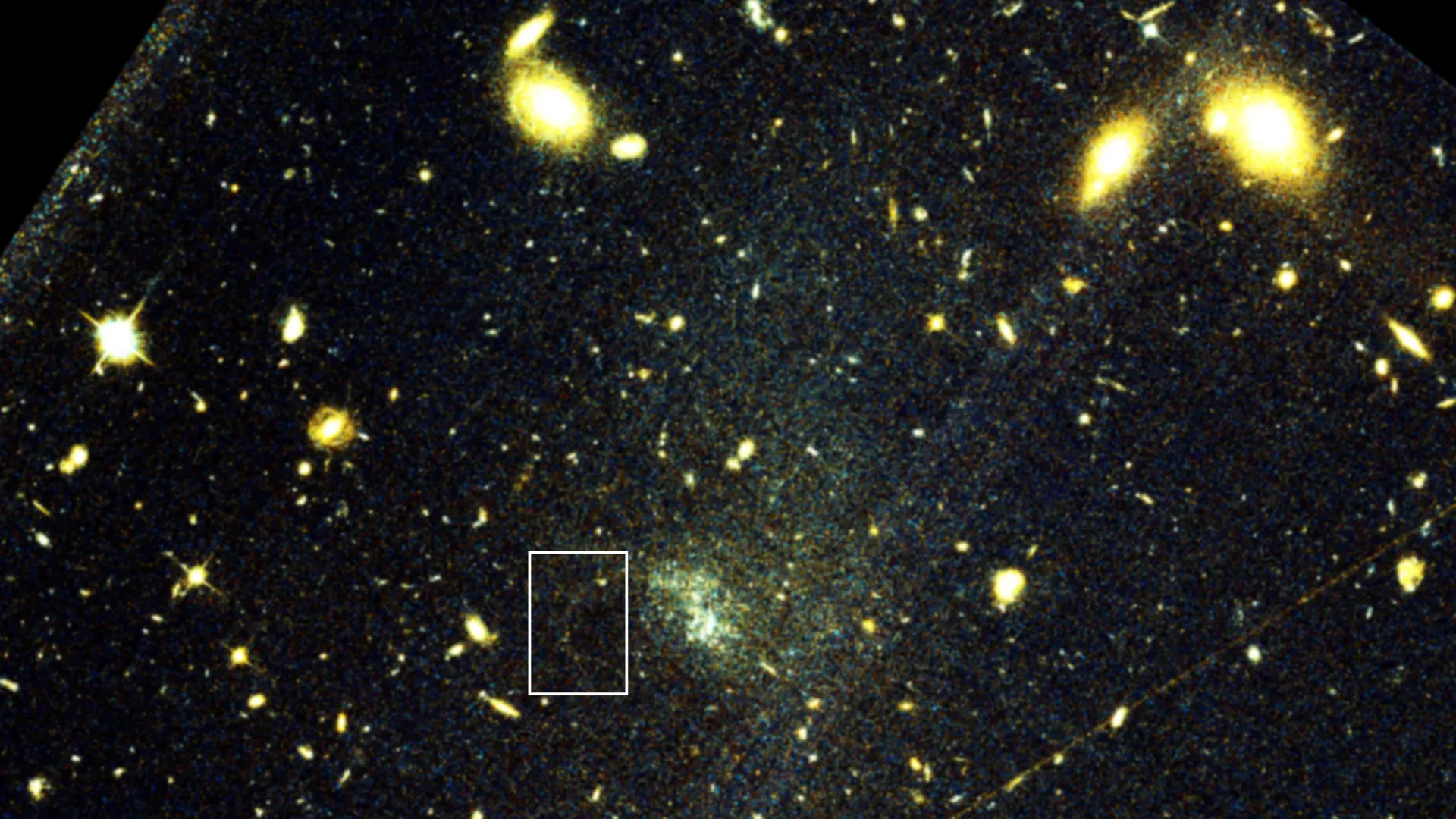
An international research team has discovered a faint ribbon of stars orbiting the ultra-diffuse galaxy UGC 9050-Dw1, approximately 115 million light-years from Earth. This stellar stream represents the first of its kind ever observed beyond the Milky Way, according to findings published on Aug. 12 in the journal Nature. The stream formed as a globular cluster gradually lost stars over billions of years, with those stars continuing along nearly identical orbital paths rather than dispersing randomly through space.
The discovery emerged from archival observations taken by NASA’s Hubble Space Telescope. Researcher David Hendel noticed the faint arc while examining images of UGC 9050-Dw1, with the galaxy’s relatively sparse stellar population providing a dark background that made the dim stream visible. The ultra-diffuse galaxy’s characteristics proved advantageous for detection, as the stream would typically be obscured against the brighter background of galaxies containing more stars.
The research team, led by Julie Kiel Holm and Sarah Pearson, used the stream’s structure as an unconventional tool for studying dark matter, one of astrophysics’ most significant unresolved questions. Dark matter comprises approximately 85% of all matter in the universe but cannot be directly observed because it emits no light. By running thousands of computer simulations comparing different dark matter distributions with the stream’s observed appearance, researchers could reconstruct the galaxy’s gravitational field and estimate its total mass composition.
The methodology demonstrates that stellar streams may provide a new means of investigating dark matter distribution beyond the Milky Way. Future observations could reveal small concentrations of dark matter that disturb the streams, potentially creating visible gaps or clumps. Upcoming observatories, including the Nancy Grace Roman Space Telescope and the European Space Agency’s Euclid mission, are expected to survey significantly larger sky regions than current instruments, promising detection of additional stellar streams and expanded dark matter research opportunities.
Article Attribution | Read More at Article Source
Article summary produced by Claude AI