

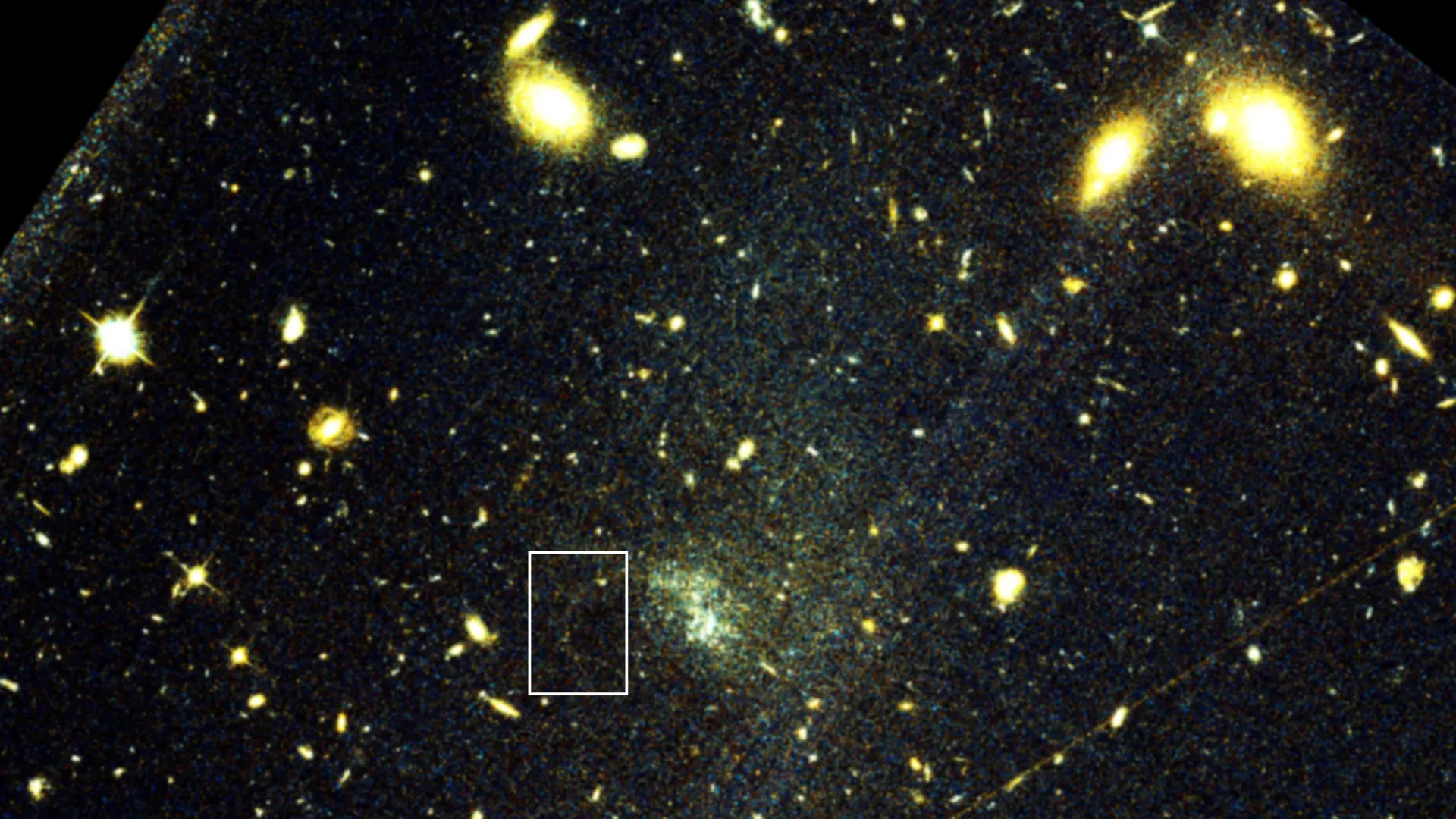
An international research team has discovered the first stellar stream beyond the Milky Way galaxy, marking a significant breakthrough in observational astronomy. The stream, found around the ultra-diffuse galaxy UGC 9050-Dw1 located approximately 115 million light-years from Earth, consists of stars gradually shed from an ancient globular cluster as it orbits its host galaxy. The detection was made through archival observations from NASA’s Hubble Space Telescope, with the faint, narrow arc becoming visible against the galaxy’s unusually dark background due to its low stellar density.
The discovery opens new avenues for investigating dark matter, one of astrophysics’ most significant unsolved mysteries. Dark matter comprises roughly 85% of all matter in the universe but remains invisible to direct observation. By analyzing how the stream’s shape is influenced by gravitational forces, researchers reconstructed the gravitational field of UGC 9050-Dw1 and determined how dark matter affected the stars’ orbital paths. The international team, led by researchers from the University of Copenhagen and Technical University of Denmark with contributions from Northwestern University, ran thousands of computer simulations to test various dark matter distributions and globular cluster characteristics against the observed stream’s appearance.
The findings demonstrate that stellar streams can serve as an innovative tool for measuring dark matter in galaxies beyond the Milky Way. While stellar streams have been identified within the Milky Way for decades, this represents the first confirmed detection in another galaxy and validates a completely new measurement methodology for ultra-diffuse galaxies. The results indicated that UGC 9050-Dw1 contains substantial dark matter, consistent with expectations for galaxies of its type.
The implications extend further as thin stellar streams may reveal small concentrations of dark matter through visible gaps or clumps, potentially providing a new avenue for understanding dark matter’s fundamental nature and distribution patterns. Future space observatories, including the European Space Agency’s Euclid mission and NASA’s Nancy Grace Roman Space Telescope, are expected to dramatically expand detection capabilities. These next-generation instruments will survey far larger sky regions than Hubble, substantially increasing the likelihood of identifying additional stellar streams around diverse galaxy types and enabling comprehensive studies of dark matter behavior across the universe.
Article Attribution | Read More at Article Source
Article summary produced by Claude AI