

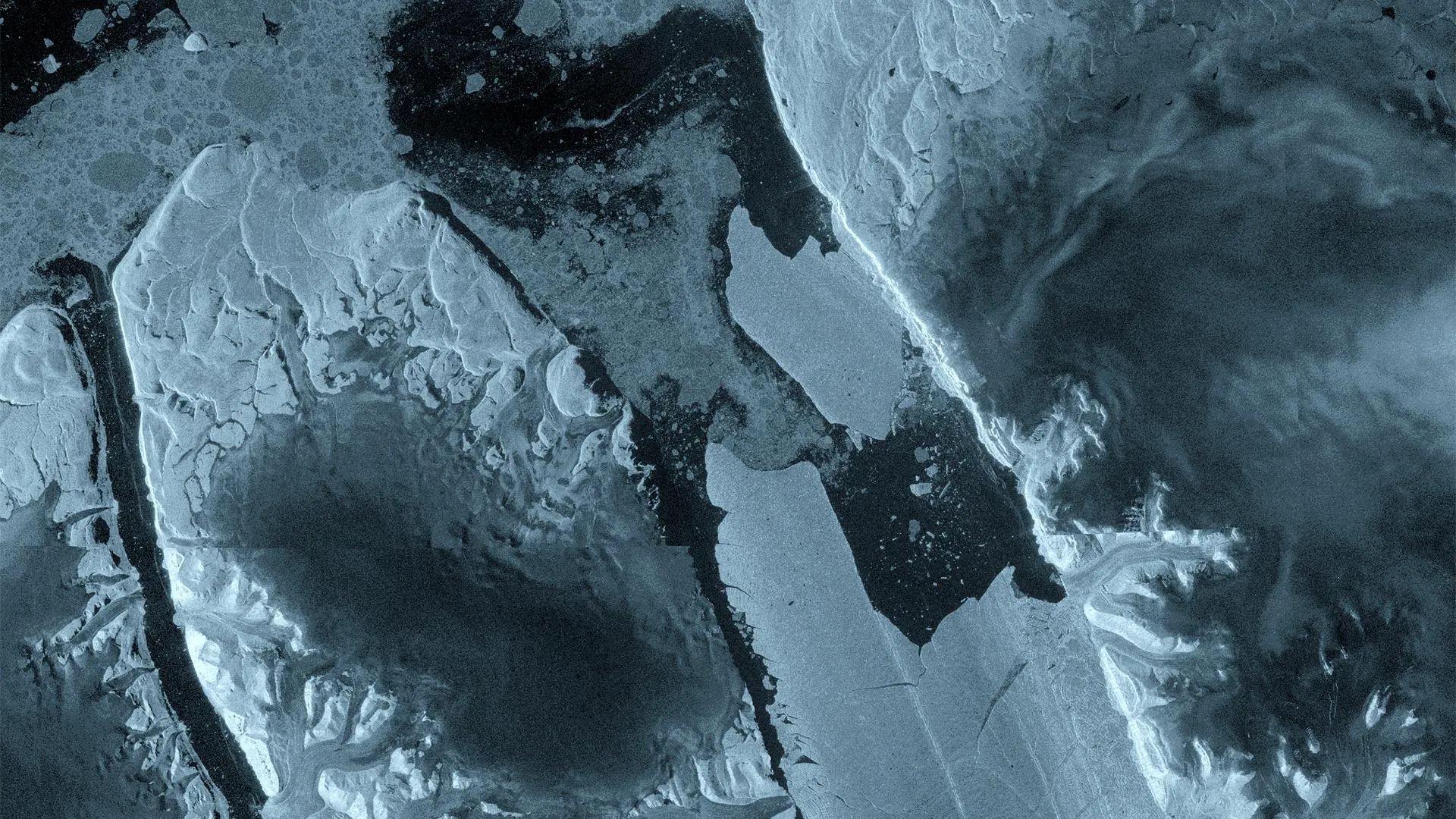
Europe’s Copernicus Sentinel-1 satellite mission documented a significant calving event at Petermann Glacier in northwest Greenland, where a section of floating ice measuring 76 square kilometers separated from the main glacier. The break occurred on August 4, 2026, and represents the most substantial loss of floating ice from this glacier since 2012, as well as the largest calving event recorded across the Arctic region since 2020. The newly formed ice island, comparable in size to Manhattan, may reach thicknesses of approximately 150 meters.
Radar imagery from Sentinel-1 captured the deterioration process, with images from August 3 showing significant structural breakdown along the ice tongue’s center. Within a single day, the massive ice island had separated from the glacier’s eastern side. The satellite’s radar capability proved particularly valuable for this monitoring effort, as it can collect observations regardless of daylight hours or cloud conditions. An international research team involving institutions from Canada and the United Kingdom has been tracking Petermann Glacier using Sentinel-1 data since 2019, with observations funded through the ESA’s FutureEO ARCTEX project.
Detailed monitoring revealed that fractures and deformation had been developing across the floating ice tongue for months prior to the calving event. Interferometric observations gathered in April showed clear signs of instability that preceded the break. The glacier has a history of major calving events, having produced large ice islands in 2008, 2010, and 2012, though conditions had remained relatively stable since the last major event. Scientists anticipate that two additional ice islands, measuring approximately 97 and 87 square kilometers respectively, could eventually detach as existing rifts continue to widen across the floating ice tongue.
The high-resolution satellite data captured how cracks propagated rapidly across the ice shelf and how surface movement responded to ocean tides leading up to the separation. Large tabular icebergs remain relatively uncommon in the Arctic compared to Antarctic waters, making this event particularly valuable for scientific study. Researchers will continue monitoring both the glacier and the drifting ice island using satellite imagery, aerial observations, and tracking data to better understand Arctic ice dynamics and impacts on sea-level rise. The tracking effort also addresses practical navigation and safety concerns, as ice masses of this magnitude can remain in the ocean for extended periods while gradually fragmenting into progressively smaller and harder-to-detect pieces.
Article Attribution | Read More at Article Source
Article summary produced by Claude AI