

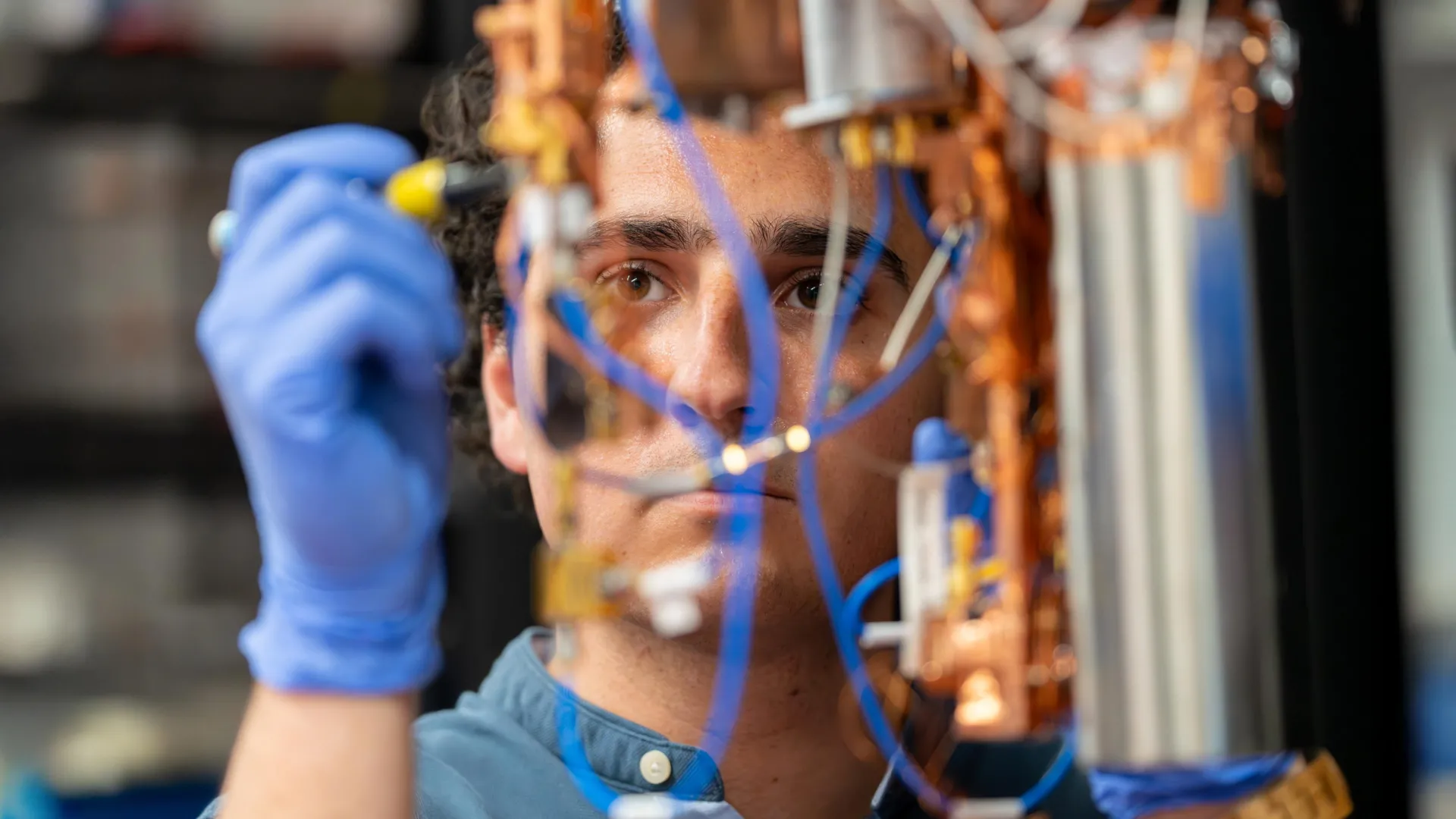
Researchers at the Institute of Science and Technology Austria have successfully demonstrated a novel approach to creating distributed entanglement between physically separated qubits, a capability considered essential for building larger quantum computers and future quantum networks. The work, published in Physical Review X, represents the first experimental validation of a theoretical concept proposed more than two decades earlier.
Previous methods for entangling distant qubits have generally relied on either sending actively controlled photons between qubits or having each qubit emit photons that are subsequently matched to generate entanglement. The latter approach, recognized by the 2022 Nobel Prize in Physics, still depends on repeated measurements and post-selection procedures, and does not guarantee successful entanglement production. The ISTA team, led by PhD student Alejandro Andrés-Juanes and professor Johannes Fink, developed an alternative strategy that uses a quantum bath—the qubits’ environment itself—as the source of entanglement.
The key innovation involves using a continuous stream of correlated photons to create and stabilize an entangled state that persists beyond the qubits’ individual lifetimes. This approach is fully autonomous and requires no active control or measurement interventions. The researchers employed microwave photons to couple the qubits with the entangled photon source, leveraging technology already central to leading superconducting-qubit systems. To verify that the two qubits were synchronized within the quantum bath, they used quantum tomography, performing brief measurements lasting 20-80 nanoseconds to investigate the underlying quantum states.
While the prototype successfully demonstrates the concept, the method currently transfers approximately 10 percent of the bath’s available entanglement, making it less efficient than approaches that actively control qubit states. The researchers attribute the delay in experimental realization partly to the original theory being developed under idealized conditions difficult to reproduce in practice. They suggest their work has revealed several factors that may have previously hindered the development of functional quantum baths using single sources of correlated photons for distributed entanglement.
The achievement could provide new opportunities for quantum-optics experiments and may contribute to expanding quantum processors and advancing them toward fault-tolerant operation. The team indicates that the relatively simple method may be scalable to synchronize multiple distant qubits simultaneously.
Article Attribution | Read More at Article Source
Article summary produced by Claude AI