

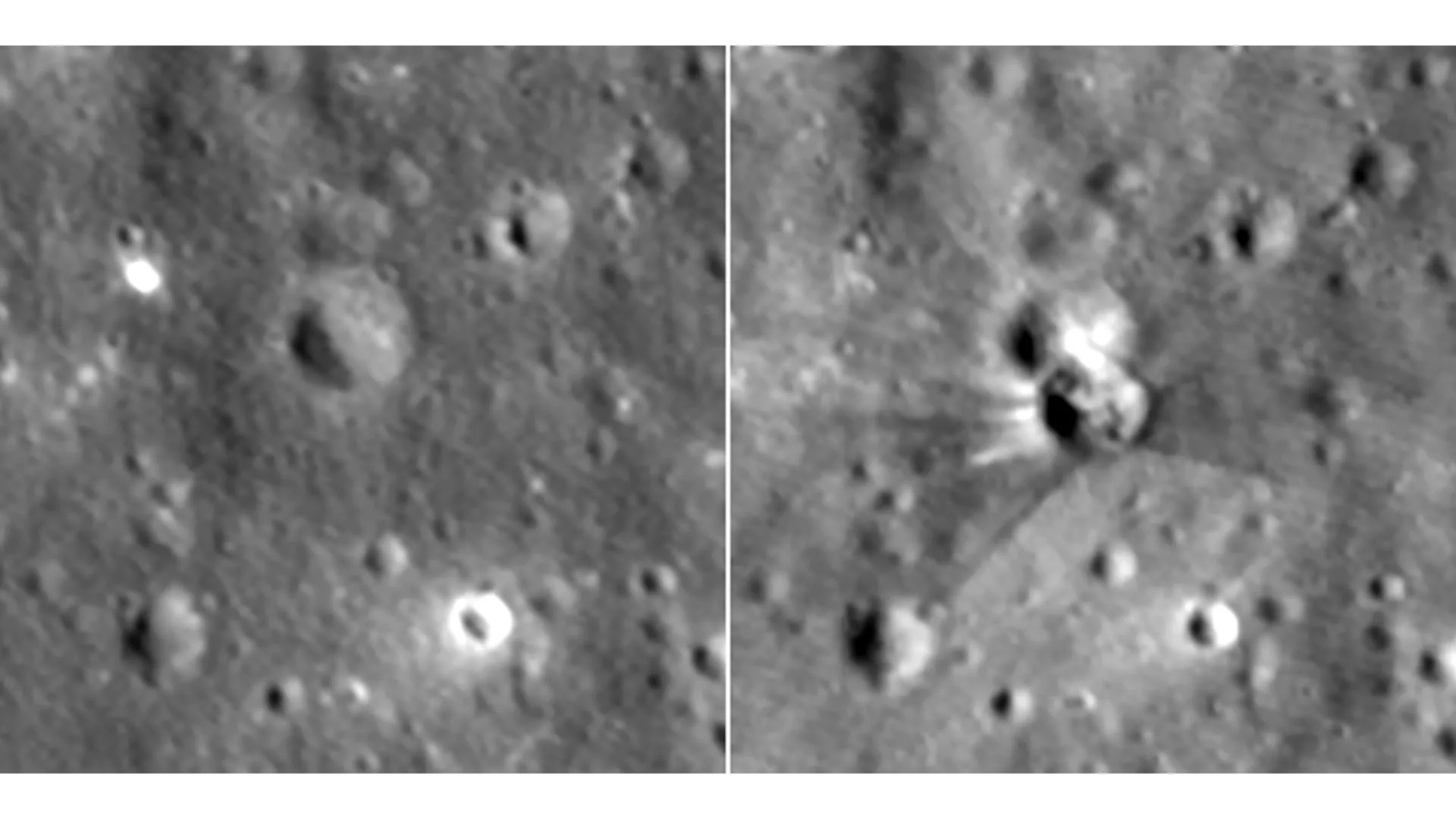
Between Aug. 11 and 12, NASA’s Lunar Reconnaissance Orbiter captured images of a fresh impact crater on the Moon resulting from a collision with a SpaceX Falcon 9 upper stage rocket. The rocket stage, which launched in January 2025 as part of the Firefly Blue Ghost 1 mission, struck the lunar surface on Aug. 5. Photographing the crater required precise timing and maneuvering, as the orbiter needed to position its cameras while traveling at approximately one mile per second at an altitude of roughly 60 miles above the surface.
The imaging process presented significant technical challenges. The orbiter, which circles the Moon from pole to pole every two hours as the lunar surface rotates beneath it, had to wait six days before the impact site rotated into an observable position. Engineers achieved the necessary precision by tilting the spacecraft to direct its cameras toward the target, understanding that photographs taken even 10 seconds off in timing would have displaced the crater by approximately 10 miles in the resulting image.
Measurements conducted using the orbiter’s Narrow Angle Camera, which can detect features as small as 3 feet across, revealed the crater extends approximately 60 feet in width and reaches less than 10 feet in depth. Analysis of imagery captured from multiple angles and lighting conditions showed both bright and dark rays extending outward from the impact site. The darker streaks consist of surface material altered over extended periods by solar wind, cosmic rays, and micrometeorite impacts, excavated from depths of approximately 1.5 feet. Brighter streaks near the crater rim revealed fresher subsurface material uncovered by the collision.
Locating the impact site involved international collaboration and coordination. Independent astronomers worldwide determined the rocket’s trajectory using publicly available data, while NASA’s Center for Near Earth Object Studies refined impact predictions as part of testing its planetary defense methodologies. The agency’s predictions were shared with South Korea’s Danuri lunar orbiter team, which successfully imaged the crater and confirmed NASA’s predicted impact location to within 0.6 miles. Following the observations, the Danuri mission provided precise crater coordinates that enabled NASA’s lunar reconnaissance team to refine the impact site’s center to 19.4759°N, 266.7138°E, at an elevation of 511 meters.
Article Attribution | Read More at Article Source
Article summary produced by Claude AI