

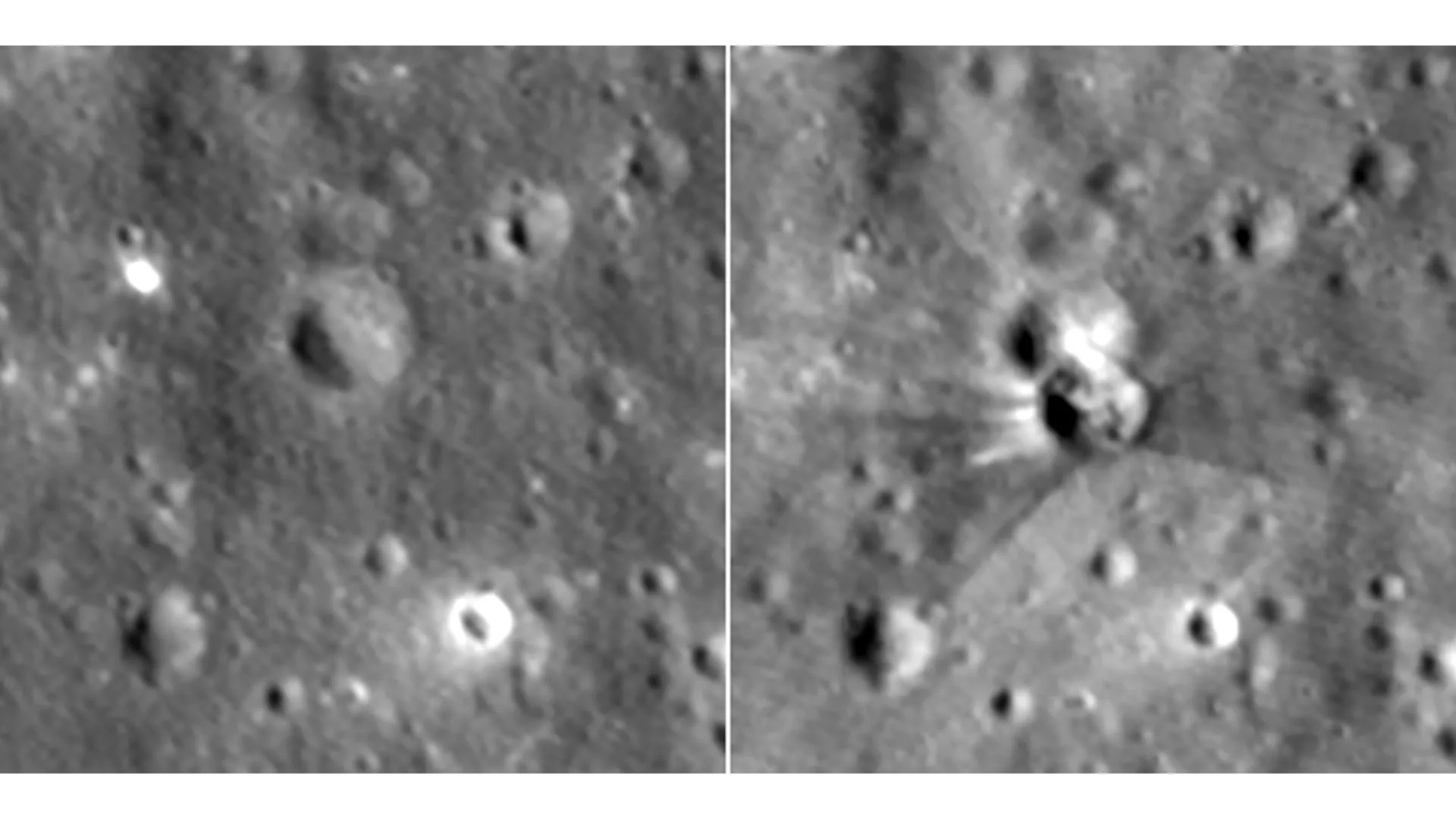
Between Aug. 11 and 12, NASA’s Lunar Reconnaissance Orbiter captured imagery of a previously undetected crater on the Moon’s surface. The crater resulted from a SpaceX Falcon 9 upper stage striking the lunar terrain on Aug. 5. The rocket stage had been launched in January 2025 as part of the Firefly Blue Ghost 1 mission.
Acquiring detailed photographs of the impact site presented significant technical challenges for the orbiting spacecraft. LRO operates in a polar orbit, circling the Moon once every two hours while the lunar surface rotates beneath it. To image the crater, mission engineers adjusted the orbiter’s orientation to angle its cameras toward the target area as the spacecraft traveled at approximately one mile per second at an altitude near 60 miles. Approximately six days elapsed before the Moon’s rotation positioned the crater within the orbiter’s observable range. Timing precision proved equally critical, as photographs captured even 10 seconds off-target would have placed the crater roughly 10 miles from the image center.
Analysis of the crater using multiple photographic angles and varying illumination conditions revealed specific dimensions and composition details. The Narrow Angle Camera, capable of resolving features as small as three feet, determined the crater measured approximately 60 feet in width, with a depth of less than 10 feet based on shadow analysis. The impact excavated both weathered surface material and fresher subsurface material from depths exceeding 1.5 feet, creating distinctive bright and dark rays extending outward from the impact point.
Identifying and verifying the impact location required coordinated efforts among international space agencies and independent astronomers. NASA’s Center for Near Earth Object Studies, which monitors potential Earth-threatening objects, used the event to validate impact prediction methodologies. After calculating the expected impact coordinates, NASA shared this information with South Korea’s Korea Pathfinder Lunar Orbiter team. The Danuri spacecraft subsequently imaged the crater and confirmed NASA’s prediction accuracy to within approximately 0.6 miles. Data from Danuri enabled the LRO team to further refine the crater’s precise location to 19.4759°N, 266.7138°E at an elevation of 511 meters.
Article Attribution | Read More at Article Source
Article summary produced by Claude AI