

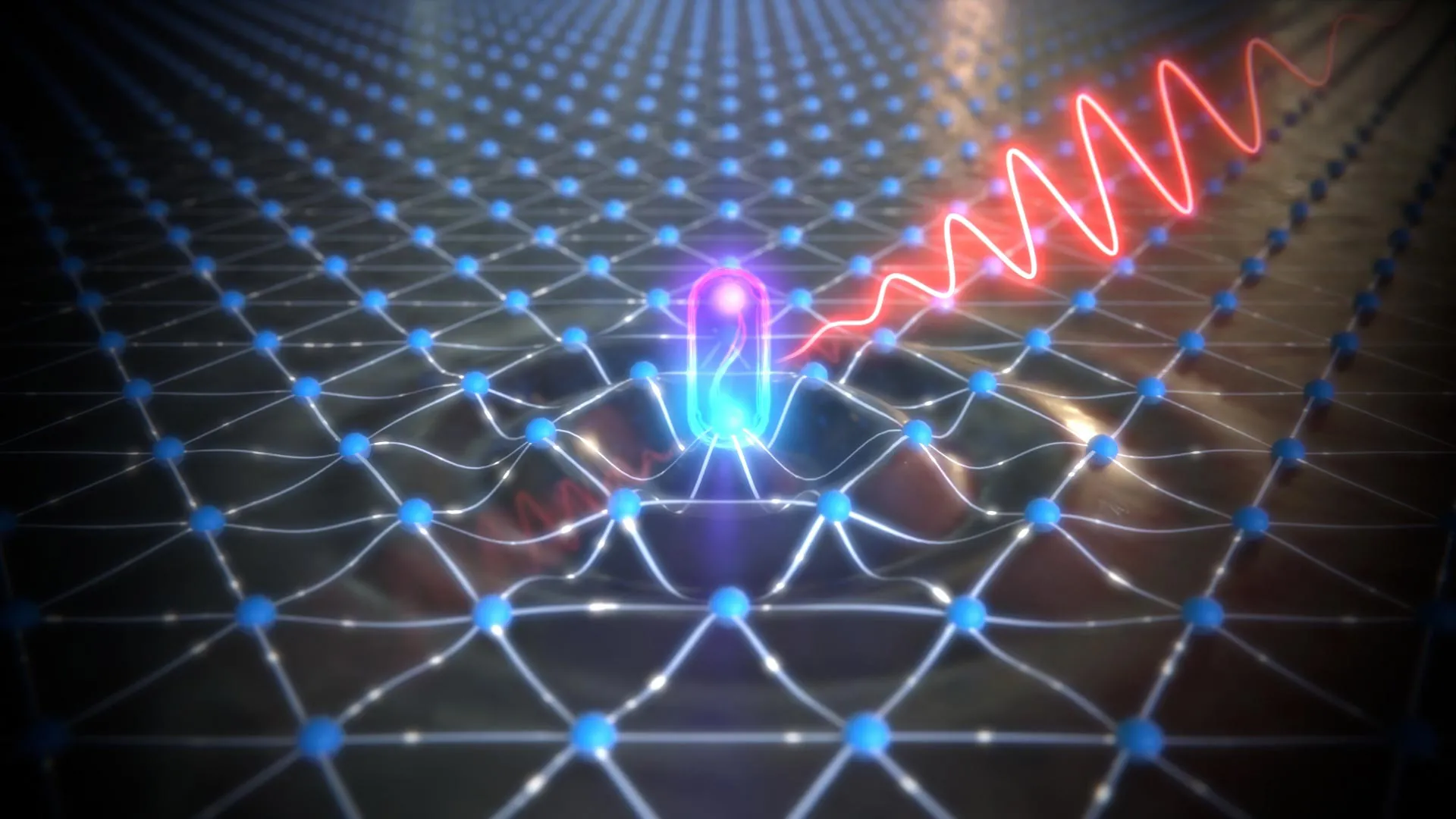
Scientists at the University of Basel and the Technical University of Munich have demonstrated a novel technique for observing the collective behavior of electrons within Wigner crystals, a particularly exotic state of matter. Their findings, published in Nature Physics, offer new insights into how electrons organize and move when confined to two-dimensional structures under specific conditions.
Wigner crystals form when electrons confined to a two-dimensional plane interact strongly with one another, causing them to arrange themselves into regular, repeating patterns rather than moving independently. Unlike conventional crystals, whose structure is determined by the atoms or ions comprising the material, Wigner crystals emerge entirely from electron-electron interactions. While scientists have previously detected these crystals in various systems, understanding their internal dynamics has remained challenging, with existing methods making it difficult to directly observe how electrons within them move collectively or respond to external influences.
The research team, led by Professor Tomasz Smoleński at the University of Basel, studied a single atomic layer of tungsten diselenide cooled to near absolute zero. By shining light on the material and analyzing the reflected signals, they detected optical features that encode information about the electrons’ coordinated movement. The measurements revealed hybrid particles called Wigner crystal polarons, which form when light-generated excitations couple with the ordered electron structure, effectively serving as sensitive optical probes of the crystal’s internal behavior.
A complementary theoretical team at the Technical University of Munich, led by Professor Michael Knap, developed a model explaining how these quasiparticles emerge and behave. The researchers found that the strength of electron interactions directly influences the optical signals observed, suggesting applications for studying strongly correlated systems where collective behavior dominates. According to the researchers, this approach opens new avenues for examining complex quantum states where understanding emerges from many particles interacting together rather than individual particle properties.
Article Attribution | Read More at Article Source
Article summary produced by Claude AI