

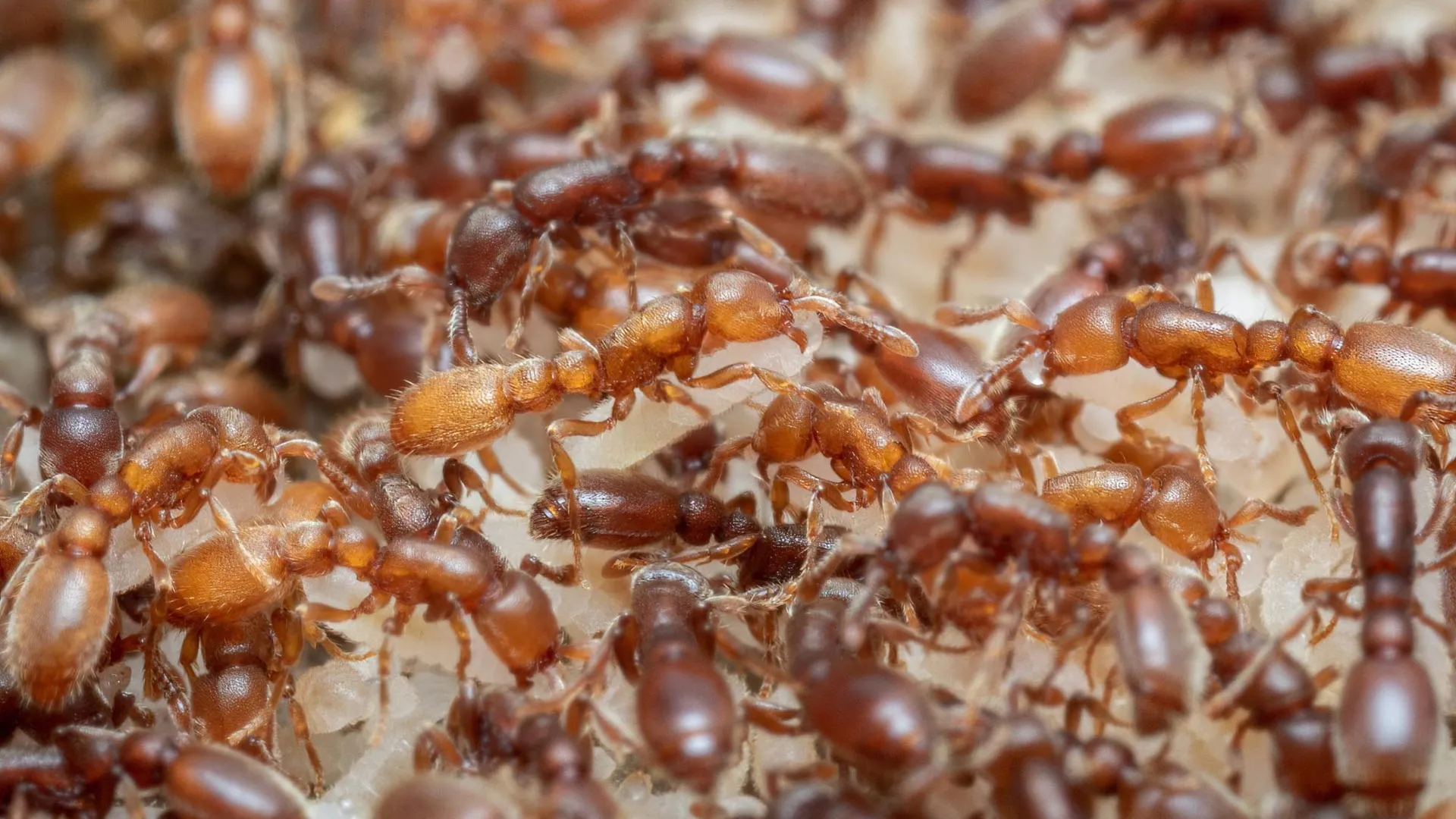
Researchers studying clonal raider ants have identified how parental care may have evolved from nonparental ancestors, according to findings published in Nature. The work suggests that evolution repurposed existing biological systems rather than inventing caregiving behaviors from scratch. Specifically, ancient neural pathways that originally controlled hunger and feeding appear to have been adapted to regulate social care.
The research team, led by Daniel Kronauer at Rockefeller’s Laboratory of Social Evolution and Behavior, selected clonal raider ants as their model organism because of their relatively simple brain structure—containing about 60,000 cells compared to roughly 100 million in a mouse brain—and their age-dependent behavioral transitions. Younger ants typically remain in the nest and care for larvae, while older ants forage for food outside. Scientists have long sought to understand how such complex caregiving behaviors evolved, but studying this transition has proven difficult in traditional research organisms like fruit flies, which do not provide parental care, or mice, whose brains are too complex to map in detail.
Using an automated behavioral monitoring system, researchers tracked hundreds of caregiving interactions between individual ants and larvae. They identified 70 neuropeptides in ant brains and tested whether each molecule influenced caregiving behavior. Two signaling molecules emerged as particularly significant: neuropeptide F (NPF) encouraged caregiving, while allatostatin A (AstA) promoted foraging. Young ants naturally displayed higher NPF and lower AstA levels, while older ants showed the opposite pattern. When researchers altered the activity of either molecule, ants changed their behavior accordingly.
The same molecules also responded to hunger conditions. Starved ants exhibited higher NPF and lower AstA levels, causing them to behave more like caregivers. After feeding, the chemical balance reversed, making ants less focused on larval care and more inclined to forage. These findings support the hypothesis that parental behavior evolved by expanding feeding-related brain systems, allowing animals to become motivated to nurture offspring as well as themselves.
Mammals use related neuropeptides in their caregiving behaviors, suggesting a shared evolutionary strategy for parenting across distant animal lineages. Future research will map the specific neural circuits affected by these molecules and compare them between ants and mammals. Additionally, the predictable age-related behavioral transitions in clonal raider ants may provide insights into how brain chemistry influences behavioral changes during normal aging in other species, including humans.
Article Attribution | Read More at Article Source
Article summary produced by Claude AI