

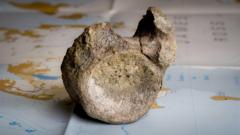
Scientists have identified a fossil stored at the British Antarctic Survey in Cambridge as the first dinosaur bone ever discovered in Antarctica. The specimen, a tail vertebra from a Titanosaur, was originally collected on James Ross Island in 1985 by a geological team who were uncertain of its classification and placed it in storage alongside other collected materials.
The fossil remained catalogued but largely unexamined until Dr Mark Evans, collections manager at the survey, recently reviewed the specimen while organizing archived materials. Upon closer inspection, Evans recognized characteristics consistent with a dinosaur rather than a marine reptile, which the original team had suspected. He consulted Prof Paul Barrett from the Natural History Museum, who confirmed the identification by examining distinctive anatomical features including a hollow depression and rounded projection that form part of a ball-and-socket joint system unique to Titanosaurs.
Titanosaurs comprised over 100 identified species globally and were four-legged herbivores characterized by elongated necks and counterbalancing tails. Based on the vertebra’s dimensions, researchers estimate the Antarctic specimen belonged to an individual approximately 23 feet in length, suggesting either a juvenile or an unusually small adult for the species. The fossil dates to approximately 82 million years ago during the Late Cretaceous Period, when Antarctica maintained a warmer climate with extensive forested ecosystems.
The discovery carries significance for understanding prehistoric Antarctic fauna and paleoenvironmental conditions. Though other dinosaur fossils have been recovered from Antarctica subsequently, finds remain relatively scarce due to harsh conditions and ice coverage obscuring geological formations. The research, published in the journal Acta Palaeontologica Polonica, contributes to broader understanding of how large herbivorous dinosaurs inhabited and adapted to ecosystems in Earth’s southern regions during the Late Cretaceous.
Article Attribution | Read More at Article Source
Article summary produced by Claude AI