

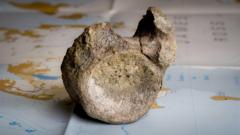
A fossil that had been stored away in a geology collection for decades has been identified as the first dinosaur bone ever found in Antarctica. The specimen was collected on James Ross Island in 1985 and documented by geologist Dr Mike Thomson, who initially noted it as a vertebra from a large reptile. The fossil remained in storage at the British Antarctic Survey in Cambridge until recently, when collections manager Dr Mark Evans recognized its significance and consulted with Prof Paul Barrett from the Natural History Museum to confirm the discovery.
The bone has been identified as a tail vertebra from a Titanosaur, a group of massive four-legged herbivores that included the largest dinosaurs known to have walked the Earth. The distinctive hollow on one end of the vertebra and the rounded bump on the other are characteristic features unique to Titanosaurs, forming ball-and-socket joints that run along the spine. Based on the size of the tail bone, scientists estimate the Antarctic specimen belonged to an individual measuring approximately 23 feet in length, making it relatively small compared to the largest Titanosaurs, which exceeded 115 feet and weighed around 60 tonnes.
The dinosaur inhabited Antarctica approximately 82 million years ago during the Late Cretaceous Period, when the continent featured lush forests that provided abundant vegetation for plant-eating species. The discovery contributes important information to the sparse fossil record of Antarctica and demonstrates that the region, now considered inhospitable, once supported diverse wildlife and complex ecosystems. While other dinosaur fossils have been found in Antarctica since 1985, they remain uncommon due to the challenging conditions paleontologists face working in the region. The findings have been published in the journal Acta Palaeontologica Polonica.
Article Attribution | Read More at Article Source
Article summary produced by Claude AI