

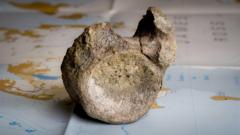
A fossil that had been housed in the geology collection at the British Antarctic Survey in Cambridge for approximately 40 years has been identified as Antarctica’s first confirmed dinosaur bone. The specimen was originally collected on James Ross Island and documented in a field notebook dated 9 December 1985, where the original discoverer noted it as a vertebra belonging to a large reptile measuring roughly 10 centimeters in width.
The fossil remained unstudied until recently when Mark Evans, collections manager at the British Antarctic Survey, examined it among thousands of specimens from Antarctic expeditions. Upon closer inspection, Evans recognized characteristics distinctive of dinosaur anatomy and consulted Professor Paul Barrett from the Natural History Museum for confirmation. Barrett identified the vertebra as belonging to a Titanosaur, a group known for producing some of the largest terrestrial animals ever to exist. The distinctive ball-and-socket joint structure visible in the fossil proved definitive for this classification.
Titanosaurs were four-legged herbivorous dinosaurs characterized by elongated necks and counterbalancing tails. More than 100 species have been identified globally. Based on the size of the discovered tail bone, scientists estimate the Antarctic specimen reached approximately 7 meters in length, suggesting either a juvenile or an unusually small adult member of its species. The dinosaur inhabited Antarctica approximately 82 million years ago during the Late Cretaceous Period, when the continent supported lush forest ecosystems rather than its current ice-covered landscape.
The discovery holds significance for understanding ancient Antarctic paleontology, as the continent’s harsh conditions and ice cover make fossil excavation and research particularly challenging. While additional dinosaur fossils have been found in Antarctica since 1985, discoveries remain sparse. This vertebra provides evidence that the region once harbored diverse life forms within complex ecosystems, contributing to broader understanding of Late Cretaceous Period environments and animal communities in Earth’s southernmost regions. Research findings have been published in the journal Acta Palaeontologica Polonica.
Article Attribution | Read More at Article Source
Article summary produced by Claude AI