

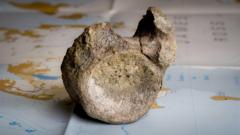
A paleontological research team has authenticated a fossil specimen as the first dinosaur bone ever recovered from Antarctica, resolving decades of uncertainty about its classification. The bone was originally collected on James Ross Island in 1985 by a geological expedition and documented in field notes by geologist Dr Mike Thomson, who sketched the specimen and noted it as a vertebra from a large reptile. The fossil subsequently entered the collections of the British Antarctic Survey in Cambridge, where it remained unstudied amid thousands of other Antarctic specimens.
Dr Mark Evans, collections manager at the British Antarctic Survey, recently identified the fossil as potentially significant while reviewing stored materials. He consulted Prof Paul Barrett from the Natural History Museum, who confirmed the specimen’s true nature through its distinctive anatomical features. The vertebra displays characteristic ball-and-socket joint structures unique to Titanosaurs, a group of massive herbivorous dinosaurs that inhabited various continents during the Cretaceous period.
Based on the size of the tail bone, researchers estimate the Antarctic dinosaur reached approximately 23 feet in length, suggesting it may have been either a juvenile or an unusually small member of its species. The creature lived approximately 82 million years ago when Antarctica featured a temperate climate with dense forests capable of supporting large plant-eating animals. Scientists believe the earliest discoverers likely mistook the specimen for marine reptile remains, a reasonable conclusion given Antarctica’s fossil record and the challenging conditions researchers face working on the continent.
The authenticated discovery holds significance for understanding prehistoric Antarctic ecosystems and demonstrates the potential for additional paleontological findings in this remote region. Despite the harsh modern environment, Antarctica once supported diverse fauna adapted to its warmer prehistoric conditions. The research has been published in the journal Acta Palaeontologica Polonica, contributing to broader scientific knowledge about Titanosaur distribution and Late Cretaceous life at Earth’s southern extremes.
Article Attribution | Read More at Article Source
Article summary produced by Claude AI