

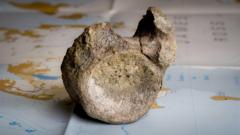
Researchers have identified a fossil stored in the British Antarctic Survey’s geology collection in Cambridge as the first dinosaur bone ever discovered in Antarctica. The specimen, a tail vertebra from a Titanosaur, was originally collected on James Ross Island and catalogued in 1985, but its true nature went unrecognized for decades until collections manager Dr Mark Evans recently examined it alongside thousands of other Antarctic specimens.
Paleontologists determined that the original field team likely mistook the fossil for a marine reptile bone. Upon closer inspection, Dr Evans recognized distinctive dinosaur characteristics and consulted Prof Paul Barrett from the Natural History Museum, who confirmed the identification. The vertebra displays a hollow on one end and a rounded protrusion on the other, creating the ball-and-socket joint structure unique to Titanosaurs—the group containing the largest land dinosaurs ever known.
Based on the bone’s dimensions, researchers estimate the Antarctic specimen came from a Titanosaur approximately 23 feet in length, making it either a juvenile or unusually small adult of its species. The creature lived 82 million years ago during the Late Cretaceous Period, when Antarctica featured a lush forest environment suitable for plant-eating dinosaurs. This discovery provides valuable insight into prehistoric ecosystems in Earth’s southernmost continent, where fossil records remain sparse and challenging to access beneath extensive ice coverage.
The finding was published in the journal Acta Palaeontologica Polonica and represents a significant addition to the limited record of dinosaur fossils found in Antarctica. While additional dinosaur remains have surfaced since the initial 1985 discovery, paleontological work on the continent remains difficult due to extreme environmental conditions and geological factors that obscure the prehistoric record.
Article Attribution | Read More at Article Source
Article summary produced by Claude AI