

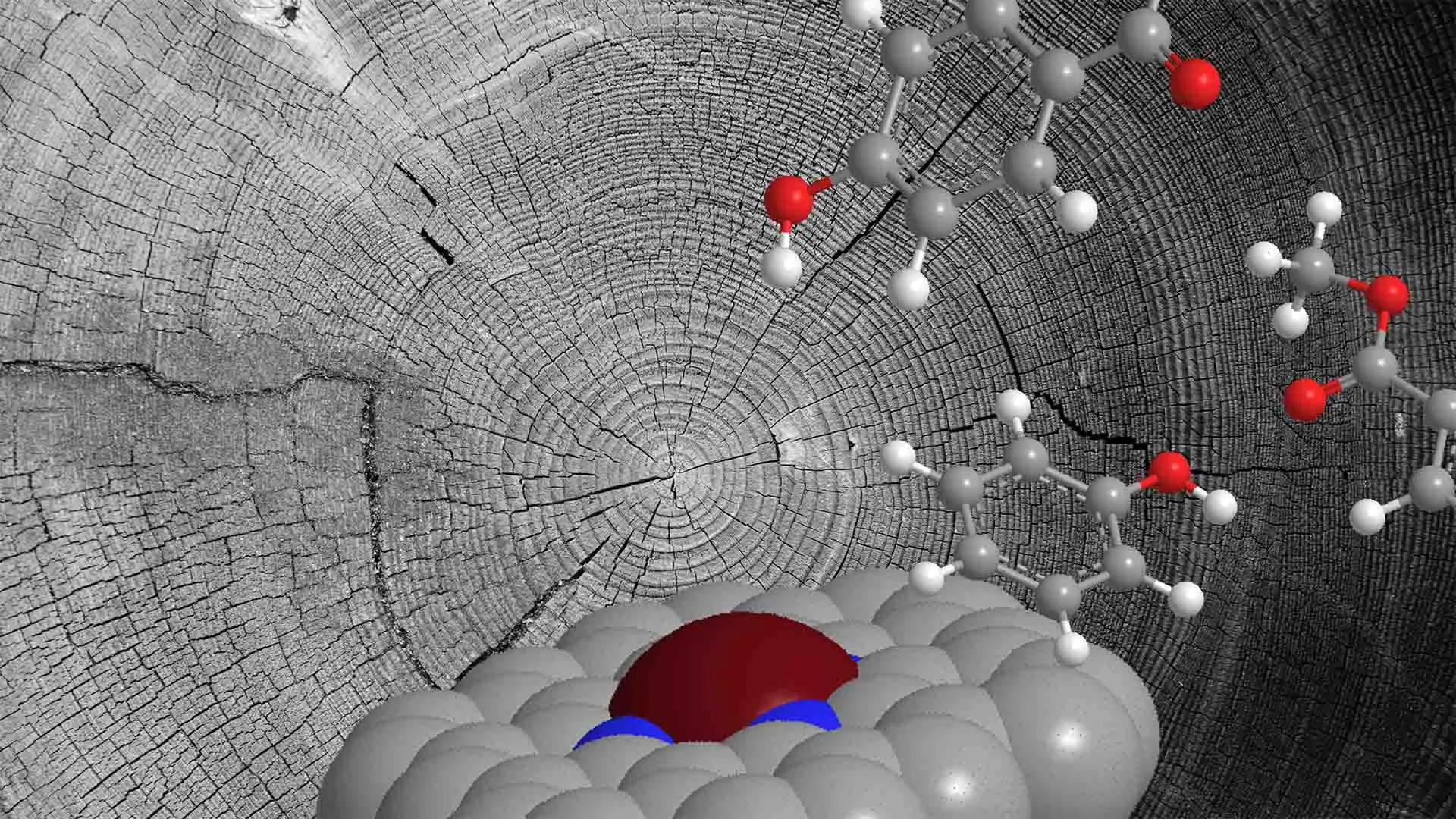
An international research team has created a single-atom catalyst designed to address long-standing challenges in processing lignin, a complex polymer that comprises up to 35 percent of agricultural and forestry waste. Lignin represents the largest renewable source of aromatic chemicals available in nature, but its complicated molecular structure has historically made it difficult to break down efficiently for industrial use.
The catalyst, detailed in a study published in ACS Catalysis, contains individual ruthenium atoms embedded within nitrogen-doped carbon material. By isolating the ruthenium atoms, the design achieves strong catalytic performance while requiring minimal quantities of metal, offering improved efficiency over conventional approaches. The research team, led by Dr. Christopher Parlett and including Xinyue Zhou and Yutao Jiang from the Department of Chemical Engineering, identified the specific atomic mechanisms responsible for breaking lignin’s strong chemical bonds.
The researchers determined that a particular atomic arrangement called a “Ru-N4 site” plays a crucial role in the catalytic process. These sites activate oxygen molecules, which then trigger the breaking of carbon-oxygen and carbon-carbon bonds within the lignin structure. Laboratory experiments combined with computational modeling allowed the team to map out the process in detail, showing how the catalyst first activates oxygen to create reactive species that subsequently attack and split the lignin into smaller molecules.
When tested with model compounds under optimized conditions, the catalyst converted nearly all lignin compounds and produced high yields of valuable chemical products, including phenol. The process operates under relatively mild conditions without requiring harsh chemicals, potentially enabling more sustainable chemical manufacturing approaches. Testing on real lignin samples from various biomass sources demonstrated the catalyst’s effectiveness in converting these materials into useful aromatic compounds suitable as precursors for fuels, plastics, and other products.
The findings could guide development of more efficient catalytic systems for biomass conversion and support a shift toward circular, biomass-based chemical production rather than reliance on traditional petroleum-derived processes.
Article Attribution | Read More at Article Source
Article summary produced by Claude AI