

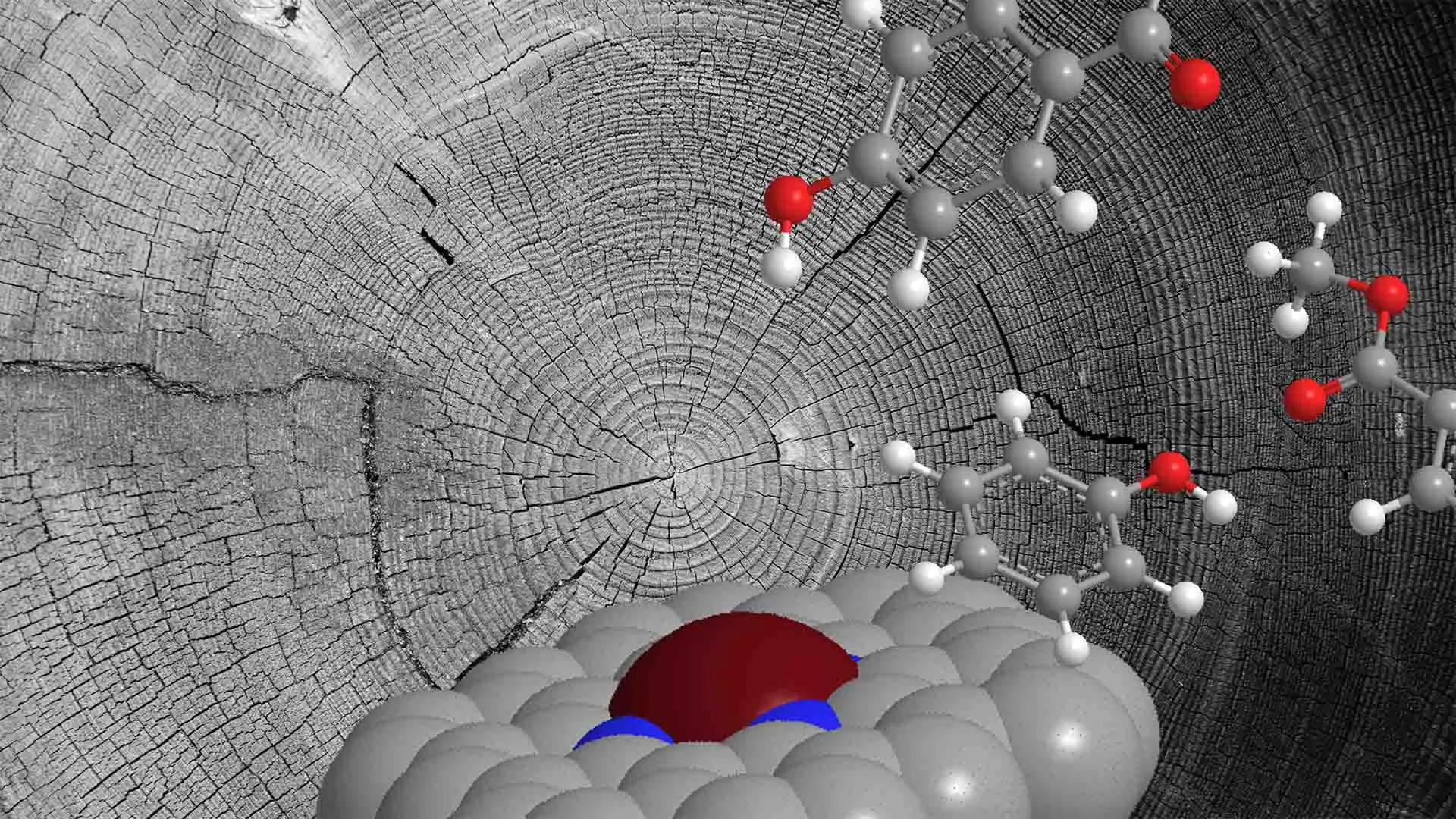
An international research team has created a catalyst designed to address long-standing challenges in converting lignin—a major component of agricultural and forestry waste—into useful chemical compounds. Lignin comprises up to 35% of plant biomass but has resisted efficient processing due to its complex molecular architecture.
The single-atom catalyst developed by Dr. Christopher Parlett, Xinyue Zhou, Yutao Jiang, and collaborators contains individual ruthenium atoms distributed throughout a nitrogen-doped carbon support material. This design maximizes catalytic efficiency while minimizing the amount of metal required, offering advantages over conventional multi-atom systems. The research, published in ACS Catalysis, identifies specific atomic arrangements called “Ru-N4 sites” as the key active components responsible for breaking the strong chemical bonds within lignin molecules.
Laboratory experiments combined with computational analysis revealed the catalyst’s mechanism of action. The Ru-N4 sites activate oxygen molecules, which then generate highly reactive species capable of cleaving both carbon-oxygen and carbon-carbon bonds in lignin, fragmenting it into smaller, more valuable compounds. When optimized, the catalyst achieved near-complete conversion of model lignin samples and produced high quantities of valuable products including phenol.
A significant advantage of the approach involves its use of relatively benign operating conditions without requiring corrosive or toxic chemicals. Testing extended beyond simplified model compounds to actual lignin samples from various biomass sources, demonstrating successful conversion into aromatic compounds suitable for producing fuels, plastics, and other materials. The molecular-level understanding of the catalyst’s function provides a foundation for designing increasingly effective systems for future applications.
The research advances the potential for more sustainable chemical manufacturing by making lignin-to-products conversion more practical and cost-effective, potentially supporting transitions from petroleum-based production toward renewable, biomass-derived chemical economies.
Article Attribution | Read More at Article Source
Article summary produced by Claude AI