

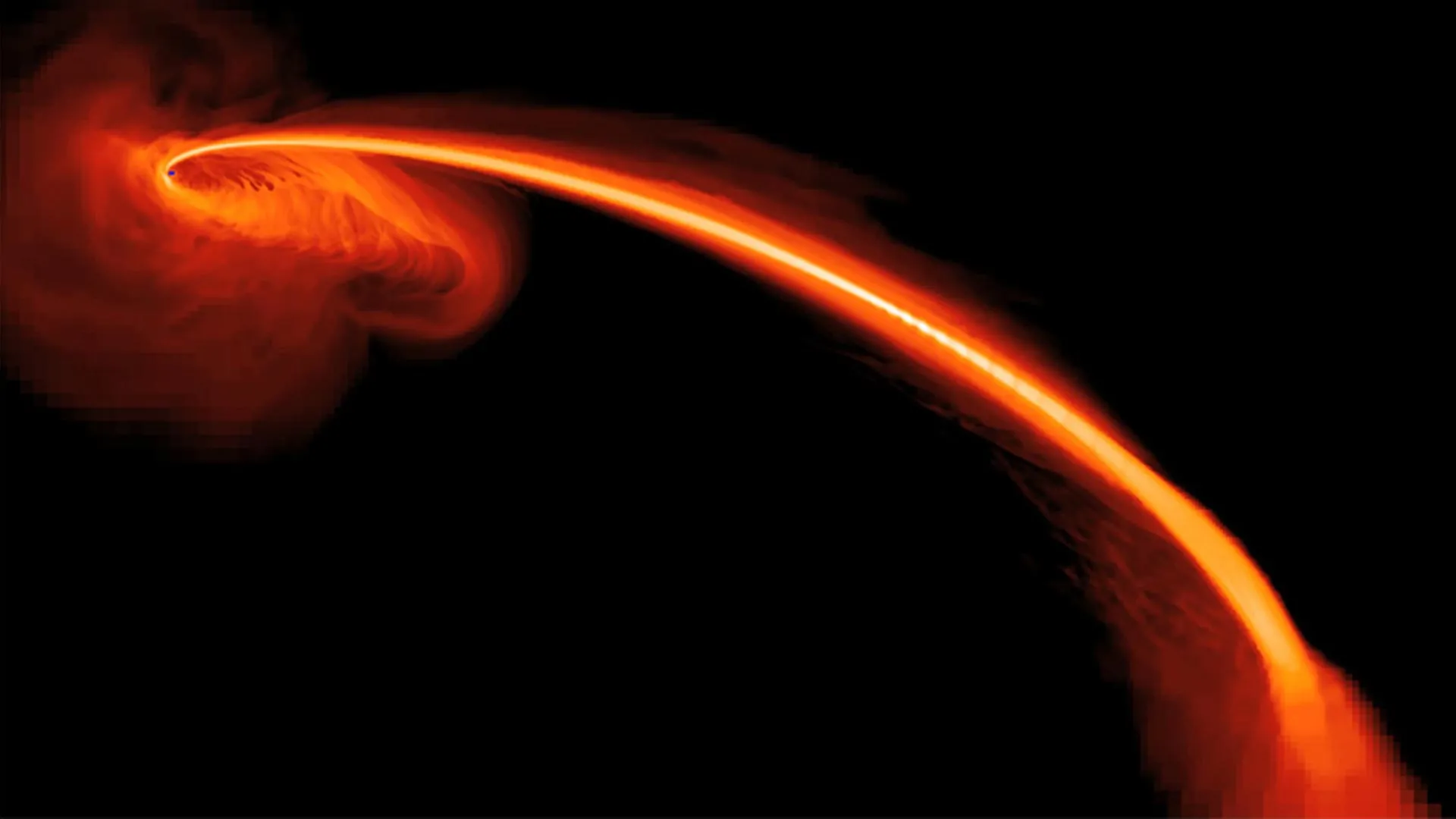
Supermassive black holes at the centers of most galaxies can destroy stars through tidal disruption events, where gravitational forces tear stellar material apart. When a star passes too close to a black hole, the resulting debris falls toward the black hole and releases light, temporarily illuminating the otherwise invisible region around it. Not all encounters result in complete destruction; some stars lose only outer material and return for additional close approaches in what astronomers call repeating partial tidal disruption events (rpTDEs).
Astronomers have identified roughly 10 such repeating systems, with four showing progressively dimmer flares across successive encounters. This pattern presented a theoretical puzzle, as previous simulations predicted that even with less material being stripped during each passage, the flares should maintain similar peak brightness levels. Research from astrophysicists at Syracuse University, published in The Astrophysical Journal, identified the missing element: a star that was already spinning rapidly before its first encounter with the black hole.
The study, led by doctoral student Ananya Bandopadhyay with postdoctoral researcher Benjamin Amend and associate professor Eric Coughlin, reveals how stellar rotation critically affects the dynamics of repeated tidal disruption. Previous work showed that a black hole’s tidal forces not only strip material from a star but also apply torque that increases the star’s rotation after each encounter. This accelerated rotation causes stripped material to return to the black hole more quickly, which had previously kept predicted flare brightness relatively constant across multiple encounters.
When researchers incorporated a star that was already rotating quickly before capture, the simulations changed dramatically. Such a star cannot be spun up significantly during subsequent passages. Without substantial increases in rotation, the timescale for stripped material to fall back to the black hole remains more constant, causing the peak fallback rate and resulting flare brightness to decrease as less material is stripped with each encounter. This matches observations of actual fading rpTDE systems.
The findings suggest these captured stars likely originated in extremely tight binary systems that were disrupted by the black hole’s gravity through a process known as the Hills mechanism. In this scenario, one star from a closely orbiting binary pair is ejected while the other becomes gravitationally bound to the black hole. Such compact binary configurations naturally produce rapidly rotating, tidally locked stars before black hole capture, providing a potential explanation for both the initial rapid rotation and the unusually tight orbits observed in repeating partial tidal disruption events.
Article Attribution | Read More at Article Source
Article summary produced by Claude AI