

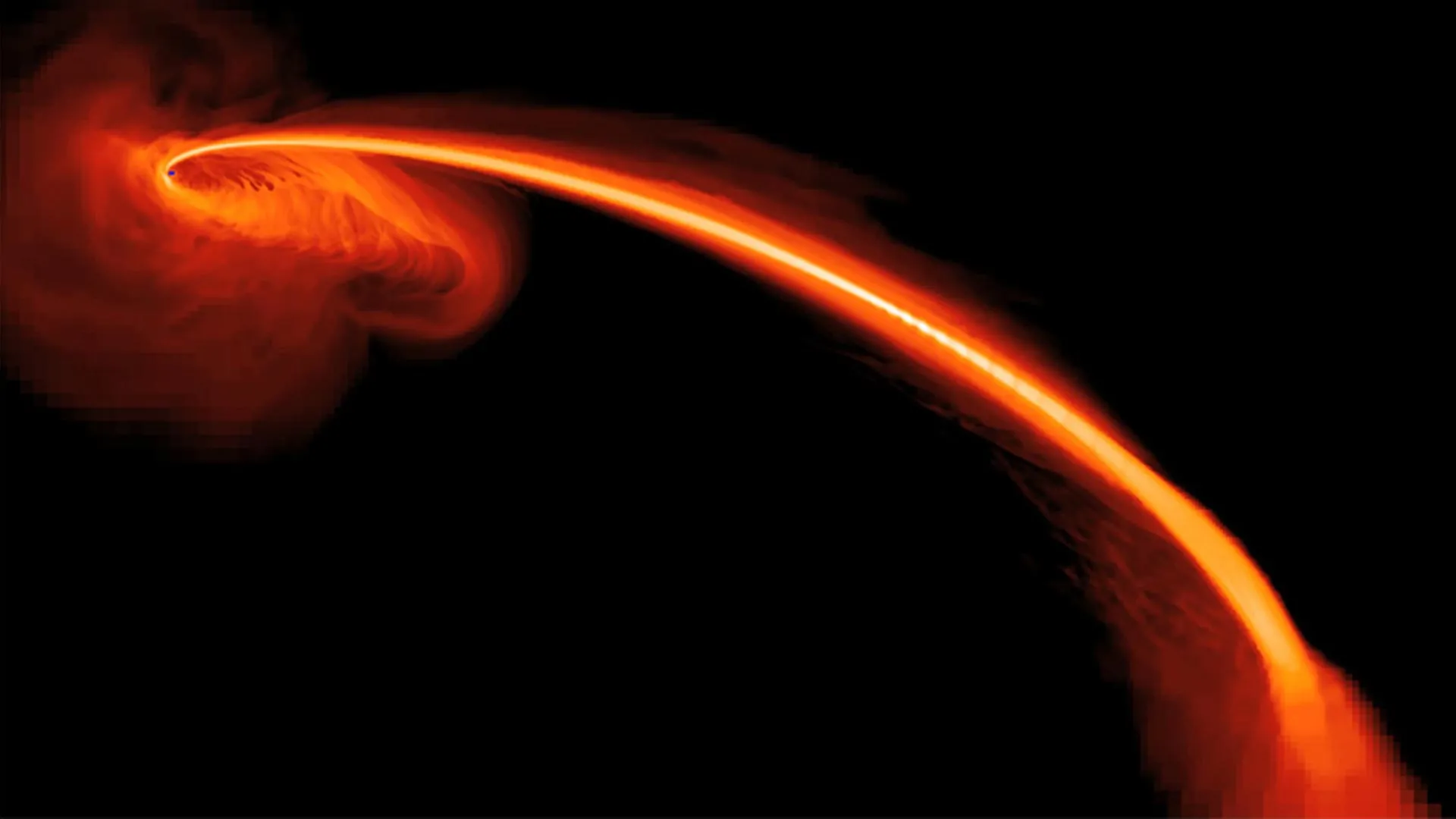
Supermassive black holes at galaxy centers can partially tear apart nearby stars without destroying them completely, allowing the stellar remnants to return for multiple close encounters. Each passage strips additional material from the star, generating bursts of light that astronomers can observe through wide-field surveys. These repeating partial tidal disruption events, or rpTDEs, provide unique opportunities to study the same star-black hole interaction multiple times.
However, observations of roughly 10 known repeating systems have revealed a puzzling pattern. While four of these systems show progressively dimmer flares with each encounter, previous computer simulations could not explain this behavior. When researchers modeled stars losing progressively less material during successive passes, the simulations still predicted flares of roughly equal brightness, contrary to astronomical observations.
Scientists at Syracuse University have proposed that a star’s initial rotation rate before its first encounter with the black hole may hold the key to solving this mystery. During close passages, the black hole’s gravitational forces apply torque to the star, causing it to spin faster. This increased rotation affects how quickly stripped material falls back toward the black hole. However, if a star was already rotating rapidly before the first encounter, subsequent tidal forces cannot spin it up as dramatically, changing the dynamics of material fallback and allowing predicted flare brightness to decrease over time.
The researchers suggest that rapidly spinning stars captured into tight orbits around supermassive black holes may originate from binary star systems. When two closely orbiting stars approach a black hole, its gravity can tear the pair apart while capturing one star into orbit. In very compact binaries, stars become tidally locked, rotating at extremely high speeds. Such a configuration would naturally produce a rapidly spinning star before its capture, potentially explaining both the observed rotation rates and the unusually tight orbits seen in rpTDE systems.
Article Attribution | Read More at Article Source
Article summary produced by Claude AI