

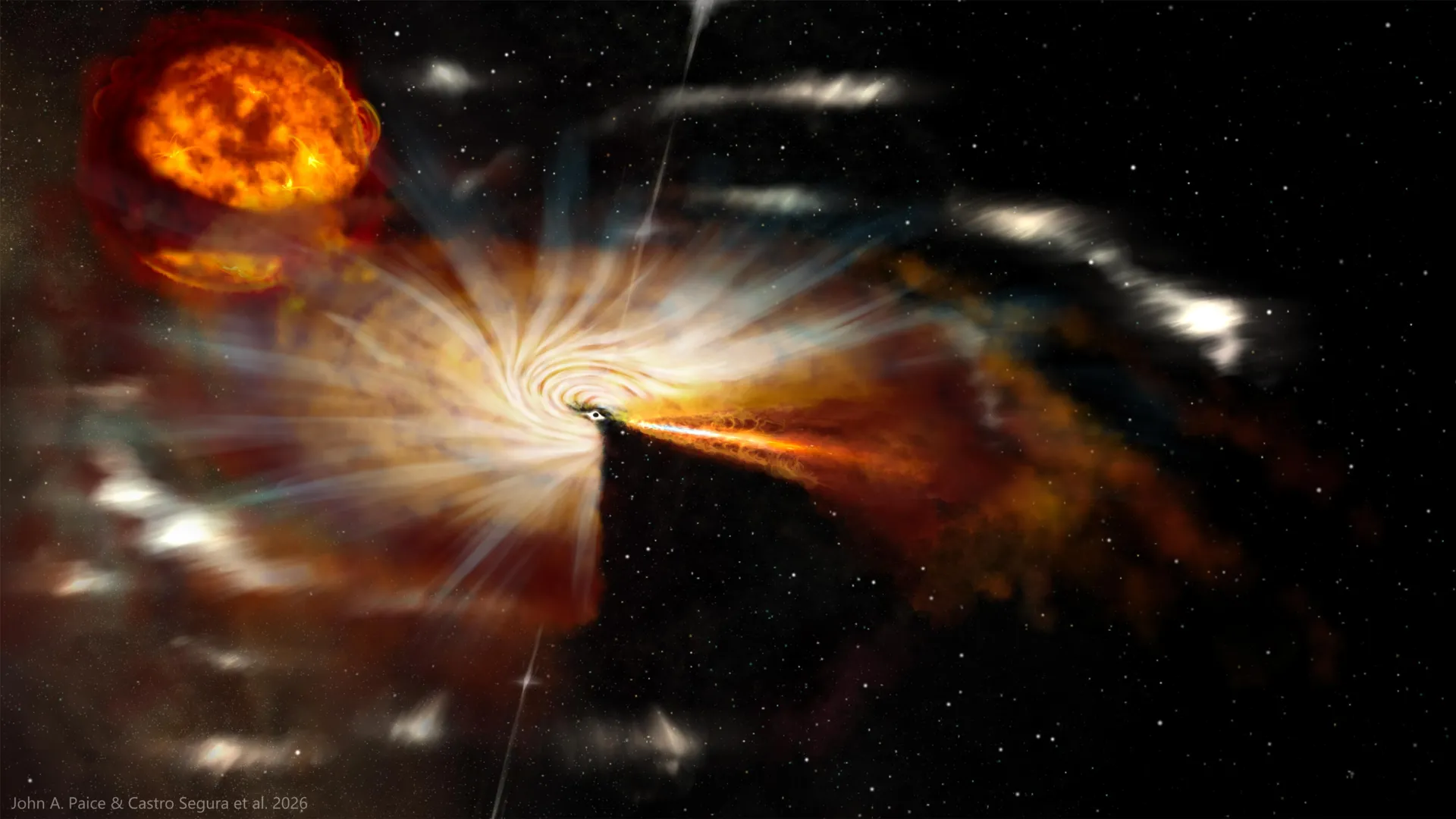
Researchers at the University of Warwick have documented detailed observations of a black hole system that challenge traditional assumptions about how these cosmic objects consume matter. Using the European Southern Observatory’s Very Large Telescope, the team monitored Swift J1727.8−1613 during a significant eruption in 2023, capturing one of the most comprehensive optical records of a black hole outburst to date.
The observations reveal that as the black hole drew material from a nearby companion star, it simultaneously expelled substantial quantities of gas back into space through jets and powerful winds. Rather than functioning as simple cosmic vacuum cleaners that indiscriminately swallow everything nearby, the system operated as a more complex processor that took in matter, transformed it, and returned a significant portion to the surrounding environment. The research team, led by Postdoctoral Fellow Dr. Noel Castro Segura, tracked the system through multiple stages of activity, providing an unusually detailed view of the inflow and outflow processes occurring simultaneously.
A particularly striking finding emerged after the black hole’s most active phase had subsided. Even when the system had dimmed to approximately one hundredth of its peak brightness, astronomers continued detecting dense gas being expelled from the region. This discovery indicates that powerful outflows may persist well beyond the dramatic initial outburst phase, suggesting the amount of material expelled could potentially equal or exceed the amount ultimately consumed by the black hole.
The implications of these findings suggest that black holes may be considerably less efficient at retaining consumed matter than previously believed. A substantial fraction of the material drawn toward a black hole may never actually cross the event horizon, instead being redirected into space through various ejection mechanisms. This understanding of black hole behavior as active systems that redistribute material throughout their surroundings may require scientists to reconsider how binary star systems evolve within galaxies and the role black holes play in shaping their cosmic environments.
Article Attribution | Read More at Article Source
Article summary produced by Claude AI