

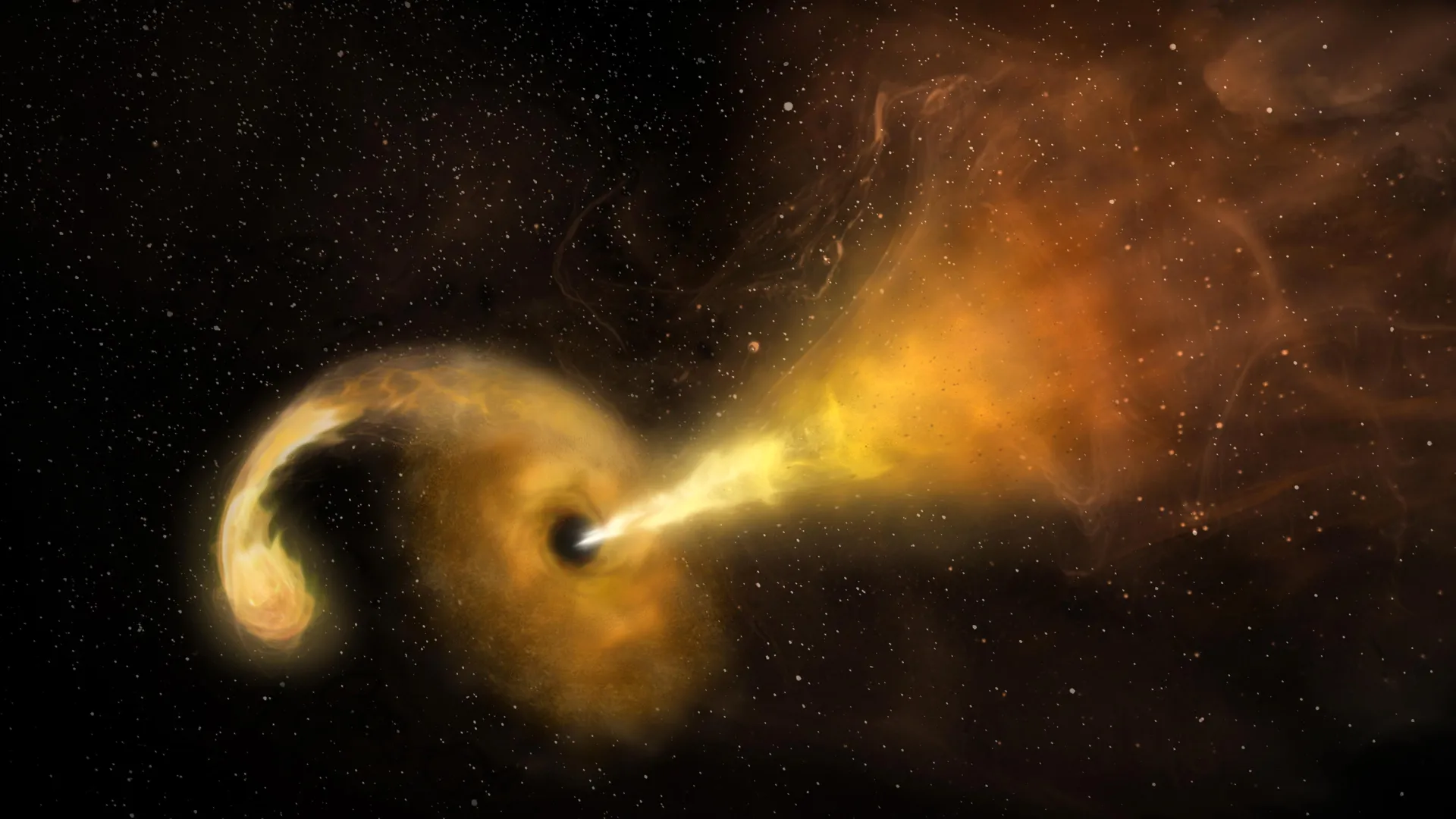
NASA’s Neil Gehrels Swift Observatory has identified an unusual tidal disruption event in which a supermassive black hole located unusually far from the center of a distant galaxy tore apart and consumed a nearby star. The black hole, roughly 1 million times the mass of the Sun, was discovered approximately 750 million light-years from Earth. This represents the first confirmed detection of such a star-shredding event occurring at such a great distance from a galaxy’s center, with the event happening more than 30,000 light-years from the host galaxy’s core.
The discovery began when the Zwicky Transient Facility detected an exceptionally bright flare in November 2025. At its peak intensity, the flare radiated with the brightness of approximately 10 billion suns and became brighter in ultraviolet light than the entire surrounding galaxy. Following the initial detection, the SOAR telescope in Chile examined the event’s spectrum, finding characteristics consistent with a tidal disruption event. NASA’s Swift Observatory then conducted ultraviolet and optical measurements, determining the flare’s temperature at approximately 54,000 degrees Fahrenheit, confirming the nature of the event.
The black hole’s distant location from the galactic center raises important questions about its origin. Researchers propose that the black hole likely originated at the center of another galaxy and may have been displaced through galactic mergers. In one scenario, multiple galaxies merged and their central black holes engaged in gravitational interactions that ejected the lightest black hole toward the outer regions. Alternatively, a dwarf galaxy may be in the process of merging with the larger system, with the displaced black hole originating from the smaller galaxy.
This discovery validates a new detection technique using artificial intelligence algorithms to identify tidal disruption events in unusual locations. Astronomers plan to apply this method to observations from the Vera C. Rubin Observatory and NASA’s upcoming Nancy Grace Roman Space Telescope to search for additional displaced black holes. Swift’s operations are temporarily suspended as the spacecraft awaits an orbital boost planned for later this summer, which could extend its operational lifespan and enable continued observations of similar phenomena.
Article Attribution | Read More at Article Source
Article summary produced by Claude AI