

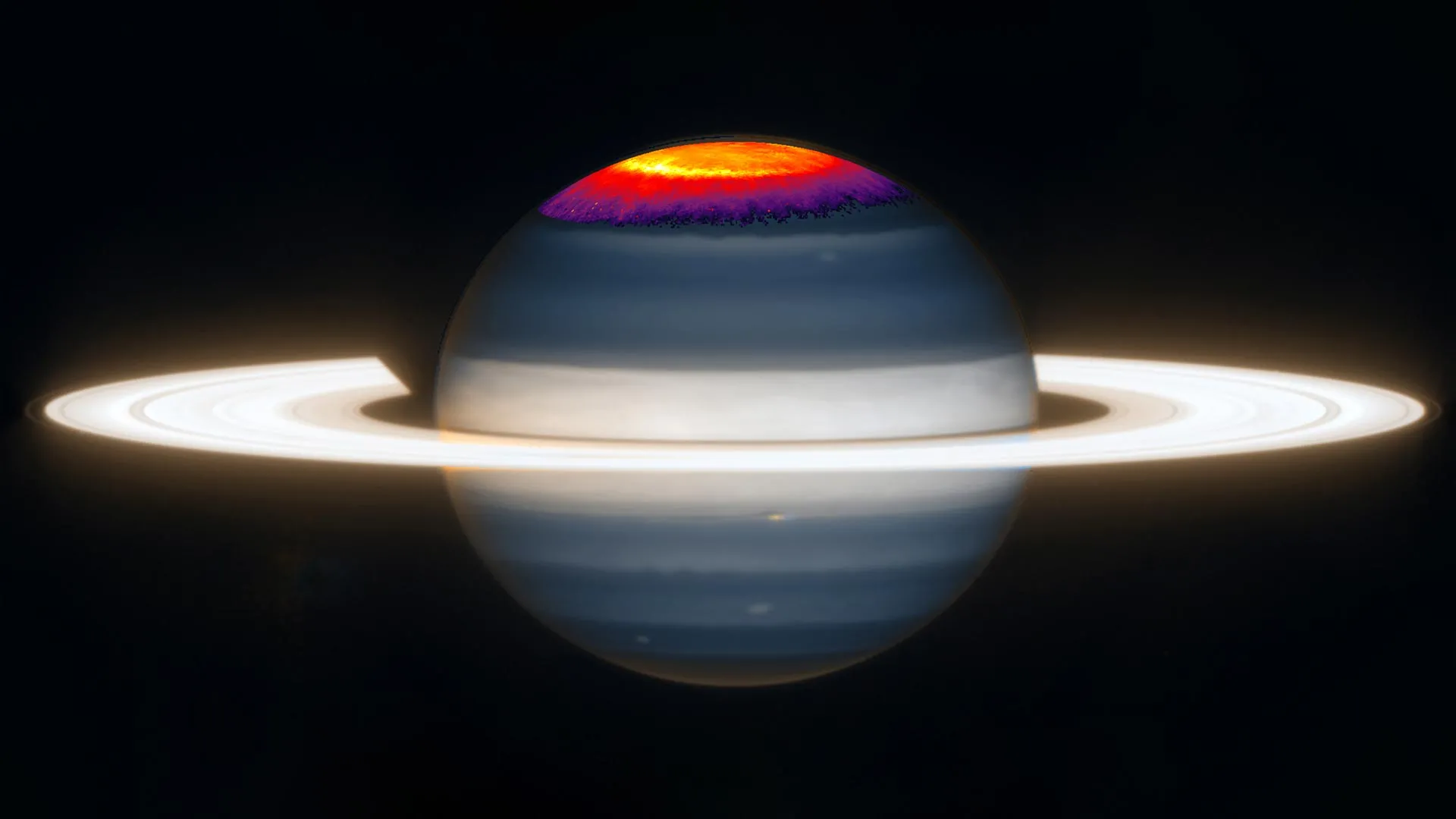
Researchers analyzing observations from NASA’s Cassini-Huygens mission have identified an unexpected characteristic of Saturn’s magnetosphere, the protective magnetic region surrounding the planet. The findings, published in Nature Communications and involving scientists from Lancaster University and collaborators, reveal that Saturn’s magnetospheric cusp—a funnel-shaped opening near the planet’s poles—is displaced significantly from the position observed at Earth.
The research, based on Cassini data collected between 2004 and 2010, shows that Saturn’s cusp is typically located between 13:00 and 15:00 local time on average, with some instances extending toward 20:00 local time. This contrasts sharply with Earth’s cusp, which is positioned near local noon. The displacement supports long-established theoretical predictions that the rapid rotation of massive gas giants can play a more dominant role than solar wind pressure in shaping their magnetospheric structures.
The key difference between the two planets relates to their rotational characteristics and composition. Earth completes one rotation in 24 hours, with its magnetosphere primarily shaped by the interplay between solar wind pressure and magnetic field pressure. Saturn, however, rotates much more rapidly, completing a full day in approximately 10.7 hours. Additionally, Saturn’s magnetosphere contains substantial amounts of ionized material sourced from the moon Enceladus, creating a more complex pressure balance that fundamentally alters the geometry of its magnetic protection bubble.
According to the research team, this unexpected cusp location carries significant implications for understanding Saturn’s auroral activity and the energetic processes occurring within its magnetosphere, particularly regarding magnetic reconnection—an explosive process that accelerates particles to extremely high energies. The discovery demonstrates that even after more than eight years since the Cassini mission concluded in 2017, the spacecraft’s data continues to yield valuable insights into planetary magnetospheric behavior and the ways in which planetary rotation can reshape space environments around giant planets.
Article Attribution | Read More at Article Source
Article summary produced by Claude AI