

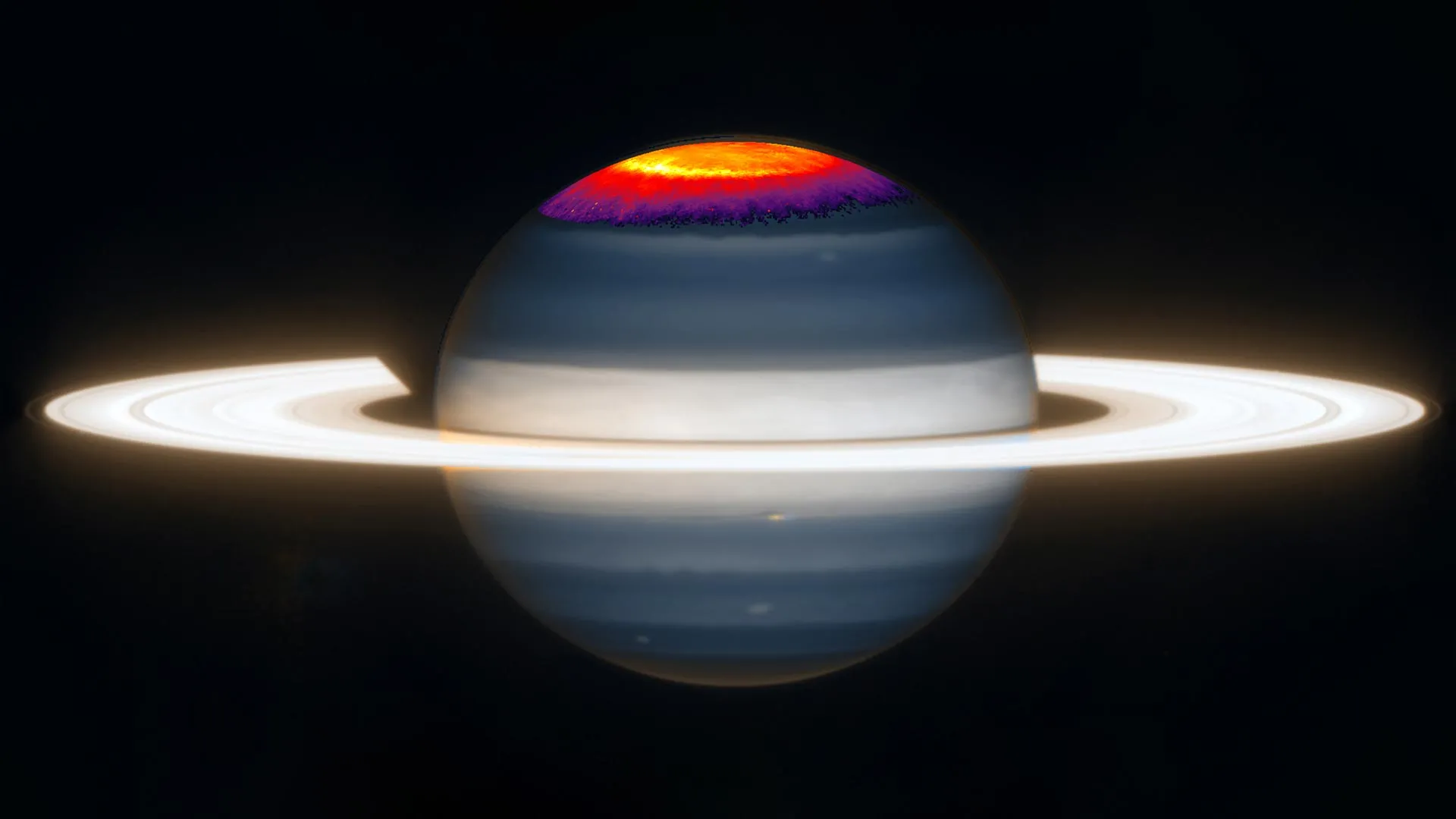
Researchers examining data from the Cassini-Huygens mission have identified an unexpected characteristic in Saturn’s magnetosphere, the region of space where the planet’s magnetic field shields against charged particles from the solar wind. The findings, published in Nature Communications and involving researchers from Lancaster University and colleagues, support long-established theoretical models regarding how rapidly rotating gas giants structure their protective magnetic environments.
The investigation focused on magnetospheric cusps, funnel-shaped openings near a planet’s poles that allow charged solar particles to penetrate a planet’s atmosphere more directly. By analyzing Cassini observations collected between 2004 and 2010, scientists determined that Saturn’s cusp location differs markedly from Earth’s. While Earth’s cusp remains positioned near local noon due to the balance between solar wind pressure and magnetic field pressure, Saturn’s cusp is displaced significantly toward afternoon and evening hours, typically between 13:00 and 15:00 local time, with some observations extending toward 20:00 local time.
This displacement reflects the combined influence of Saturn’s rotation rate and the composition of its magnetosphere. Saturn completes one rotation in approximately 10.7 hours, considerably faster than Earth’s 24-hour day. Additionally, Saturn’s magnetosphere contains substantial quantities of ionized material originating from its moon Enceladus. These factors—the planet’s rapid rotation combined with the abundant charged material in its magnetic environment—create pressure dynamics fundamentally different from those at Earth, causing the cusp to shift toward dusk.
The discovery carries implications for understanding Saturn’s auroral emissions and magnetic reconnection processes, which accelerate particles to high energies. According to researchers involved in the study, these findings enable improved theoretical frameworks for understanding how planetary magnetospheres interact with solar wind across different planetary systems. The analysis demonstrates that Cassini data, collected during the mission’s 2004 to 2017 operational period, continues to yield significant scientific insights years after the spacecraft’s mission concluded.
Article Attribution | Read More at Article Source
Article summary produced by Claude AI