

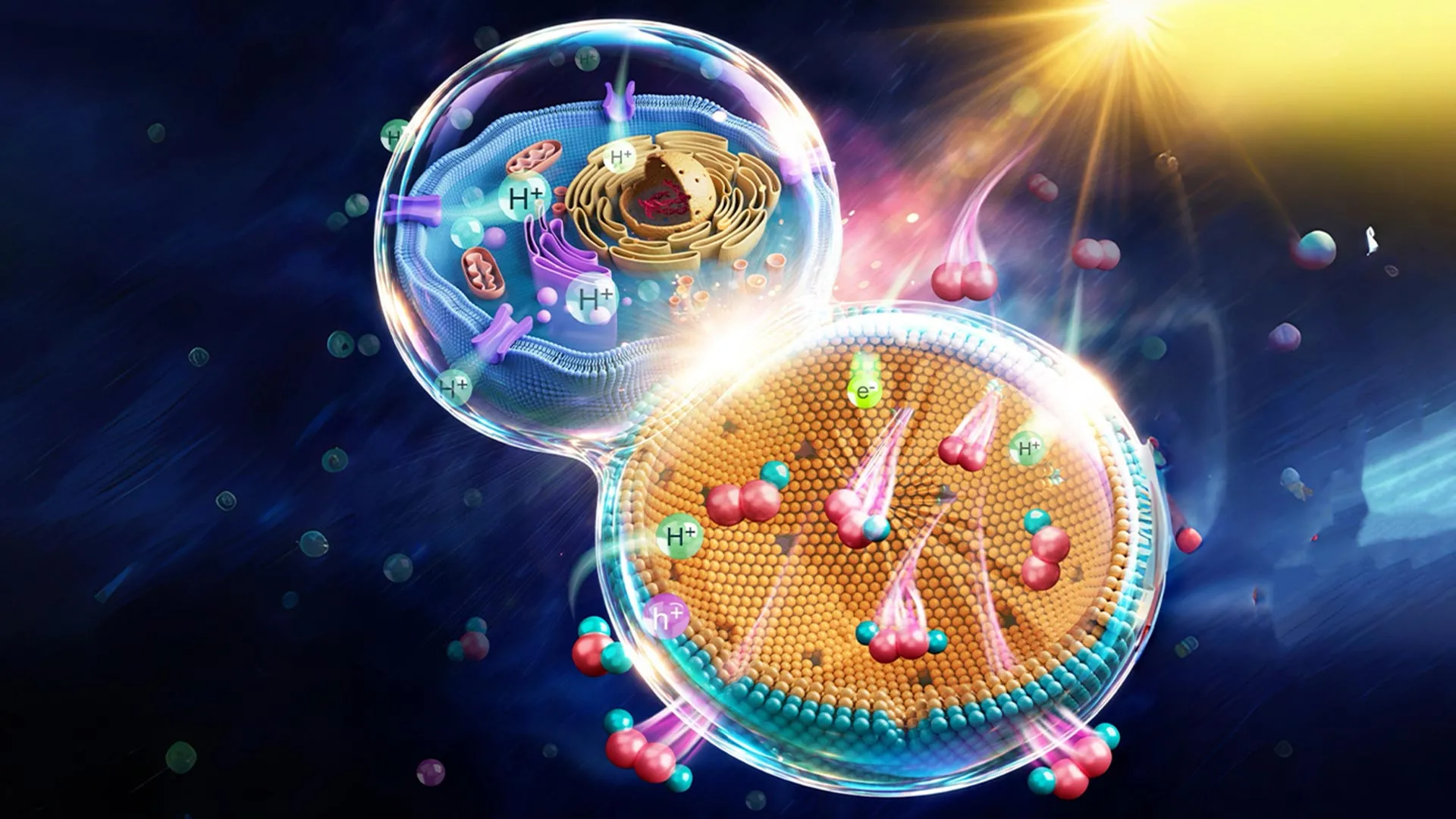
Scientists at the Dalian Institute of Chemical Physics and Inner Mongolia University have engineered a novel nanoreactor designed to replicate key organizational features found in living cells. The work, published in the Journal of the American Chemical Society, demonstrates how principles from cell biology can be applied to synthetic nanomaterials to achieve complex chemical transformations with improved efficiency.
The nanoreactor, composed of a hollow cadmium sulfide and polydopamine structure, incorporates two biomimetic elements that mimic cellular organization. The first is a dynamic chemical pair within the polydopamine shell that functions as a proton relay, accelerating the movement and transfer of protons and electrons in coupled reactions. The second feature is the nanoreactor’s compartmentalized design, which creates a confined hollow cavity surrounded by a porous shell. This architecture allows reactants to accumulate, supports molecular movement, and captures incoming light energy more effectively than conventional systems.
When exposed to visible light in an aqueous environment, the nanoreactor achieved hydrogen peroxide synthesis at a rate of 3.24 millimoles per gram of catalyst per hour, with a solar-to-chemical energy conversion efficiency of 1.2%. Researchers employed multiple analytical techniques including real-time spectroscopy, photochemical measurements, computer simulations, and theoretical modeling to understand the underlying mechanisms driving the photocatalytic process.
To enhance practical applicability, the team embedded the nanoreactors into a sodium alginate hydrogel matrix, creating solid, reusable catalysts capable of continuously producing hydrogen peroxide under natural sunlight while maintaining consistent performance across multiple uses. The research represents a step toward artificial photosynthesis systems and synthetic chemistry applications powered by renewable solar energy.
Article Attribution | Read More at Article Source
Article summary produced by Claude AI