

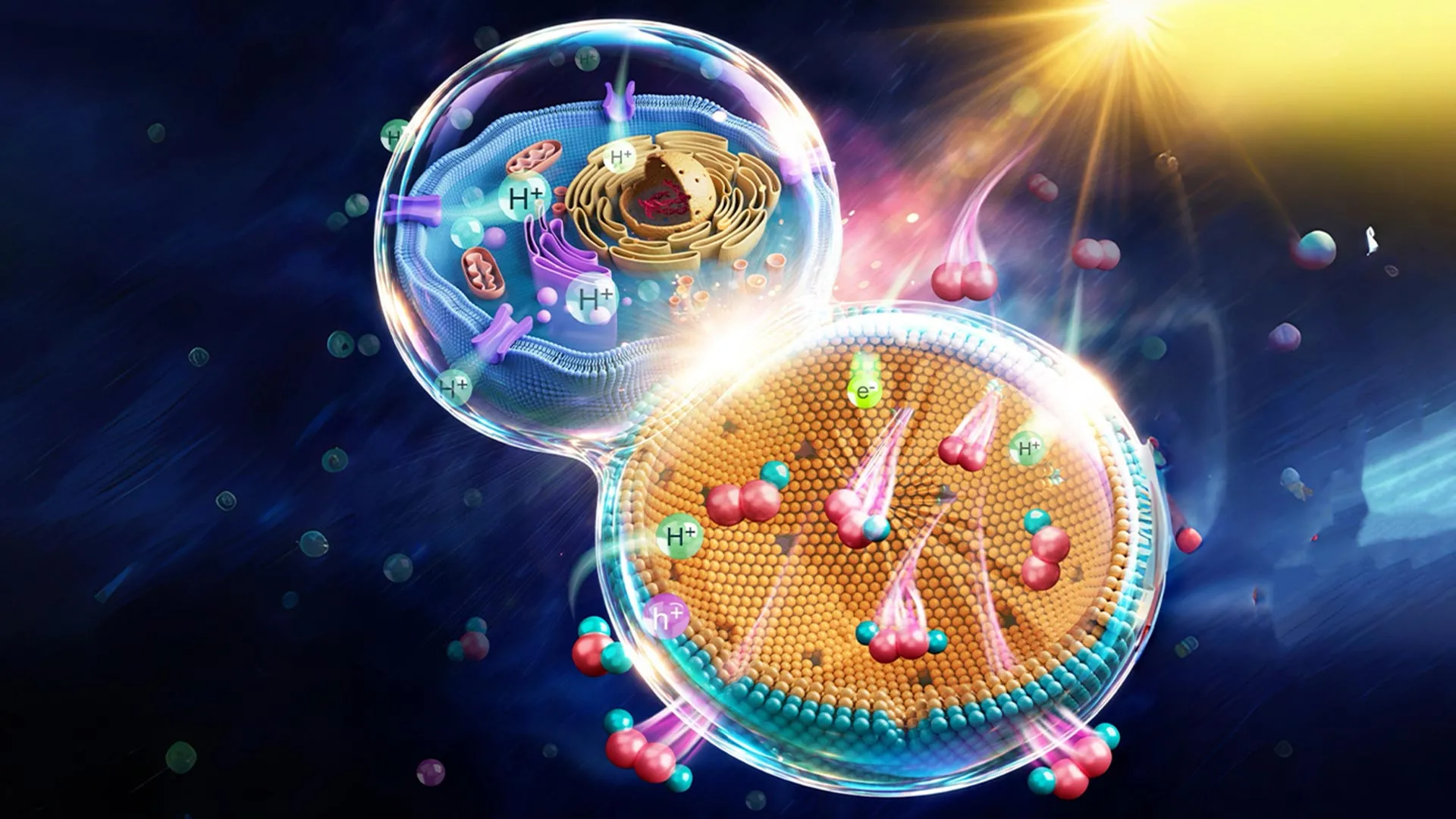
Scientists at the Dalian Institute of Chemical Physics have designed a hollow CdS@polydopamine nanoreactor that replicates key organizational features found in living cells. The research, published in the Journal of the American Chemical Society, was conducted by Prof. LI Can’s team in collaboration with Prof. Jian Liu at Inner Mongolia University. This work represents an advance in nanocell engineering, a field focused on creating synthetic nanomaterials that perform complex chemical reactions with the precision and efficiency characteristic of biological systems.
The nanoreactor incorporates two biomimetic design elements. The first is a catechol/o-benzoquinone redox pair embedded in the polydopamine shell that functions as a proton relay, accelerating proton-coupled electron transfer. The second is a compartmentalized structure consisting of a hollow cavity surrounded by a porous shell, which creates a confined reaction environment that accumulates reactants and enhances light absorption.
When exposed to visible light in aqueous solution, the nanoreactor demonstrated a hydrogen peroxide photosynthesis rate of 3.24 mmol gcat.-1 h-1 and achieved a solar-to-chemical conversion efficiency of 1.2%. The system balances the kinetics of oxygen reduction and water oxidation, two half-reactions necessary for hydrogen peroxide production. Researchers used in situ spectroscopy, photochemical analysis, simulations, and theoretical calculations to characterize the Z-scheme heterojunction-based photocatalytic mechanism driving the reaction.
The team further enhanced the system’s practical utility by embedding the nanoreactors in a sodium alginate hydrogel matrix, creating solid, reusable photocatalysts capable of sustained hydrogen peroxide synthesis under natural sunlight. According to Prof. Li, the approach provides new possibilities for artificial photosynthesis, energy catalysis, and synthetic chemistry applications by enabling synthetic materials to increasingly replicate sophisticated cellular functions.
Article Attribution | Read More at Article Source
Article summary produced by Claude AI