

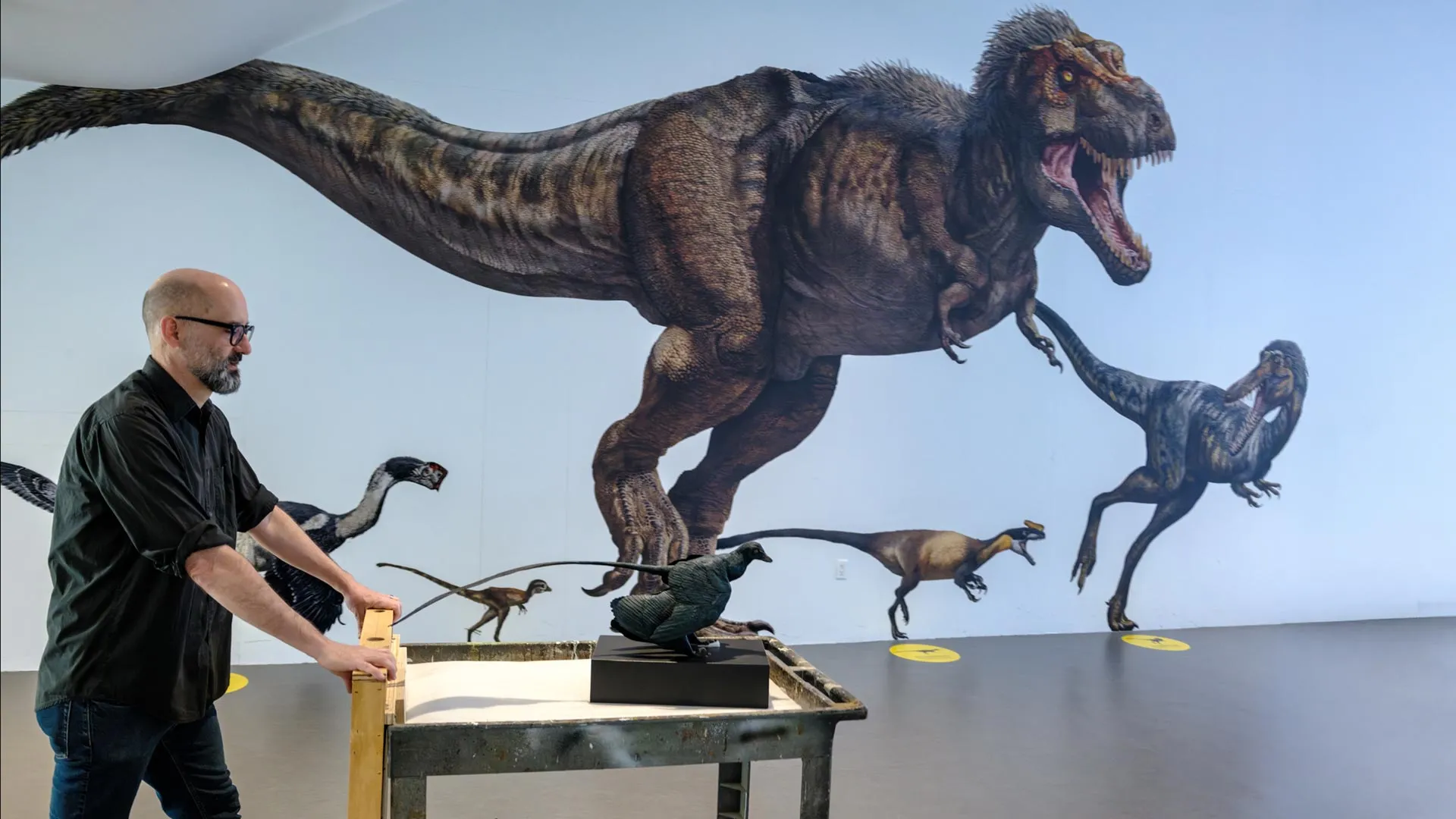
Scientists from the American Museum of Natural History and Princeton University have published findings examining why dinosaurs, despite reaching enormous proportions, apparently never evolved to become extremely small. The research, appearing in the journal Evolution, employed mathematical models to investigate how body size changed throughout vertebrate evolution.
The contrast between ancient and modern animals is notable. The largest dinosaurs exceeded 80 tons in weight, yet the smallest known dinosaurs outside the bird lineage weighed approximately one pound, roughly equivalent to a large rabbit. This represents a significant difference from contemporary species: approximately 75 percent of living mammal species and 90 percent of living bird species are smaller than the smallest known non-avian dinosaurs. Other modern vertebrates achieve far more extreme miniaturization, including the bee hummingbird at 1.75 grams and the dwarf gecko at 0.15 grams.
When researchers applied their physiological models to various vertebrate groups, the framework successfully predicted body size patterns in mammals, birds, and turtles. However, the models failed to explain why non-avian dinosaurs remained relatively large despite varying physiological conditions. This suggests that factors beyond physiology influenced dinosaur size evolution. The researchers propose that ecological pressures, particularly competition with early small mammals, may have prevented dinosaurs from occupying the tiny ecological niches that modern vertebrates frequently inhabit.
An alternative explanation—that tiny dinosaur fossils simply went undiscovered—appears unlikely according to the research team. Fossil sites containing dinosaurs frequently preserve much smaller animals including mammals, lizards, and amphibians, making it probable that genuinely tiny dinosaurs would have left some fossil evidence had they existed in significant numbers.
Interestingly, birds escaped this apparent size constraint. Birds evolved from dinosaurs but achieved body sizes far smaller than any other dinosaur group, possibly because powered flight opened new ecological opportunities unavailable to terrestrial relatives. This distinction highlights a puzzling evolutionary pattern: the ancestors of dinosaurs could be tiny, their modern descendants can be tiny, yet dinosaurs themselves appeared unable to achieve miniature body sizes.
Article Attribution | Read More at Article Source
Article summary produced by Claude AI