

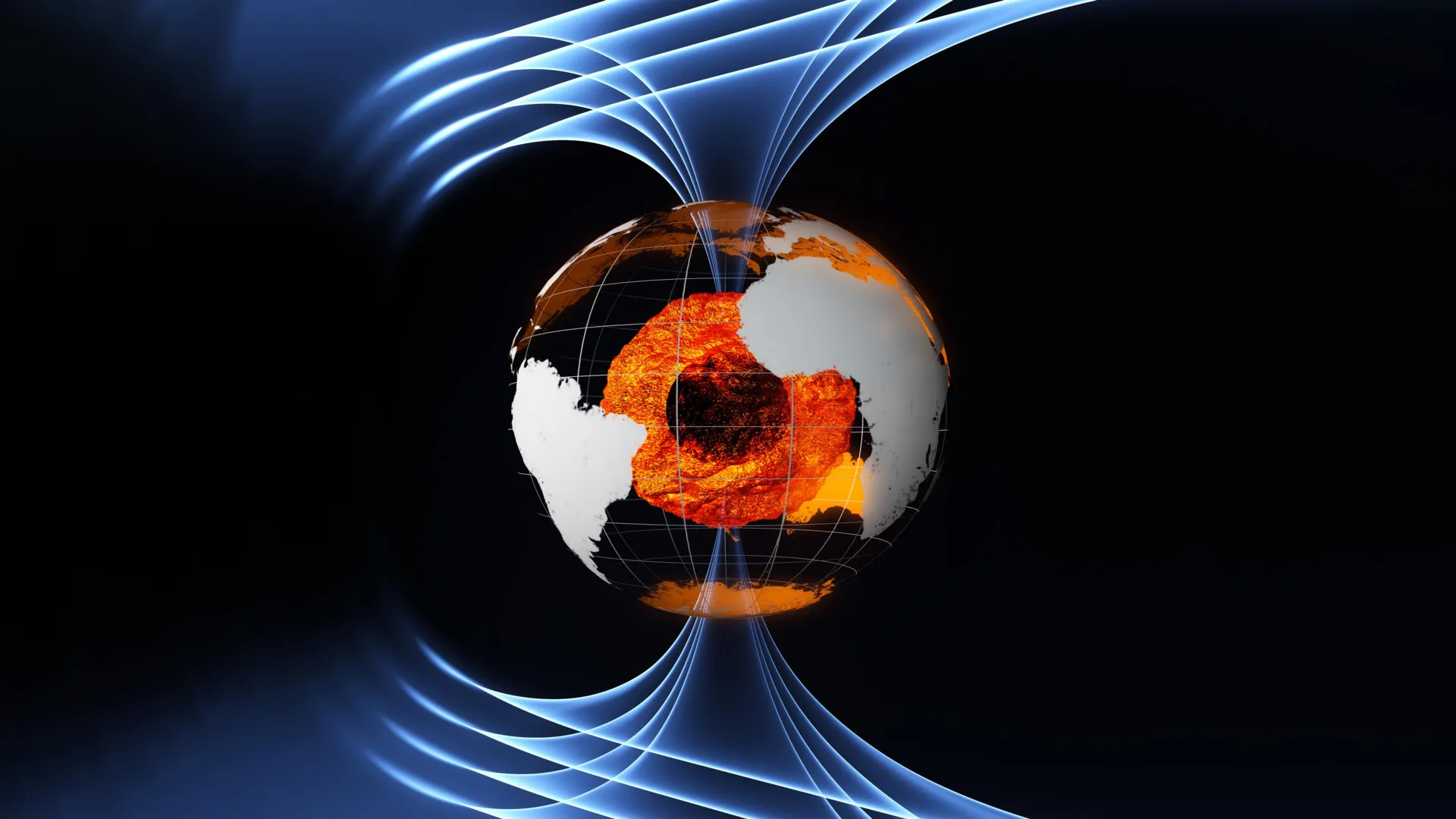
Researchers have identified a significant shift in the movement of Earth’s outer core located approximately 2200 kilometers below the surface. For years, observations indicated that liquid iron in this region primarily flowed toward the west. However, in 2010, a large mass of molten material beneath the Pacific Ocean abruptly began moving eastward instead, representing a dramatic departure from the established pattern.
Scientists remain uncertain about what triggered this reversal. To investigate the phenomenon more thoroughly, researchers combined satellite measurements from multiple missions, including the European Space Agency’s Swarm and CryoSat satellites, with ground-based observations spanning from 1997 through 2025. The comprehensive analysis, published in the Journal of Studies of Earth’s Deep Interior, documented the precise timing and extent of the flow reversal. According to the research, the eastward movement has intensified and then weakened since its initial emergence, with the strongest activity occurring several years before the present date.
The discovery challenges previous scientific understanding of core dynamics. Researchers had generally assumed that large-scale circulation patterns in the outer core remained relatively stable over extended periods. The Pacific reversal suggests that these systems can shift dramatically over surprisingly short timescales, measured in just a single decade. The findings have prompted questions about whether the reversal represents a temporary fluctuation, part of a recurring cycle, or a permanent shift in core circulation patterns.
The research also indicates potential connections between the outer core reversal and simultaneous changes occurring in Earth’s inner core, as detected through geological and seismic measurements. Scientists hypothesize that these separate regions may be dynamically linked. The liquid iron movement in the outer core generates the planet’s magnetic field, which shields Earth’s atmosphere and technological infrastructure from harmful solar radiation. Understanding how and why the core evolves thus carries implications for navigation systems, space weather modeling, and broader comprehension of Earth’s internal functioning.
Article Attribution | Read More at Article Source
Article summary produced by Claude AI