

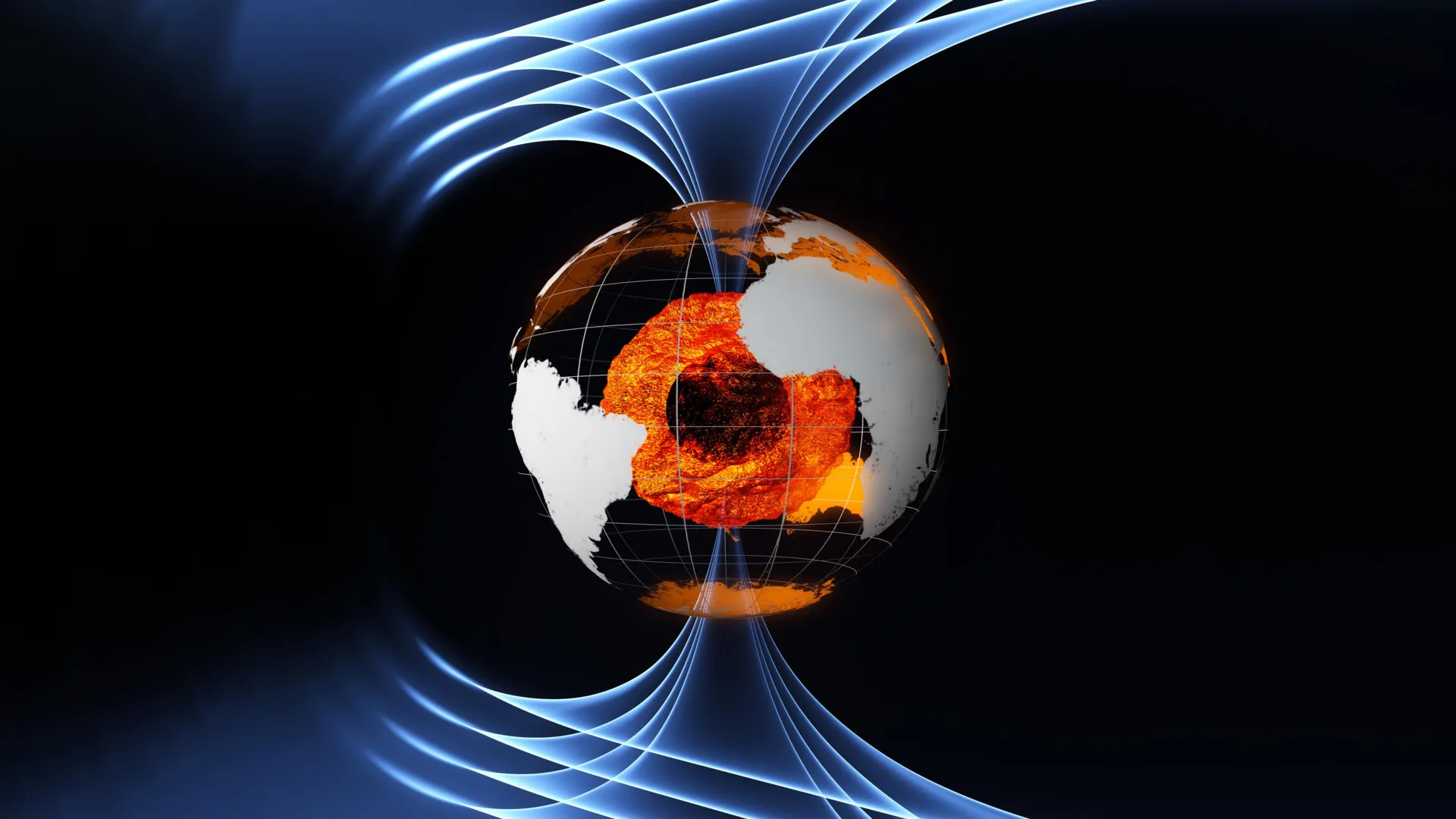
Researchers studying Earth’s outer core have identified a significant shift in the circulation patterns of molten iron deep beneath the Pacific Ocean. Beginning in 2010, a large region of electrically conducting liquid material changed direction dramatically, moving strongly eastward instead of its previously observed weak westward flow. The cause of this reversal remains unexplained by the scientific community.
The discovery was made possible through data collected by European Space Agency satellites, particularly the Swarm and CryoSat missions, combined with ground-based measurements spanning from 1997 through 2025. Analysis published in the Journal of Studies of Earth’s Deep Interior examined observations from multiple satellite systems including Germany’s CHAMP mission and the Ørsted mission. The research revealed that scientists had underestimated how rapidly large-scale circulation in the outer core could change, as the system was generally considered relatively stable.
Lead researcher Frederik Dahl Madsen of the University of Edinburgh noted that the reversal raises fundamental questions about the behavior of Earth’s interior. Scientists are now investigating whether the shift represents a temporary fluctuation, part of a cyclical pattern, or a new permanent state for core circulation. Additionally, the research indicates the strong eastward flow has weakened since 2020, suggesting the reversal may be temporary or part of a longer natural cycle.
The findings also suggest possible connections between outer core activity and changes occurring in Earth’s inner core. The timing of the Pacific reversal appears related to shifts observed through geodesy and seismology studies. Understanding these deep interior processes is significant because circulating molten iron in the outer core generates Earth’s magnetic field, which protects the planet from solar radiation and influences navigation systems and spacecraft operations.
Satellite measurements revealed wave-like accelerations and rapidly shifting flow structures that would have been difficult to detect using conventional ground-based observatories. Continued monitoring through future satellite missions will be essential to determine how core circulation evolves and to develop more comprehensive models of Earth’s magnetic field dynamics.
Article Attribution | Read More at Article Source
Article summary produced by Claude AI