

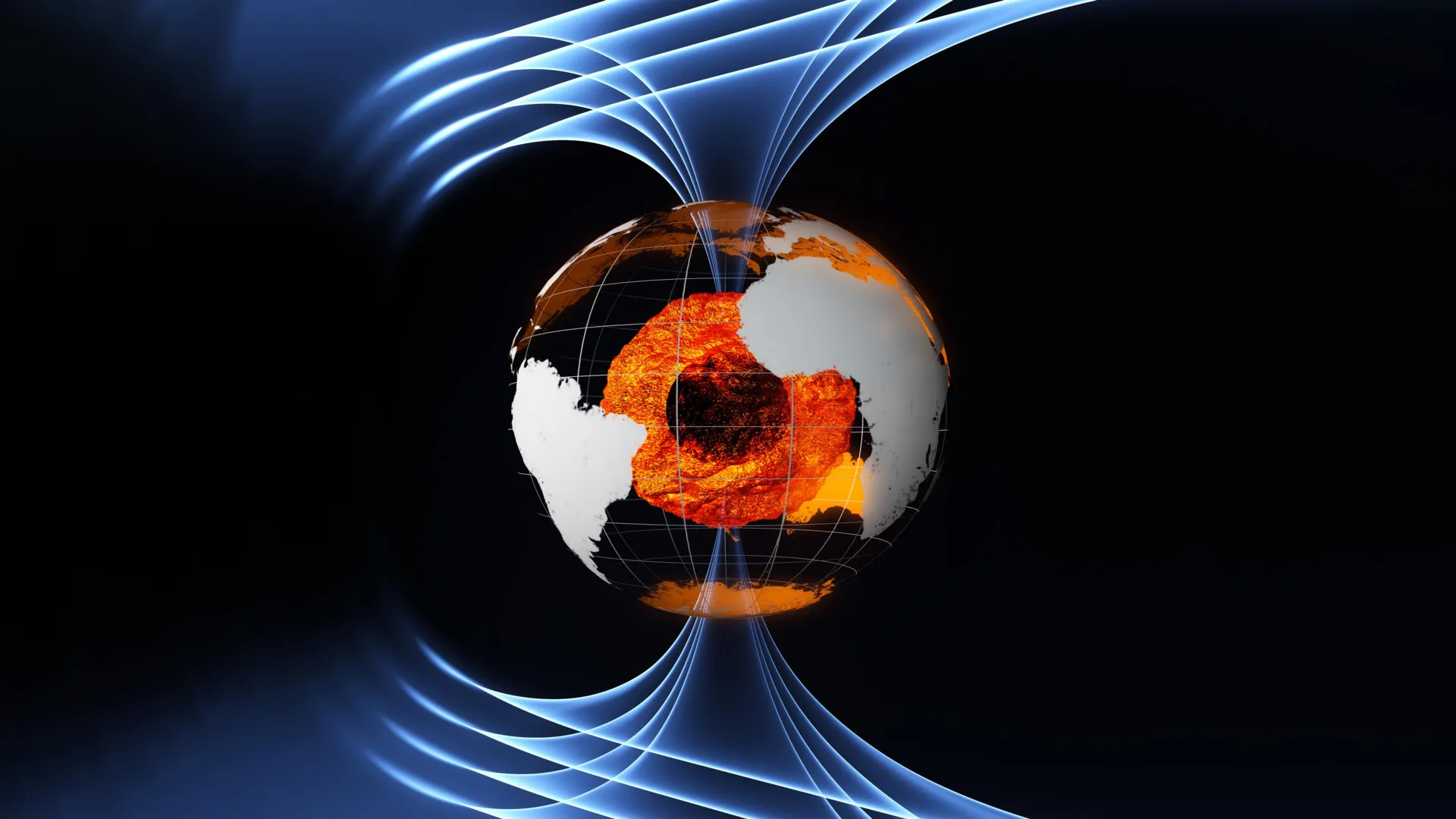
Researchers studying Earth’s molten outer core have identified a significant shift in the movement of liquid iron beneath the Pacific Ocean. Located approximately 2200 kilometers below the surface, this electrically conducting material plays a crucial role in generating the planet’s magnetic field. Analysis of satellite data spanning from 1997 through 2025 revealed that a large region of iron-rich fluid beneath the equatorial Pacific transitioned from a weak westward flow to a strong eastward flow in 2010, marking a dramatic departure from long-observed patterns.
The discovery, published in the Journal of Studies of Earth’s Deep Interior, was made possible through observations from multiple satellite missions, including ESA’s Swarm and CryoSat missions, as well as data from Germany’s CHAMP mission and the Ørsted mission. Scientists had generally believed that large-scale circulation in the outer core remained relatively stable over extended periods. The sudden reversal challenges this understanding and suggests that the system can undergo significant changes much more rapidly than previously thought. Lead researcher Frederik Dahl Madsen of the University of Edinburgh noted that the findings raise questions about whether the reversal represents a temporary fluctuation, part of a repeating pattern, or a new stable state for core circulation.
Recent analysis indicates that the strong eastward flow has weakened since 2020, suggesting the reversal may be temporary or part of a longer natural cycle. Researchers have also identified potential connections between the outer core activity and simultaneous changes occurring in Earth’s inner core, though the precise relationship remains under investigation. The satellite measurements revealed wave-like accelerations and rapidly shifting flow structures that would have been difficult to detect using traditional ground-based observations alone.
These deep interior changes do not pose direct risks to people or climate systems but are important for understanding Earth’s fundamental functioning. The movement of liquid iron in the outer core generates the magnetic field that shields the planet from harmful solar radiation. As this field continues to evolve, understanding core dynamics becomes increasingly relevant for navigation systems, spacecraft operations, and space weather modeling. Future satellite observations will be essential for monitoring how these flows develop and for refining scientific understanding of Earth’s complex internal dynamics.
Article Attribution | Read More at Article Source
Article summary produced by Claude AI