

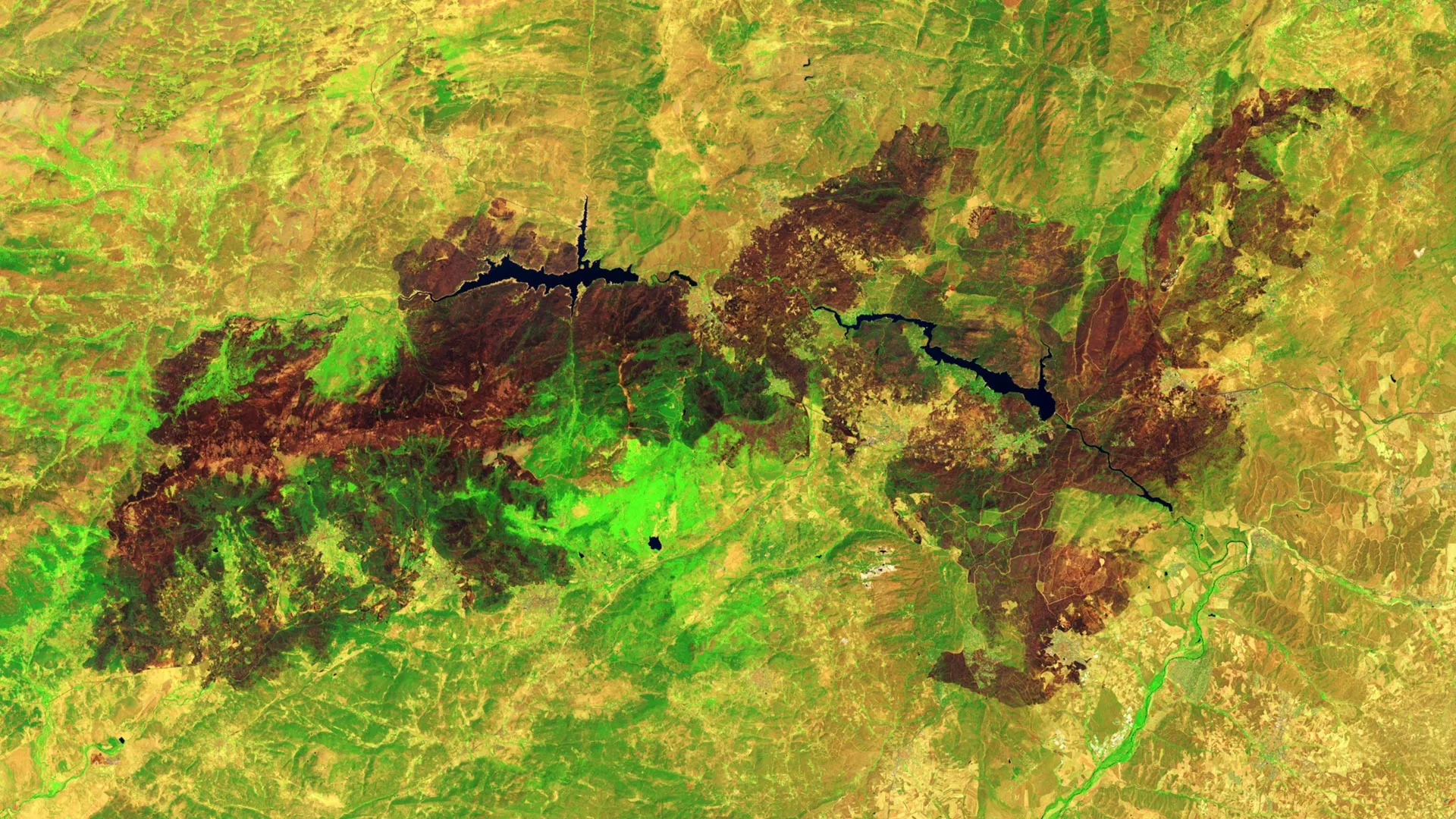
Wildfires that spread across Spain and France in July 2026 ranked among the most severe fire events in either country within recent decades. The most destructive outbreaks occurred in southwestern France’s Gironde Department and in Spain’s Ávila and Madrid provinces during the middle of the month. Hundreds of thousands of residents were forced to leave their homes, and hundreds of structures were destroyed by the advancing flames.
Spanish authorities confirmed that the fire centered in Ávila consumed approximately 50,000 hectares, establishing a new record as the largest wildfire in Spain’s documented history. This surpassed a previous significant fire from 2025. NASA satellite imagery first identified the Ávila fire near Burgohondo on July 22 and July 23. By July 24, this fire had merged with additional blazes in neighboring regions, combining to burn 77,000 hectares total. Imagery captured later in the month showed extensive destruction across the affected landscape, with reservoirs and surrounding infrastructure among the hardest-hit areas.
In France, a comparable crisis unfolded west of Bordeaux in the southwestern portion of the country. One of the most significant French fires of the decade affected more than 42,000 hectares and caused severe damage to the village of Le Porge. By late July, the cumulative area burned across France exceeded 90,000 hectares, representing the largest area lost to fire in the country within recent decades according to European Forest Fire Information System data.
Researchers with The State of Wildfires Project identified several meteorological factors that created dangerous conditions for rapid fire spread. An unusually wet winter had promoted thick vegetation growth across grasslands, shrublands, and forest understories. Subsequent heat waves and drought then dried this accumulated vegetation into highly flammable fuel. Strong winds with speeds reaching 65 kilometers per hour further accelerated the fires’ progression across the landscape.
The intensity of the southwestern French fires reached a notable threshold on July 25 when firefighters documented the formation of a pyrocumulonimbus, a rare type of towering cloud generated by the fires’ convective energy. International specialists monitoring these phenomena indicated this represented the first recorded instance of such a cloud formation in France, though occasional occurrences have been documented in Spain and Portugal in recent years. Thousands of firefighters and military personnel engaged in suppression efforts across both nations, employing aircraft for water and retardant drops while ground crews constructed firebreaks. By late July, authorities had begun lifting evacuation orders as crews gained control, though meteorologists cautioned that elevated fire danger would persist due to expected continuation of hot and dry conditions.
Article Attribution | Read More at Article Source
Article summary produced by Claude AI