

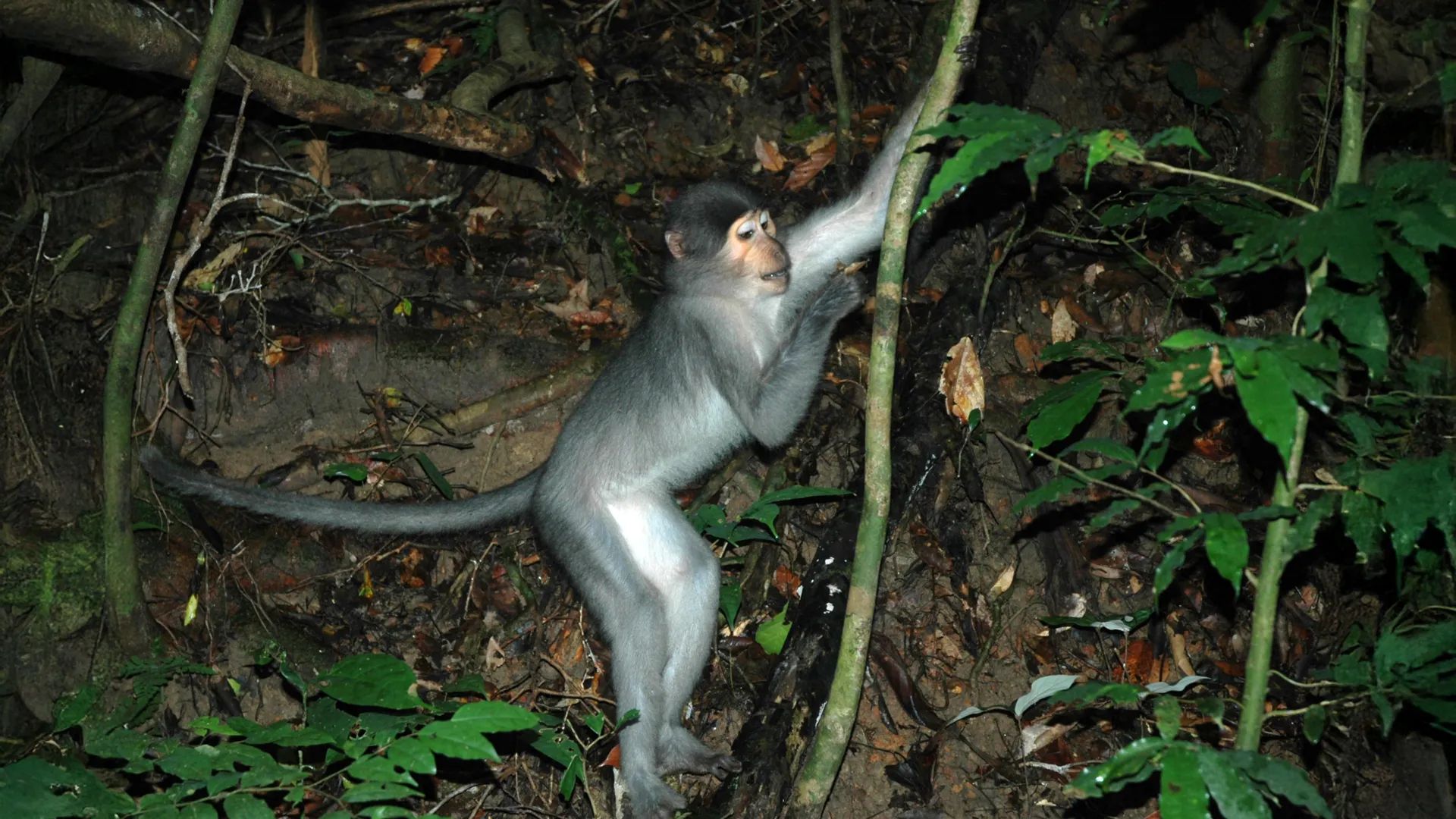
A study led by researchers at Ohio State University is prompting a reconsideration of how scientists interpret fossil feet when reconstructing the evolutionary history of humans and our primate relatives. The research focused on sooty mangabey monkeys native to West Africa and examined their climbing capabilities using high-resolution video documentation.
The investigation compared how different primates move through forest environments, particularly their ability to climb vertical tree trunks. Chimpanzees are known for their impressive climbing skills, supported by ankle joints that can bend approximately 45 degrees. Monkeys have traditionally been viewed as relying more heavily on arm-based movement through trees rather than the kind of trunk climbing that apes perform. This distinction has influenced scientific theories about whether the last common ancestor of humans and chimpanzees possessed feet more similar to modern apes or monkeys.
The new findings challenge these assumptions by demonstrating that mangabeys achieve substantial vertical climbing capability through a different anatomical mechanism. The researchers measured approximately 46 degrees of flexion in the animals’ midfoot during vertical climbing—functionally equivalent to the ankle flexion observed in chimpanzees despite using different parts of the foot structure. This functional equivalence suggests that scientists cannot definitively rule out vertical climbing ability based solely on foot structure differences evident in the fossil record.
These results complicate existing theories about the evolutionary ancestor shared by humans and chimpanzees roughly 6 to 7 million years ago. While some paleontologists have argued that ape-like foot anatomy was necessary for effective vertical climbing, the new evidence indicates that ancestors with more monkey-like foot structures could have possessed comparable climbing abilities. The video documentation from the Taï Forest in Ivory Coast provided unprecedented kinematic detail about locomotor behaviors that were previously underappreciated in scientific literature.
The research suggests that understanding human evolution requires considering how modern primates actually move in natural environments, not just interpreting skeletal structures. The findings indicate that future fossil discoveries will be needed to resolve competing hypotheses about the ancestor’s characteristics and locomotor repertoire.
Article Attribution | Read More at Article Source
Article summary produced by Claude AI