

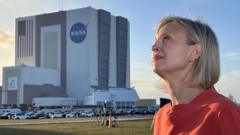
Four crew members—Reid Wiseman, Victor Glover, Christina Koch, and Jeremy Hansen—completed a historic lunar mission over the last 10 days, marking the furthest distance humans have traveled into space. The mission launched from Kennedy Space Center in Florida with the crew aboard a 98-meter-tall rocket, beginning their quarter-million-mile journey to the Moon. Once in microgravity, the astronauts occupied a cramped capsule roughly the size of a minibus, where they lived, worked, ate, and slept in close quarters with no privacy from each other or the millions of people worldwide following the mission.
Throughout the flight, NASA mission control in Houston monitored all spacecraft systems continuously, as this was the first crewed test flight of both the rocket and spacecraft, carrying inherent risks. The astronauts had candidly discussed these dangers with their families before launch. As the crew approached the Moon and witnessed its surface growing larger in their windows, they identified new features on the lunar landscape. In a particularly emotional moment, they named a crater after Reid Wiseman’s late wife Carroll, with the entire crew and mission control teams moved to tears.
The Artemis II astronauts surpassed Apollo 13’s distance record, eventually reaching 252,756 miles from Earth while documenting the lunar surface through thousands of images and audio recordings. The mission carried symbolic weight, with messages from Apollo-era astronauts played to the crew during their flight. NASA Administrator Jared Isaacman stated the agency aims to build upon Apollo’s legacy rather than simply repeat it, outlining plans for a lunar landing in 2028, a Moon base, and eventual human missions to Mars. However, some observers questioned whether the estimated $93 billion cost was justified when robotic missions could accomplish similar scientific objectives.
The final phase proved the most challenging: re-entry to Earth. The capsule experienced temperatures approximately half as hot as the Sun’s surface as it hurtled through the atmosphere. The astronauts safely completed their splashdown, successfully concluding the decade-long journey and advancing human space exploration capabilities.
Article Attribution | Read More at Article Source
Article summary produced by Claude AI