

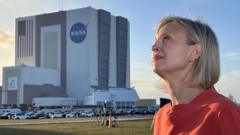
A crew of four astronauts—Reid Wiseman, Victor Glover, Christina Koch, and Jeremy Hansen—completed NASA’s Artemis II mission, which marked a significant milestone in human space exploration. The mission lasted approximately 10 days and saw the crew travel a record distance of 252,756 miles from Earth, surpassing the previous record set by Apollo 13. The journey included a lunar flyby that brought the spacecraft and its occupants closer to the Moon than any humans had ventured since the Apollo era.
The mission began with a launch from Kennedy Space Center in Florida, where the four astronauts were propelled skyward atop a 98-meter tall rocket. Once in space, the crew adapted to microgravity conditions while living in quarters comparable in size to a minibus. Throughout their voyage, the crew conducted observations of the lunar surface, capturing thousands of images and recording detailed descriptions of the landscape beneath them. A particularly poignant moment occurred when the astronauts named a lunar crater after Reid Wiseman’s late wife, Carroll, honoring the personal sacrifices astronauts make in pursuing space exploration.
Mission control teams at Johnson Space Center in Houston monitored all spacecraft systems throughout the flight, managing navigation, life support, and other critical operations. Despite the historic significance of the achievement, the mission carried inherent risks, as it represented the first crewed flight of both the launch vehicle and spacecraft. Several crew members had discussed with their families the possibility of not returning before the launch.
The return to Earth presented the final challenge of the mission, with the capsule experiencing extreme conditions during re-entry, including temperatures reaching approximately half the surface temperature of the Sun. NASA leadership indicated that this mission represents a stepping stone toward broader lunar exploration objectives, including a planned landing in 2028 and eventual establishment of a Moon base. Officials have also outlined aspirations for future human missions to Mars, framing the Artemis II mission as part of a larger strategy to expand human presence in space rather than simply revisiting previous achievements.
Article Attribution | Read More at Article Source
Article summary produced by Claude AI