

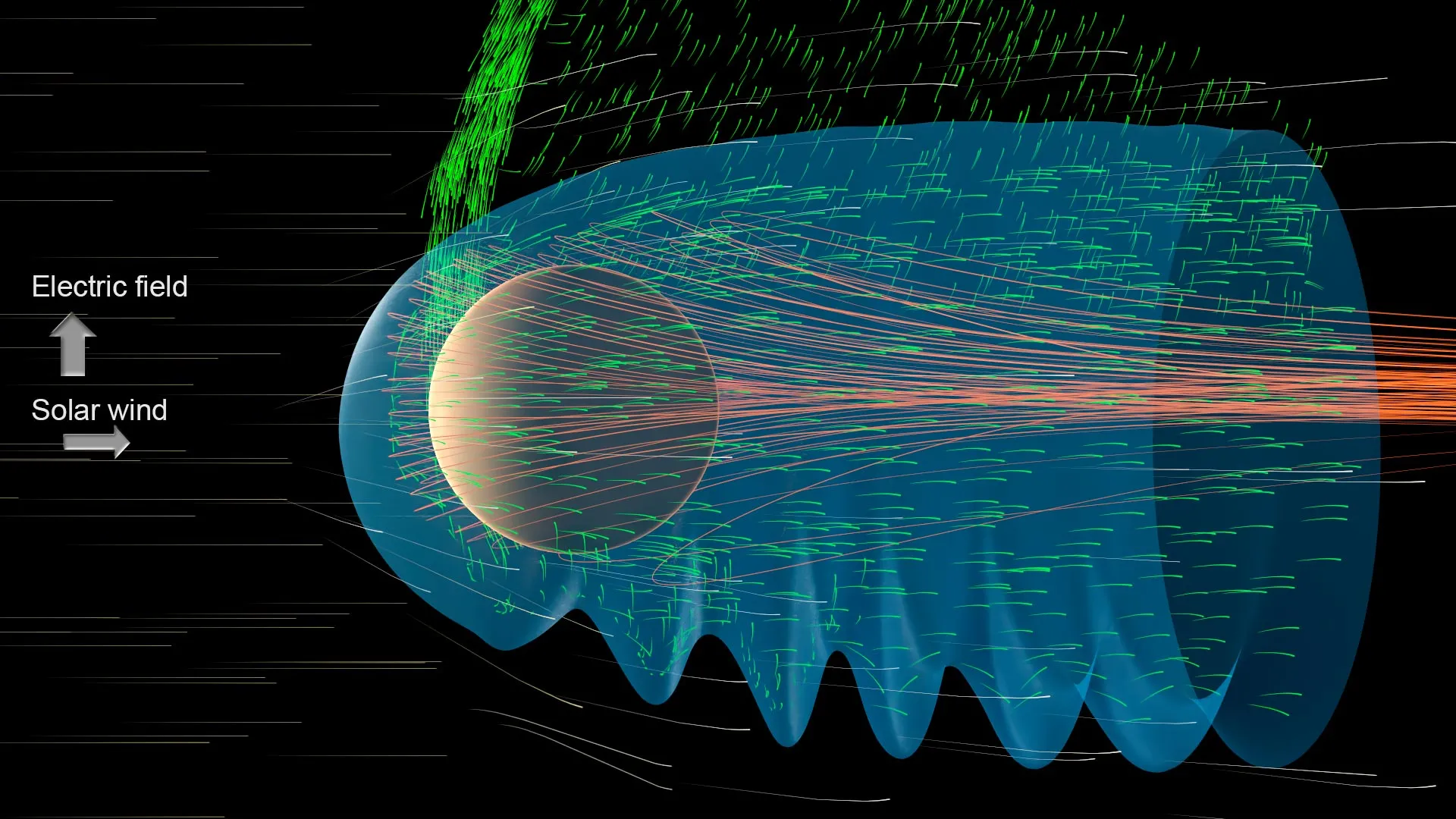
A new study led by Boston University and published in Science Advances has identified a previously unclear mechanism responsible for the loss of Mars’ atmosphere. The research reveals that the solar wind, a constant stream of charged particles emitted by the Sun, generates enormous boundary waves—known as Kelvin-Helmholtz waves—that sweep atmospheric particles away from the planet. Unlike Earth, which benefits from a protective magnetic field, Mars lacks such a shield, leaving its upper atmosphere directly exposed to the solar wind’s effects.
Researchers analyzed data from the MAVEN and Tianwen-1 space missions to make this discovery. Tianwen-1 measured the solar wind before it reached Mars, while MAVEN tracked atmospheric ions escaping from the planet. By comparing these simultaneous observations, scientists were able to connect changes in incoming solar wind conditions directly to the movement of Martian atmospheric particles. The new findings build on earlier work that demonstrated the value of combining measurements from multiple spacecraft positioned at different locations.
The investigation found clear evidence that Kelvin-Helmholtz waves produce the large clouds of plasma responsible for atmospheric escape from Mars. The researchers also determined that this process occurs unevenly across the planet, concentrated on one side depending on the direction of the solar wind’s electric field. This discovery provides a direct link between wave formation and increased atmospheric ion loss.
Future research will seek to identify the conditions that promote these wave formations and to quantify their contribution to Mars’ atmospheric loss. Scientists plan to use additional spacecraft measurements and computer simulations to address these questions. The MAVEN mission is entering its final phase, but the recently launched NASA ESCAPADE mission is expected to continue investigations into solar-wind-driven atmospheric loss at Mars.
Understanding this atmospheric escape mechanism may help explain Mars’ transformation from a potentially habitable planet with a thicker atmosphere and surface water to the cold, dry world observed today. Scientists suggest that this process could also occur on other planets lacking strong magnetic fields, including some exoplanets.
Article Attribution | Read More at Article Source
Article summary produced by Claude AI